
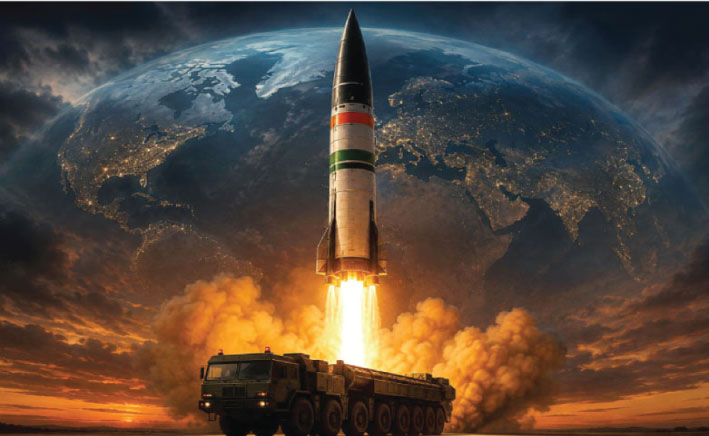
At the ANI National Security Summit 2.0 in New Delhi, Dr. Samir V. Kamat, Chairman of India’s Defence Research and Development Organisation, stated that “DRDO is ready whenever the government gives us the go ahead” to test the Agni-VI intercontinental ballistic missile. The statement was meaningfully kept ambiguous. It is unclear whether a fully assembled missile is awaiting authorization for testing or whether the technological design has been completed and institutional clearance is all that remains. What is obvious, however, is the intent. By publicly affirming readiness to test a missile reportedly capable of traveling up to 12,000 kilometers and carrying multiple warheads, DRDO has signaled that it is pursuing an intercontinental ballistic capability with global reach, a development that carries consequences far beyond its immediate regional security environment and deserve far greater scrutiny than the statement has received from the nonproliferation scholars.
The Agni-VI, if tested and operationally deployed, would represent an expansion in India’s strategic capabilities — not merely an incremental upgrade over its predecessor, the Agni-V, which was formally inducted in 2018 with an officially acknowledged range of approximately 5,500 kilometers (though independent analysts have long assessed its true range to be closer to 7,000-8,000 kilometers). The Agni-VI is reported to possess a range of up to 12,000 kilometers — a figure that transforms it from a regional deterrent weapon into a true ICBM capable of reaching every major capital on the planet, from Beijing to Brussels, from Moscow to Washington D.C., from London to Canberra.
But range alone does not capture the full significance of the Agni-VI. According to multiple credible defense sources, open-source intelligence assessments, and statements from former DRDO scientists, the missile is expected to incorporate several advanced technologies that would place it in the same technological class as the most sophisticated ICBMs operated by the United States, Russia, and China:
These technologies include a) MIRVed Warheads (Multiple Independently Targetable Re-entry Vehicles):The Agni-VI is widely assessed to carry between 4 to 6 independently targetable nuclear warheads. This means a single Agni-6 launch could simultaneously destroy multiple cities or strategic targets separated by hundreds of kilometers. b) Advanced Solid-Fuel Propulsion: The missile is expected to use a three-stage solid-fueled propulsion system, enabling rapid launch preparation, reduced vulnerability to pre-emptive strikes, and the ability to be stored and transported in sealed canisters — a technology India has already demonstrated with the Agni-5.c) Maneuverable Re-entry Vehicles (MaRVs): Beyond MIRVs, the Agni-VI may incorporate maneuvering warheads capable of evasive terminal-phase flight paths, designed specifically to defeat missile defense systems. d) Canisterized, Road-Mobile Deployment: Like the Agni-V, the Agni-VI is expected to be canisterized and launched from road-mobile Transporter Erector Launchers (TELs), making it extremely difficult to locate and destroy pre-emptively .e) Submarine-Launched Variant Potential: Perhaps most consequentially, the Agni-VI’s technology is widely understood to be the foundational architecture for India’s next-generation submarine-launched ballistic missiles (the K-5 or K-6 SLBM), which would arm India’s growing fleet of nuclear-powered ballistic missile submarines (SSBNs) and provide the most survivable leg of India’s nuclear triad.
Taken together, these capabilities paint a picture not of a defensive, regionally-focused deterrent, but of a weapon system designed for global strategic reach. The question that demands rigorous international examination is simple yet consequential that Why does India need a 12,000-kilometer ICBM?
India’s declared nuclear doctrine is built on two foundational pillars — No First Use (NFU) and Minimum Credible Deterrence. Its stated adversaries in the nuclear domain are Pakistan and China. Pakistan is entirely within range of even India’s shorter-range Agni-I and Agni-II missiles. China’s most distant strategic targets — including Beijing, Shanghai, and the nuclear and missile facilities in Xinjiang and Inner Mongolia — fall well within the proven reach of the Agni-V. If India’s strategic calculus is genuinely limited to its immediate neighborhood, then the Agni-VI, with its 12,000-kilometer reach, is an answer to a question that India’s existing threat environment does not appear to ask.
The Unanswered Question: Why 12,000 Kilometers?
The most consequential aspect of Dr. Kamat’s statement is not what it reveals about Indian technological capability. It is what it reveals about Indian strategic intent. Capability and intent are two distinct analytical categories in nonproliferation scholarship, but they are deeply interrelated. A state does not invest decades of scientific resources, billions of dollars of public funding, and the full weight of its premier defense research institution into a weapons system without a corresponding strategic rationale. The Agni-VI demands that rationale be examined with the same rigor that the international community applies to North Korean missile tests or Iranian enrichment activities.
The standard framework for analyzing ballistic missile programs beyond immediate threat requirements was established in the academic literature by scholars like Scott Sagan, Matthew Kroenig, and Vipin Narang. Their work consistently points to three drivers of nuclear expansion beyond minimum deterrence. First, security requirements that exceed what existing arsenals can address. Second, domestic institutional pressures from military and scientific establishments. Third, the pursuit of international status and prestige. In the case of the Agni-VI, the first driver is conspicuously weak while the second and third are conspicuously strong.
Consider the security argument on its own terms. The threat spectrum that India officially acknowledges consists of two nuclear armed adversaries. One is Pakistan, a state with an estimated arsenal of 160 to 170 warheads and a maximum missile range of approximately 2,750 kilometers with the Shaheen 3. The other is China, a state with an estimated 500 warheads and missiles that can reach India from multiple directions. India’s existing Agni-V, with its assessed real world range of 7,000 to 8,000 kilometers, already holds all of China’s strategic assets, population centers, and command and control infrastructure at risk. The marginal security gain from extending range to 12,000 kilometers against these two adversaries is, by any serious strategic calculation, negligible.
When a state’s declared threat environment does not justify its weapons development trajectory, the weapons program is serving purposes beyond deterrence. Those purposes may include technological ambition, institutional momentum, or most significantly for the global order, the desire to acquire capabilities that signal membership in an exclusive tier of states. As Vipin Narang has argued in his seminal work on nuclear postures, states that pursue what he calls “asymmetric escalation” or “catalytic” postures eventually seek to graduate to what might be termed “assured retaliation at the global level.” The Agni-VI appears to be precisely that graduation.
What makes this particularly significant from a nonproliferation standpoint is the MIRV dimension. MIRVed ICBMs are not merely quantitative improvements over single warhead missiles. They represent a qualitative transformation in nuclear capability. A MIRVed ICBM changes the fundamental calculus of deterrence by simultaneously multiplying the number of targets a state can hold at risk and complicating the defensive calculus of potential adversaries. When China deployed MIRVs on its DF 5B missiles, the United States was compelled to revise its nuclear employment strategy. When China expanded MIRV deployment on the DF 41, the Pentagon included it as a justification for modernizing the American nuclear triad in its 2022 Nuclear Posture Review. An Indian MIRV capable ICBM will trigger the same recalculations, not just in Beijing, but in every nuclear armed capital.
The trajectory of India’s missile program also raises uncomfortable questions about the concept of minimum credible deterrence that India has long proclaimed as the foundation of its nuclear doctrine. Minimum deterrence, as understood in strategic studies literature, implies a finite and relatively modest arsenal calibrated to inflict unacceptable damage on a potential aggressor. It does not typically imply ICBMs with global reach and multiple warheads. The evolution from Agni-I to Agni-VI traces a trajectory that looks less like minimum deterrence and more like maximalism while maintaining the rhetorical commitment to minimalism.
Perhaps most troubling from an arms control perspective is the complete absence of any legal or institutional framework within which India’s missile expansion is occurring. The existing nuclear weapon states under the NPT operate within a web of bilateral and multilateral constraints. The United States and Russia was bound by New START. NATO nuclear sharing arrangements are governed by established protocols. Even China, which has resisted formal arms control, participates in strategic stability dialogues with both Washington and Moscow. India participates in none of these frameworks. There is no treaty that limits Indian warhead numbers, no agreement that caps Indian missile ranges, no verification mechanism that provides transparency into Indian nuclear intentions. The Agni-VI will be developed, tested, and deployed in what is effectively a strategic vacuum, governed only by India’s own self-declared doctrine which it can revise at any time without international consequence.
This is the central alarm that the nonproliferation community should be sounding. A state with global strike capability, a rapidly expanding arsenal, no arms control obligations, and a doctrine that can be revised unilaterally represents precisely the kind of unpredictable variable that the international nuclear order is least equipped to manage. The Agni-VI does not just change India’s strategic posture. It changes the structural conditions of global nuclear stability in ways that the existing institutions were not designed to handle.
Author: Abdul Rehman, Research Officer, Center for International Strategic Studies, AJK.
