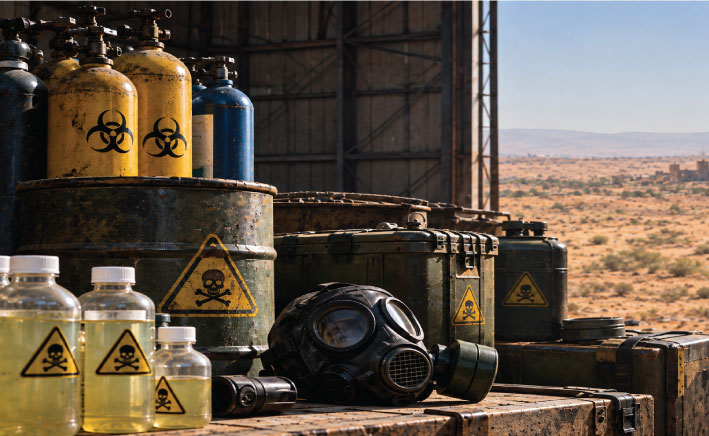
Somewhere in a warehouse outside Khartoum, welders took ordinary propane tanks, the kind you would hook up to a backyard grill, and bolted nose cones and tail fins onto them. They filled those tanks with chlorine drawn from cylinders meant to purify drinking water. Then they loaded the finished bombs onto a Soviet era cargo plane and dropped them over the desert to watch yellow plumes bloom against the sand.
That is not a scene from a history textbook about the First World War. It happened in 2024 and 2025, in a country that signed the Chemical Weapons Convention in 1999.
On September 5, The Washington Post published a report on internal Sudanese military files showing that the Sudanese Armed Forces built a stockpile of roughly 290 chlorine bombs, tested them in a desert, and deployed at least some of them against rival Rapid Support Forces (RSF) fighters. The files include text messages between officers, videos of test drops, and design documents for a “dual effect” warhead packed with gas and ball bearings. One message to a pilot reads “Your cooking,” alongside a photo of a victim with burned skin.
The pairing of high explosives, ball bearings, and chlorine was designed to maximize lethality by combining immediate fragmentation with a persistent toxic cloud. While the initial blast and shrapnel shattered physical cover and inflicted direct casualties, the heavier gas settled into bunkers and guard towers to flush out or incapacitate anyone who survived. Furthermore, cloaking the chemical agent within a conventional blast helped obscure the telltale signs of toxic munition use, complicating outside efforts to verify a treaty violation.
What strikes me most about this story is not the horror of it, though the horror is real. It is how cheap and easy the whole operation appears to have been. No secret underground laboratories. No exotic precursors smuggled through elaborate networks. Just diverted water treatment chemicals, scrap metal, and a welding torch.
This is the uncomfortable truth about chemical weapons in 2026. They are the most accessible weapon of mass destruction on the planet, and the gap between civilian industry and military application is so thin that it barely exists.
Consider the supply chain. Chlorine is produced in massive quantities worldwide for perfectly legitimate purposes: sanitizing swimming pools, treating municipal water, manufacturing plastics and pharmaceuticals. Global production exceeds 70 million tons per year. Monitoring every shipment is a logistical impossibility, and the Chemical Weapons Convention was never designed to track a chemical this common. The treaty’s watchlists focus on exotic nerve agents and blister compounds, not the stuff sitting in a yellow tank behind your local water plant.
The Sudan case shows exactly how this blind spot gets exploited. According to the leaked files, some of the chlorine came through United Nations humanitarian programs. UNICEF confirmed it had supplied chlorine gas to Khartoum water facilities between 2023 and 2025. The agency says it has no record of diversion, but the internal Sudanese messages tell a different story, with one officer allegedly boasting about taking cylinders “from there.”
This is the loophole that keeps arms control experts up at night. You cannot embargo a chemical that every city on earth needs to keep its tap water safe. You cannot put an end user certificate on every canister of bleach. The point to understand here is that the dual use problem is not a bug in the system. It is the system. And technology is making things worse, not better.
Ten years ago, building a crude chemical munition still required some specialized knowledge of fluid dynamics, detonation timing, and dispersal patterns. Today, generative AI tools can walk a determined user through the synthesis of toxic compounds step by step. Cloud laboratories allow someone to order custom chemical reactions from a laptop without ever touching a flask. Automated synthesis platforms, originally designed to accelerate drug discovery, can produce novel toxic molecules faster than any inspector can catalog them.
The OPCW’s new ChemTech Centre in The Hague is trying to keep up, but the pace of commercial innovation is simply outrunning the pace of treaty verification. The convention’s three schedules of controlled chemicals read like a museum catalog of twentieth century threats. They do not account for AI designed molecules that have never existed in nature and have no entry in any database.
Meanwhile, the barrier to weaponization keeps dropping. Three dimensional printing lets you fabricate warhead casings in a garage. Drone delivery systems, already proven on battlefields from Ukraine to Sudan, remove the need for aircraft or artillery. A sufficiently motivated group no longer needs a state sponsor or a military budget. They need a 3D printer, a commercial drone, and a few hundred dollars’ worth of industrial chemicals.
Chemical weapons have always been called the poor man’s atomic bomb. That phrase was coined decades ago, when it still took a functioning state apparatus to pull off something like the Halabja attack. It is truer now than it has ever been, all you need today is a regime, person, or a state willing to walk that ruthless path.
So what do we do? I will not pretend to have a tidy answer, because anyone offering one is probably selling something. But a few things seem obvious.
First, the international community needs to stop treating chemical weapons as a solved problem just because the big declared stockpiles are gone. The United States destroyed its last munition in 2023, and there was a brief moment of celebration. Sudan should be a cold splash of water. The threat did not disappear. It just moved to places where inspectors cannot go.
Second, verification regimes need to get serious about the commercial chemical industry and the digital tools accelerating discovery. That means updating the CWC schedules, funding real time monitoring of precursor flows, and building forensic capacity that can attribute attacks even when the perpetrators operate in active war zones.
Third, and most painfully, we need to accept that the humanitarian supply chains we rely on to keep people alive in conflict zones are also potential weapons pipelines. That does not mean cutting off aid. It means building smarter tracking and being honest about the tradeoffs.
The revelation regarding an active chemical weapons program in Sudan is a warning. The tools to build such weapons are sitting in plain sight, in every water plant and hardware store and open source code repository on earth. The only thing standing between those tools and the next attack is a treaty that was written before the internet existed, enforced by an organization that cannot enter the countries that need inspecting most.We should probably do something about that before the next video surfaces.
Author: Abdul Rehman, Research Officer, Center for International Strategic Studies, AJK.
