
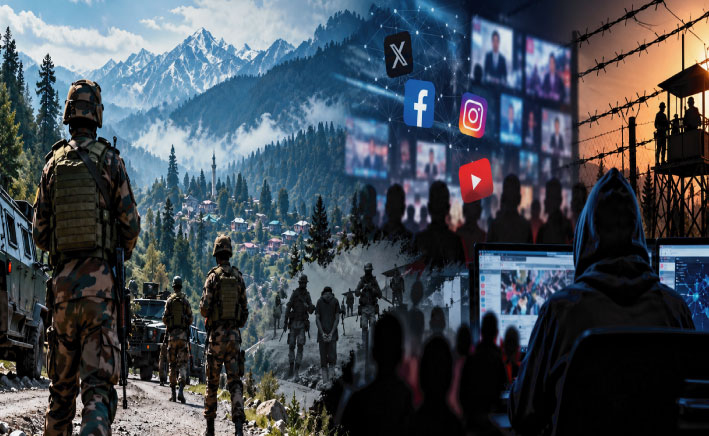
On September 29, 2026, the Indian Army’s Chinar Corps announced the “neutralisation” of Mohammad Asif, alias Hashim Musa, a purported Lashkar-e-Taiba commander and former Pakistan Army SSG commando, in an encounter near Yousmarg, Budgam. Forty-eight hours later, Pakistan’s ISPR chief, Lt Gen Ahmed Sharif Chaudhry, presented a living Havildar Mohammad Asif, retired in 2023 and residing in Attock, at a televised press conference in Rawalpindi, calling India’s narrative a “false flag” operation. This episode is not an isolated discrepancy; it is a window into a dual strategy of control in Kashmir, where kinetic operations and digital perception management reinforce one another to insulate the state from accountability.
For putting the record straight, it is significant to mention that it is not the first neither the last time, Indian military in general and Chinar Corps in particular has launched such disinformation campaign and conducted a staged killing. It is part of their Kashmir strategy to keep indigenous population under constant threat and fear of out of proportioned punishment.
In order to make the explanation easier it is pertinent to comprehend the three frameworks that help explain why digital disinformation and staged encounters function as symbiotic instruments rather than accidental failures for Indian military. Giorgio Agamben’s “state of exception” describes how emergency regimes suspend normal legal protections, enabling extraordinary measures in the name of security. In Kashmir, AFSPA and prolonged emergency provisions create precisely such an exception, creating an enabling environment to allow security forces to operate with expanded discretion without judicial oversight. Achille Mbembe’s extension of Foucault’s biopolitics into necropolitics further clarifies how sovereign power in exceptional zones dictates not only who may live but who must die and whose death can be narrated as legitimate. When civilians are misidentified as militants and their killings branded as “encounters,” the state exercises necropolitical authority to decide which bodies count as combatant and which narratives will govern their posthumous identity.
Paul Virilio’s insight that modern warfare is a “logistics of perception” completes the picture. In a disinformation-saturated conflict, battlefield success depends as much on controlling optical and digital landscapes as on territorial gains. The Chinar Corps’ disinformation campaigns, amplified by national outlets, are not mere updates; they are operational tools that pre-structure public understanding before independent verification can occur.
The Digital Frontier: Coordinated Inauthentic Behavior
The policy to build their legitimacy on disinformation and staged killings was unleashed through the investigation report published by The Washington Post in 2023. The report has documented a network operating from within the military facilities of Chinar Crops in Srinagar that deployed hundreds of proxy accounts across Facebook, Instagram, and X to amplify pro-Indian military narratives to cover up their strategy to maintain their illegal colonial occupation through extreme violence, staged killings and collective punishments. Not only this but to reduce the space for their critics they target them and their credibility as well. This coordinated inauthentic behaviour functions as an informational shield for illegitimate kinetic operations. The report explains how Chinar Corps saturates the feed, elevates official claims, and marginalizes dissenting voices through smear campaigns alleging sedition or separatism.
During operations such as “Operation Khanda” in the Hajipir sector of J&K, official channels aggressively promoted accounts of intercepted infiltrations, while independent ground reporting and media watchdogs flagged inconsistencies, and reported that individuals already in custody or poor local residents were framed to preserve operational optics. The effect is cumulative, repeated exposure to synchronized messaging hardens a “truth” that is difficult to dislodge, even when later contradicted by forensic or testimonial evidence.
The Kinetic Reality: Staged Encounters and Diluted Accountability
The poor Kashmiri, Mohammad Asif, alias Hashim Musa, is not the first scapegoat of Indian army and Chinar Corps. There is long list of those helpless poor innocents to were used as props to justify the illegal presence on Indian occupying forces.
IIOJK has witnessed thousands of such physical operations with confirmed cases of extrajudicial violence mislabeled as legitimate combat. The Pathribal encounter (2000) saw five civilians killed and declared foreign terrorists responsible for Chittisinghpora, later the claim refuted by DNA testing. The former US President Mr. Bill Clinton in his introduction to Madeleine Albright’s book, The Mighty and the Almighty (2006), wrote that “some Hindu militants decided to vent their outrage by murdering 38 Sikhs in cold blood” during his 2000 visit, and added, “If I hadn’t made the trip, the victims would probably still be alive.” Indian army’s retired lieutenant general, K.S. Gill, has publicly claimed that Indian Army officers were involved in the Chittisinghpora killings and that a report to that effect was submitted to then Home Minister L.K. Advani. This argument would be incomplete without mentioning the Machil staged killings of 2010 where three daily-wage laborers were lured to Kupwara, executed near the LoC, and staged with planted weapons; police investigations denied to label them as infiltrators. In Amshipora/Shopian (2020), three young cousins seeking work were shot by security forces under the premise of being terrorist, a claim which was proved baseless later on. Famous Kashmiri activist Afzal Guru wrote in his letter to his lawyer that DSP Davinder Singh first detained and tortured him at the STF camp in Humhama (Srinagar), then instructed him to take a man identified as “Mohammad”(later identified as one of the Parliament attackers) to Delhi, arrange his stay, and help procure a second-hand car. In public discourse and some media investigations, Davinder Singhis the Sikh police officer most directly associated with the allegation that he “lured” or directed Afzal Guru to Delhi ahead of the attack on Indian parliament. A structural pattern of systematic impunity, where the risk of reputational damage is managed more through narrative control than through durable and credible truth, can be identified in these few cases discussed earlier.
Conclusion
When synthesized, these elements outline an environment where information control and field operations intersect to maintain absolute control over both bodies and narratives. Digital disinformation preempts skepticism, while staged encounters supply the “evidence” that the digital apparatus then amplifies. The Asif alias Musa episode dramatizes this architecture, a rapid sequence of military posts, government briefs, and media reports constructed an identity that collapsed only when Pakistan produced the living subject. For policy and scholarship, Indian army requires dismantling the dual strategy itself, and ending coordinated inauthentic behavior. Without such measures, the logistics of perception will continue to outrun the search for truth.
Digital disinformation and staged encounters function as mutually reinforcing instruments for Indian military. Pakistan’s response should be equally dual-tracked: informational resilienceand accountability pressure. Below are concrete, actionable recommendations tailored to Pakistan’s institutional capacities and strategic interests.
- Institutionalize Rapid-Response Counter-Disinformation to monitor Indian military’s social media, national outlets, and open-source intelligence (OSINT). This may maintain a “living dossier” of recurring narratives, proxy accounts, and amplification patterns identified in reports like The Washington Post’s 2023 investigation.
- Pakistan may file structured complaints with UN mechanisms.
- Proactive engagement withs Commonwealth and OIC parliamentary bodies and requests for hearings or statements on patterns of staged killings and digital manipulation in IIOJK, to emphasize on the systemic nature rather than isolated incidents.
- Building a Regional OSINT and Forensic Network would be effective in timely countering false Indian narrative.
- Shift from “false flag” to “systemic impunity,” may be more beneficial. While the Asif/Musa episode is powerful, the broader argument is more persuasive when framed as a structural pattern (Pathribal → Machil → Amshipora → Asif). This aligns with global human rights discourse and avoids reducing the issue to a single “gotcha” moment.
- Investment in archival (digital and physical) permanence to ensure all evidence (videos, affidavits, forensic reports) is public and have been made part of digital algorithms.
Pakistan’s most effective leverage lies not in matching India’s disinformation volume, but in systematically exposing the Indian architecture of impunity through verifiable, internationally legible documentation. The goal is to make the cost of maintaining the dual strategy, higher than the benefit of short-term narrative control. Pakistan needs to make Indian disinformation policy more expensive and counterproductive for them.
Author: Dr. Asma Shakir Khawaja is Executive Director of Center for International Strategic Studies, AJK. The views mentioned are of her own.She can be reached at Asmakhawaja5 on X (Twitter)
