
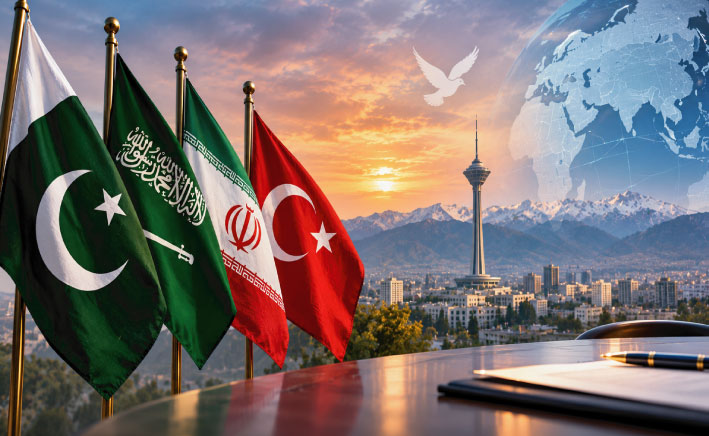
It can be said that diplomacy’s most important moments often appear to be its least conclusive at first. The eleventh-hour meeting in Tehran among officials from Iran, Pakistan, Saudi Arabia and Turkiye on Monday ended without any significant announcement, such as a ceasefire or a formal agreement. However, it deserves to be read as a significant regional development. As according to news reports, senior delegations from Saudi Arabia, Pakistan and Turkiye travelled to the Iranian capital to try to avert renewed fighting in the Iran war. The meeting, which surprised many observers, has prompted talks among these states, suggesting that regional countries are now increasingly inclined to resolve their problems on their own.
The seniority of the guests stands out. Saudi Arabia sent Defence Minister Prince Khalid bin Salman, Pakistan sent army chief Field Marshal Asim Munir, and Turkey sent intelligence chief Ibrahim Kalin. Governments rarely send such high-ranking figures at short notice unless they believe something significant is at stake. Press TV, an Iranian outlet, reported that Pakistan proposed the meeting and that Tehran supported it. This account should be read with the usual caution applied to state-linked media. If accurate, however, it suggests that the initiative came from within the region itself.
Rezaei told state television that Tehran and its three guests had agreed that regional security should be achieved through the countries of the region themselves. A senior Pakistani security official told Reuters that the primary aim of the meeting was to establish a regional mechanism to prevent military attacks among them. However, the real test lies in whether such an arrangement can work in practice. Foreign Minister Abbas Araghchi has said for months that Tehran will welcome any regional security arrangement that excludes foreign forces, a position that reflects Iran’s long-standing wariness of outside powers in the region.
This episode reinforces the question whether the American influence in the region is waning? The Mecca Agreement between Saudi Arabia, Pakistan, and Turkiye, which was followed by the Badr Agreement between Pakistan, Trukiye, Indonesia, and Qatar, did not include the US which shows that regional states want a bigger hand in managing their own security. Therefore, this is what the Tehran meeting exhibited. There were possibilities that the US-Iran negotitaions may again begin as a result of these talks and there were certain assumptions that the meeting might push a deal between the Tehran and Washington before any newer escalation takes place which can further embroil the region into an intensified instability. This also suggests that the US still has some role to play even when countries have started to think that it instigated the war that rendered region instable. However, a more inference could reading may also suggest that the region is trying to shape the process, not at once replace the American role in it all at once. Nevertheless, it depends upon how the post Iran war region milieu looks like.
There could be other possible explanations that why the Mecca Agreements allies turn toward Tehran. It could be that Pakistan and Turkey have little interest in a wider war, and both keep workable relations with Iran and neither wants to be pulled into quagmire on their doorsteps especially given the rising economic costs of the war. This was the first high-level contact between Iran and Saudi Arabia since Yemen’s Houthis escalated attacks on Saudi targets last month. Therefore, it can also be thought that Saudi Arabia plausibly hopes Tehran can use its influence to persuade the Houthis to stop. Whether Iran can or will do so is uncertain, because the group has long acted with considerable independence. Some analysts even opine that the talks as driven mainly by Saudi security concerns, with Ankara and Islamabad nudging Iran toward compromise. Iran, meanwhile, gains by showing it is not isolated.
As aforementioned there is a larger perspective to the three visitors are linked by the Mecca Joint Defence Agreement, which is described as treating an attack on one member as an attack on all. Tehran is among the first occasions on which the pact’s members have acted together outside its own framework. In this way, some will see this as an early test of whether the alliance leans toward restraint or confrontation. While others will view it a preview of how the post war order will look like in Iran where the regional powers are coordinating defense and diplomacy among themselves. But it remains to be seen how effective the diplomacy among these works. A single meeting cannot show how an alliance will behave under real strain and whether activities under its banner would prove to be fruitful or not.
What the first meeting produced at the face value was could not translated as not as significant but modest. As the joint statement called it the first meeting of four regional countries. It stated that the participants would continue the dialogue to strengthen cooperation, including on peace and security. Such a stance does commit any side to anything nor creates hopes of any type thereby allowing every side agree to it.
However, it cannot be denied that the limits are here are real. One of the primary issues remains of gurantees. Some analysts think that Iran wants a credible assurance through intermediaries if they carry some message of de-escalation from the US or want hostilities to end. In such a context, it is almost impossible for any other the country from the Mecca allies to give to provide such assurances on the behalf the US. As mediators that carry message attempt to build trust. They do not have ability compel concessions from parties who see those concessions as dangerous. And each participant has its own interests, so the apparent unity could fray if those interests diverge, so it remains a zero sum game.
But what became clear is that three regional middle powers chose to engage a regional country at war instead of isolating it. They did so at senior level, on short notice, and agreed to meet again. Each detail points toward a region that is at least trying to talk through its own disputes before outside actors or events decide them. At this juncture, it might be premature to categorically prove such meetings to be the beginning of a new regional order, and history is full of promising gatherings that faded when the underlying disputes proved too stubborn.
The signs to observe are practical in essence. Do the four sides reconvene? Does their agenda widen beyond crisis management? How do Saudis and Houthis get on? And do indirect contacts between Washington and Tehran become more structured? If this happens, then the meeting would show as the commencement of new era where regional countries take their affairs in their own hands. If not, then it may appear to a futile effort to bring stability in the region. But for now, the meeting is best read as a signal, not a verdict. Whether it creates a lasting change depends less on what was said in Tehran than on what the four capitals do next.
Author: Moneeb Mir, Associate Research Officer, Center for International Strategic Studies, AJK.
