
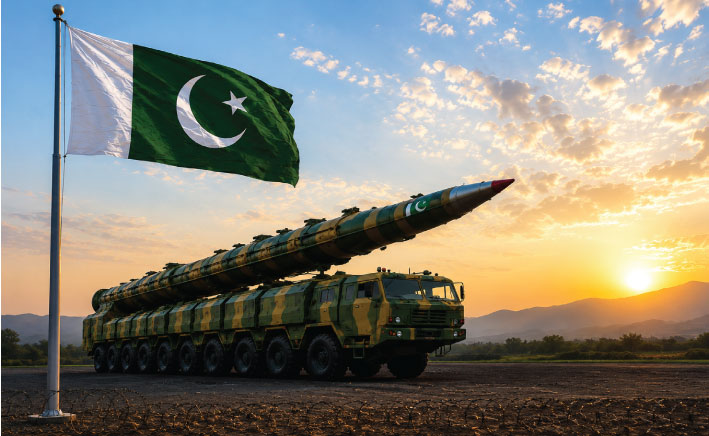
Pakistan’s nuclear signalling is not mere empty rhetoric; it rests on an actual deterrence doctrine, operational forces, preparedness, readiness, credibility, and a long-standing policy of deliberate ambiguity regarding first use rather than a declared no-first-use pledge. Pakistan’s nuclear posture is designed to deter Indian conventional superiority, not to invite a nuclear showdown that no one can reliably control.
Pakistan’s official and semi-official statements repeatedly frame its arsenal as a deterrence against threats from India. Senior Pakistani officials have also consistently explained the logic of first use as a means of preserving sovereignty and maintaining strategic ambiguity. At the same time, Pakistan continues to refine its nuclear doctrine to keep it compatible with the evolving threat environment posed by India. As a result, its doctrine has evolved from “minimum credible deterrence” toward “full spectrum deterrence,” incorporating land, air, and sea-based components intended to make retaliation believable rather than symbolic. The posture is designed to cover a wide range of threats and response options, while preserving ambiguity about thresholds so that an adversary cannot easily predict where escalation would stop. Pakistan’s effort to strengthen second-strike survivability is also explicit: credible deterrence requires an adversary to believe that retaliation remains possible even after absorbing a first strike.
Pakistan’s nuclear forces, command-and-control arrangements, demonstrated delivery systems, and deliberately ambiguous thresholds make its posture strategically potent. This ambiguity should not be mistaken for bluff; rather, it functions as a calculated mechanism of deterrence intended to raise the cost of Indian escalation.
In deterrence theory, nuclear weapons are most effective when they create credible punishment and credible denial. Pakistan seeks punishment credibility by signalling willingness to use nuclear weapons if core survival thresholds are crossed, and denial credibility by complicating any Indian assumption of a limited war or a clean conventional victory. This logic is close to assured retaliation, because it seeks to make nuclear war too risky to start.
The stability-instability paradox helps explain Pakistan’s posture. Nuclear weapons may reduce the likelihood of full-scale war, but they can coexist with lower-level crises and limited conventional force use, because each side believes escalation can still be managed. In South Asia, however, this belief creates a dangerous illusion of escalation control. Pakistan aims at convincing India that there is no usable space for limited war under the nuclear overhang.
Three factors make Pakistan’s posture more than bluff. First, it relies on deliberate ambiguity rather than harmless reassurance, which preserves uncertainty about red lines. Second, Pakistan has invested in a broader force structure, including sea-based elements and tactical options, to signal that retaliation could come in multiple forms. Third, repeated crises in South Asia have reinforced the perception that both sides take nuclear escalation seriously, even while continuing limited conflict below the nuclear threshold.
Pakistan is therefore not posing a bluff in the narrow sense, because its nuclear posture is rooted in real capability, credibility, and a coherent deterrence logic. When a smaller state faces a stronger rival, ambiguity, survivable retaliation, and escalation threats are used to prevent coercion. The credibility of this posture rests on three factors. First, Pakistan’s doctrine is tied to conventional asymmetry with India, so nuclear signalling is meant to offset a weaker conventional position. Second, doctrinal ambiguity creates uncertainty, which is valuable in deterrence because the opponent cannot safely assume the nuclear threshold is far away. Third, outside assessments continue to treat Pakistan’s posture as a serious and evolving doctrine rather than as an empty threat. The real debate, therefore, is not whether Pakistan is bluffing, but whether its deterrence is fully credible and stable under crisis conditions. Any misreading of that logic could produce catastrophic escalation. Pakistan’s nuclear policy is ultimately a strategic effort to make its nuclear capability politically and militarily consequential.
Pakistan’s commonly cited four nuclear thresholds are spatial, military, economic, and political. These are not a formal treaty text, but a widely used analytical framework for describing Pakistan’s red lines.
- Spatial threshold: Large-scale enemy penetration into Pakistani territory, especially if conventional defence cannot stop it.
- Military threshold: The destruction or near-destruction of a major part of Pakistan’s armed forces, threatening the coherence of defence.
- Economic threshold: A severe blockade, strangulation of the economy, or disruption of vital water and transport arteries.
- Political threshold: Destabilization or disintegration of the state, including threats to internal integrity or breakaway movements.
These thresholds are best understood as strategic signals rather than fixed tripwires with exact meters and miles attached. Their strategic value lies in ambiguity. Pakistan keeps the red lines broad enough to discourage limited-war options and to impose heavy costs on any Indian operational plan that seeks controlled escalation. In classic terms, this is a contest between limited-war compellence and nuclear deterrence through punishment and denial.
Primarily, Pakistan’s four nuclear thresholds are designed to deny India space for a limited-war strategy by making even small conventional gains potentially escalate into a nuclear crisis. India’s limited-war thinking, often associated with Indian doctrines such as Cold Start, aims to punish Pakistan below the nuclear threshold through rapid, controlled conventional strikes. Pakistan’s broad red lines on territory, water, military attrition, economic strangulation, and state destabilization are meant to blur that safe zone and raise the expected cost of escalation.
Author: Dr. Asma Shakir Khawaja, Executive Director, Center for International Strategic Studies, AJK.
The views expressed are of author’s and should not be attributed to any institution.
She can be reached at her X handle @asmakhawaja5
