
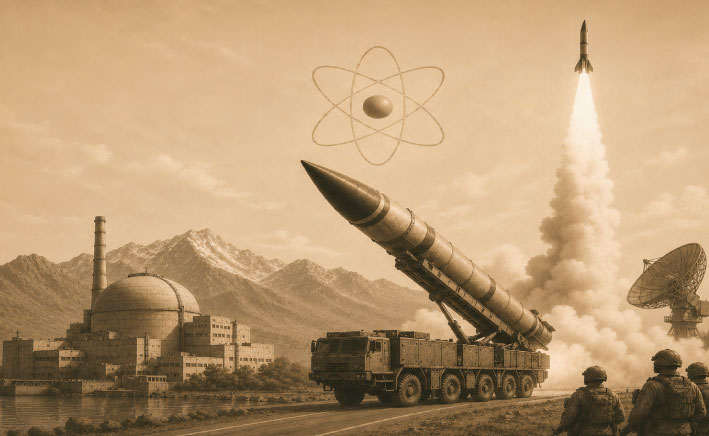
In international politics, it’s all about “capability, not the intent.” The more capable a state is, the more belligerent it becomes. Interestingly, this capability (Indian acquisition of an ICBM) is not defensive, so if a state has invested heavily in a certain capability, it is likely to use it, because states do not invest purposelessly in offensive military technologies.
If India has developed a certain capability. It reflects a nation’s strategic intent, influencing its global stature and signaling its ambitions. The recent developments in India’s nuclear and missile programs should be understood not as isolated advancements but as part of a broader strategy toward enhancing India’s technological capabilities with implications for its future power projection.
In the light of India’s recent agreement with Canada to import Uranium and the inauguration of the Fast Breeder Prototype Test Reactor FBPTR at Kalpakkam, signals a clear intent of India to bolster its nuclear capabilities. While ostensibly focused on addressing the country’s energy needs, these advancements, particularly in nuclear fuel cycle technology, also offer dual-use potential that enables India’s further development of nuclear weapons. The inauguration of FBPTR will not only strengthen India’s energy independence but also enhance its deterrence capabilities. This technological trajectory cannot be examined without considering its implications for India’s missile development program, especially in light of DRDO’s recent statement.
Keeping in view the recent developments in India, the statement given by the DRDO Chairman regarding the readiness to pursue the development of a longer-range missile, specifically an Agni-VI, with an estimated 10,000–12,000 km range, represents a massive doctrinal shift in India’s nuclear posture. In theory, India has a nuclear doctrine of “credible minimum deterrence” focused primarily on ensuring the capability to deter nuclear threats from neighboring states, particularly Pakistan and China. However, the projected range of the Agni-VI, which is capable of reaching the U.S. mainland, signals a shift toward a global power-projection strategy. This shift also poses a critical question: Will India use its ICBMs for future coercion against the West? Therefore, this shift is not simply a matter of technological development but reflects a deeper, strategic recalibration of India’s role in global geopolitics.
In addition to this, the Uranium imported from Canada can help India significantly increase its nuclear fuel cycle capabilities. India’s nuclear reactors require enriched Uranium to generate energy and to produce fissile material such as Plutonium. As India boosts its nuclear energy output, the byproduct is an increase in the stockpile of fissile materials, which are also used in the development of nuclear weapons. More fissile material from this Uranium is critical for the potential expansion of India’s nuclear arsenal.
Along with this, India’s secure and consistent access to Uranium, India can ramp up its capacity to produce Plutonium at facilities like Kalpakkam, and it is not just for civilian use. Plutonium plays a pivotal role in developing more advanced nuclear warheads for India’s long-range deterrence pursuits. As Plutonium-239, produced in reactors like the FBPTR, is a core material for more efficient and compact warheads that could be used in longer-range missiles, including the Agni-VI which is claimed to be MIRV- capable.
The recent deal with Canada solves the Indian problem by ensuring a steady supply of fuel for its nuclear power plants. The ability to produce more nuclear energy without relying solely on domestic sources of Uranium, which are limited, indirectly supports military objectives. The surplus fissile material from these reactors can be diverted toward India’s military hegemonic ambitions. it also enhances its ability to build efficient warheads, which in turn boosts the range and reliability of missiles like Agni-VI.
Moreover, the development of such a missile should not be solely interpreted as a mere technological achievement, but as a statement of intent. As states develop increasingly sophisticated technologies, the capacity to project power globally becomes more feasible. The possession of a missile capable of crossing continental distances elevates its position on the world stage, signaling its readiness to project power across the globe. This technological capability transforms India from a regional power into a potential global player with the ability to influence security dynamics far beyond its immediate geographic area.
Furthermore, this shift must be understood within the broader context of India’s increasing engagement with global power structures. As India strengthens its military and technological capabilities, its pursuit of these advancements cannot be viewed in isolation. The ongoing development of nuclear-powered submarines, the acquisition of advanced fighter jets, and the expansion of India’s strategic missile arsenal reflect a comprehensive effort to enhance its deterrence capabilities and project power beyond its immediate region. These developments underscore India’s desire to become a dominant player in the global security architecture, not just a regional power.
In conclusion, the Uranium deal with Canada, the inauguration of FBPTR at Kalpakkam, and the pursuit of an ICBM cannot be seen in isolation. The chains are connected with India’s broader strategic thinking of global power projection. In this, the lesson for the West is to think critically about the consequences of deals it signed with India because historical patterns show that India always misuses the technology that it acquires from the West, for example, the CIRUS reactor, through which India converted peaceful technology for military purposes. Again, the West gave India leverage in the shape of a uranium deal, and it is already showing the results that India will definitely use fissile material obtained from this deal in the production of more nuclear warheads that are eventually threatening the West.
Author: Sana Ahmed, Research Associate, Strategic Vision Institute.
