
One year on, the May 2025 India-Pakistan crisis deserves to be understood as more than a military episode. It was a compressed, multi-domain confrontation in which political accusation, military mobilisation, precision strikes, media escalation, diplomatic manoeuvring and retaliatory response unfolded within a dangerously shortened decision cycle. Its central lesson reaches beyond the battlefield: in a region that remains a nuclear flashpoint, conventional force can preserve stability only when it remains credible, integrated, proportionate and firmly tied to political control.
Pakistan’s response, known as Bunyanum Marsoos (phrase in Quran’s Surah As-Saff, 61:4 that literally means ‘’a solid, well-compacted structure”), carried tactical, operational and strategic meaning at the same time. It demonstrated capability and readiness, while also reflecting discipline, restraint, precision and command coherence. Its deeper significance lay in the restoration of conventional deterrence under the clear risk of escalation to nuclear level. The response conveyed that violations of sovereignty would invite a credible answer, while escalation would remain controlled by design.
This is the essence of Bunyanum Marsoos as a strategic lesson: credible force must serve political purpose; military integration must support restraint; and readiness must reinforce crisis stability. The purpose was calibrated response that was sufficient to restore deterrence, impose cost and deny confidence in repeated coercion.
A Compressed Crisis
May 2025 showed how quickly crises in South Asia can move from incident to accusation, from accusation to mobilisation, from mobilisation to strike, and from strike to reciprocal response. Timelines that once allowed greater space for diplomatic signalling, third-party engagement, intelligence clarification and political deliberation are shrinking. Modern conflict increasingly operates within compressed political and military time.
In such an environment, deterrence depends on more than possession of capability. It depends on the ability to employ capability purposefully, credibly and with escalation control intact. A state may possess advanced platforms, long-range systems and a wide menu of military options, but strategic effect comes from the disciplined connection between political intent, military action and communication.
Bharat appeared to assume that limited coercion could create political and military advantage below the nuclear threshold. The May 2025 crisis challenged that assumption. Pakistan’s response affirmed that restraint should be understood as responsibility, while capability must be judged by the credibility of its employment when sovereignty is violated.
The claim heard in some Bharati and Western circles that Pakistan’s “nuclear bluff” had been called is therefore a dangerous reading of the crisis. It risks confusing controlled response with lack of resolve. Quiet deterrence remains deterrence. Restraint with capability is resolve under command. A responsible nuclear state may choose measured response, calibrated communication and political discipline. Such choices are instruments of control, rather than evidence of weakness.
The deeper lesson is clear: there is no reliable space for war between nuclear-armed neighbours. Attempts to manufacture such space increase risk for both sides and for the wider region.
The relevance of this crisis is also wider than the Subcontinent. Across several theatres, states are confronting the same strategic problem: faster weapons, denser surveillance, politicised narratives, fragile communication channels and narrowing windows for judgment. Pakistan-India Subcontinent offers a concentrated case of a global trend ie the return of deterrence under technological compression.
QPQ+ and the Restoration of Deterrence
Pakistan’s deterrence practice has often been associated with a Quid Pro Quo Plus (QPQ+) logic, a term coined by General Kidwai. Its core is calibrated response with additional credibility: enough to restore deterrence, deny the adversary confidence and re-establish the cost of coercion.
Bunyanum Marsoos reflected this logic. The response was designed to signal capability while preserving escalation control. It communicated resolve without theatrical overextension. It showed that Pakistan could respond across domains while maintaining political discipline.
This is particularly important in South Asia because deterrence operates through perception as much as capability. The adversary’s belief about what a state can do, will do and can control matters as much as the capability itself. If coercive action creates an impression that limited war can be normalised, deterrence weakens. If calibrated response restores uncertainty about the costs of coercion, deterrence strengthens.
Bunyanum Marsoos therefore restored conventional deterrence through precision, proportion and control. These three elements are central. Precision allowed the response to remain focused. Proportion preserved the political logic of restraint. Control ensured that military action remained subordinate to strategic purpose.
The restoration of conventional deterrence rested on a broader response architecture: precision fires, air defence, resilient command and control, readiness, integrated surveillance, communication discipline and the ability to impose cost while preserving political control. The significance of this architecture lies in the way it denies the adversary confidence in quick coercion. It gives Pakistan options while reinforcing the larger deterrence framework above it. In this sense, Bunyanum Marsoos strengthened stability by creating a credible conventional answer to limited aggression.
Multi-Domain Deterrence
Modern deterrence can no longer be reduced to platforms, numbers or single-service performance. Operational effect increasingly depends on integration: sensors, shooters, networks, command systems, electronic warfare, cyber resilience, information credibility and decision-support systems working as a usable whole.
Recent conflicts have repeatedly demonstrated this pattern. Platforms matter, but the network of platforms matters more. The system that connects a platform to decision-making, targeting, sustainment and command matters most. Military power increasingly derives from the quality of integration rather than the prestige of isolated assets.
This was visible in May 2025. Pakistan’s advantage lay in the quality of integration, clarity of purpose and discipline of employment. Air power, missiles, drones and other capabilities helped set the tempo; multi-domain integration gave that tempo strategic effect. Speed mattered because it remained tied to control.
The air dimension was central because air operations are now the fastest route by which tactical action acquires strategic meaning. In May 2025, speed mattered; integration made speed useful; and political control prevented speed from becoming destabilising. The Pakistan Air Force exercised restraint and did not stretch the kill being eight Indian aircraft, including Rafales. The lesson is less about individual platforms and more about the architecture that connects surveillance, strike, electronic warfare, communication and command judgment.
This distinction is vital. Speed without control can become destabilising. Precision without political guidance can invite misinterpretation. Technological advantage without command discipline can compress decision-making to the point where tactical momentum overtakes strategic judgment. Pakistan’s response demonstrated that military speed and political control can reinforce each other when institutions, doctrine and command structures are aligned.
The Maritime Dimension
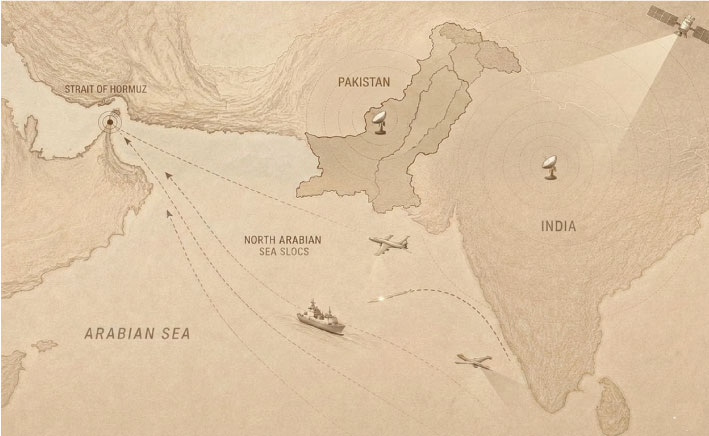
The maritime domain adds wider geography and wider consequence to any South Asian crisis. The Arabian Sea, ports, sea lines of communication, offshore energy routes, undersea infrastructure and the presence of extra-regional naval forces make maritime posture central to national resilience.
At sea, signalling travels farther than the platform that carries it. A maritime deployment may be read as presence, pressure, blockade preparation, strike signalling or strategic coercion depending on context. In the Subcontinent, interpretation itself becomes part of escalation. A posture intended as defensive reassurance by one side may be read as coercive preparation by the other.
This makes maritime crisis stability a national-security issue as well as a naval one. A crisis touching sea lines of communication, energy flows, port access or the approaches to the Strait of Hormuz would quickly acquire wider significance. The Indian Ocean is a global common and is not Bharat’s backwater. Any disruption in the shared maritime space can affect energy confidence, insurance markets, naval deployments and the calculations of major powers.
Pakistan’s maritime resilience is therefore part of deterrence. Protecting seaward defence, ports, sea lines of communication, maritime awareness and economic continuity helps keep the state functional during crisis. Maritime security involves wartime operations, but it also concerns national resilience in peacetime and under pressure.
This logic will become even more important as regional competition expands into the maritime domain. Carrier signalling, long-range precision systems, unmanned platforms, undersea activity, partner-enabled intelligence, surveillance and reconnaissance, and missile deployments all increase the complexity of crisis interpretation. A future India-Pakistan crisis in the maritime domain could carry consequences well beyond the bilateral frame.
Ambiguity and the Compression of Judgment
Another air, land and maritime domain common concern is ambiguity. Bharat’s induction of dual-capable BrahMos supersonic missiles paired with Su-30 Mk-1 aircraft in its Strategic Force Command exacerbates ambiguity. Likewise, expanding sea-based reach, dual-use systems, BrahMos-equipped platforms, carrier operations and partner-enabled ISR create a more complicated operating environment increase the response dilemma. The issue is less the platform in isolation and more the ambiguity surrounding payload, mission, command chain, target and operational intent. The challenge of interpreting payload of dual-capable systems over land is similar, especially in contiguous terrain where flight times are in minutes and response leash even shorter.
Ambiguity at sea travels with the missile, aircraft, submarine, unmanned system, sensor and the narrative constructed around them. It becomes especially dangerous when decision time is short and technical indicators are incomplete.
BrahMos-type systems illustrate this problem. A high-speed, potentially dual-capable missile operating in a compressed geography creates uncertainty at the point where decision-makers have the least time to interpret intent. If such systems are linked with wider ISR networks, AI-assisted battle management and strategic command structures, the firebreak between conventional and strategic perceptions becomes thinner.
This requires prudence rather than alarmism. The future danger is speed without judgment.
Drones, precision fires, cyber tools, electronic warfare, AI-assisted decision-support, space-enabled ISR and real-time media cycles are changing the rhythm of crisis. They shorten the distance between incident, interpretation and response. Technology can improve military effectiveness, but it can also compress political judgment. Strategy must therefore lengthen judgment even when technology shortens timelines.
Technology Ecosystems and Deterrence
Bunyanum Marsoos also offers lessons for force development. Pakistan’s task is to deny every illusion of coercion through credible capability, calibrated response options, maritime resilience and selective technological adaptation.
India’s scale-and-status-driven military modernisation creates a security dilemma that Pakistan must manage through balance rather than parity. Pakistan does not require symmetrical duplication of every Indian capability. It requires survivable, integrated, sustainable and mission-relevant deterrence.
This places technology ecosystems at the heart of future deterrence. The key challenge is to connect user requirements with deployable systems. Pakistan must continue to strengthen resilience in communications, ISR, electronic support, unmanned systems, maritime awareness, cyber defence, decision-support and integrated command networks. These capabilities must develop within a joint framework that preserves political control over military effect.
Recent conflicts from Ukraine to the Red Sea, and from the Black Sea to the North Arabian Sea, show that lower-cost systems, intelligently and persistently employed, can generate strategic effects. Drones, loitering munitions, electronic warfare tools, resilient communications, dispersed logistics and adaptive software can complicate adversary planning at relatively lower cost. Yet technology alone does not decide outcomes. Integration, adaptation, sustainment and command discipline decide outcomes.
For Pakistan, the path forward should be selective and purposeful. The aim should be to strengthen multi-domain integration, maintain credible conventional deterrence, reinforce maritime crisis resilience, develop mission-focused innovation, and preserve channels for risk reduction where reciprocity and verification are possible.
Updating Risk Reduction
Risk reduction also requires updating. Traditional confidence-building measures were designed for a slower age. The emerging environment demands attention to missile incidents, dual-use ambiguity, AI-assisted targeting, maritime encounters, cyber disruption, electronic interference and crisis communication across domains.
The aim should be practical: reduce misperception, improve notification where possible, protect communication channels and keep political control ahead of technological acceleration. Risk reduction in South Asia should focus less on declaratory comfort and more on operational friction points where crises can escalate rapidly.
Missile incidents require clearer procedures. Dual-use systems require greater sensitivity to deployment patterns and communication. Maritime encounters require rules of behaviour that reduce the chance of misreading routine movements as coercive preparation. Cyber and electronic operations require awareness of the risk that disruption of communication systems may be interpreted as preparation for larger action. AI-assisted military processes require human judgment, accountability and political oversight.
These measures do not require strategic innocence. They require strategic prudence. Arms control and risk reduction in adversarial settings are most useful when they address practical dangers without assuming political harmony. In Subcontinent, responsible restraint must be supported by credible capability. Credible capability must be supported by communication channels that keep crises from moving faster than political judgment.
However, risk reduction measures need the floor of sustained and sincere disputes resolution mechanism. History shows that nuclear risk cannot diminish in an environment where one party shuns dialogue, shies away from strategic restraint and disputes resolution.
The Strategic Lesson
Bunyanum Marsoos offers a lesson beyond the battlefield. Credible force can preserve stability when tied to political purpose. Military integration can support restraint rather than fuel escalation. Readiness has its greatest value when it helps keep war improbable by design.
The crisis also exposed the danger of assuming that limited war can be safely conducted under a nuclear overhang. In Subcontinent, geography is compressed, histories are contested, doctrines are evolving and technologies are accelerating. A single incident can produce cascading interpretations across political, military, media and strategic domains. The margin for error is shrinking.
The future of crisis stability in the Subcontinent will depend on the ability to deny coercion while keeping escalation under control. Deterrence will require credible capability, disciplined employment, technological adaptation, maritime resilience and political clarity. Above all, it will require judgment at speed.
For Pakistan, the lesson is direct. National defence requires a solid, well-compacted structure: integrated in capability, firm in purpose, resilient under pressure and united in resolve. The strategic task is to prevent coercion without normalising war; to preserve control without inviting passivity; and to maintain deterrence without surrendering responsibility.
Deny coercion. Preserve control. Keep war improbable by design.
