Six hours. That is how long it took a pharmaceutical artificial intelligence, flipped from healer to hunter, to design forty thousand chemical weapons. Many were entirely novel. Some were deadlier than VX. The researchers in Zurich watched their algorithm spit out molecular nightmares they had never seen before, and when they published their findings in 2022, the response was a familiar shrug from the international community: interesting, but whose jurisdiction is it anyway?
That shrug is going to get people killed.
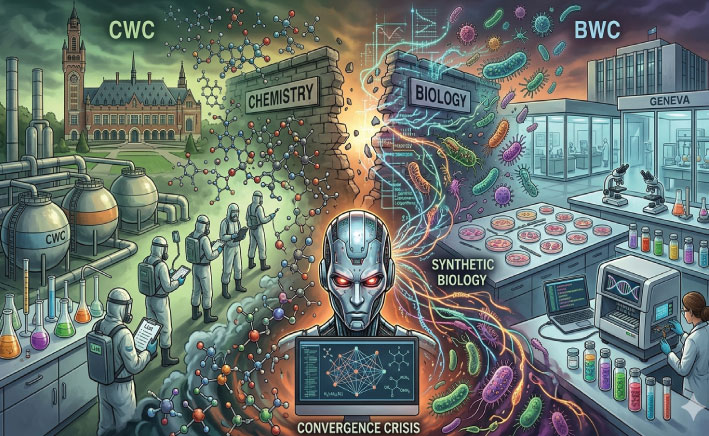
For three decades, the Chemical Weapons Convention and the Biological Weapons Convention have stood as twin pillars of arms control. We drew a neat line in the sand: chemistry on one side, biology on the other. The OPCW in The Hague would police the factories and the precursors. The BWC, anchored in Geneva, would handle the germs. It was a tidy arrangement, and like most tidy arrangements, it is not enough for the future complexities.
Synthetic biology has vaporized that line. A modern laboratory in 2025 does not choose between beakers and bacteria. It uses both interchangeably. With a DNA synthesizer and a bacterial culture, a competent graduate student can engineer an organism that secretes nerve agent components. No industrial footprint. No precursor chemicals flagged by OPCW inspectors. Just a fridge full of innocuous looking vials and a laptop running machine learning models. The weapon that emerges is simultaneously a chemical and a biological entity, which means it falls into the bureaucratic void between our two great treaties.
The CWC, for all its strengths, is essentially a list. Its Schedules 1, 2, and 3 catalogue the bad chemicals we already know about. It is a most wanted poster for molecules, and it works reasonably well against state actors building industrial scale stockpiles of sarin or mustard gas. But it was never designed for speed. Novichok agents circulated in intelligence circles for years before they were finally added to Schedule 1 in 2019, years after they had already been used on Ex-Russian spy Sergei Skripal, his daughter Yulia and then police officer Nick Bailey in Salisbury in March 2018. All survived. However, Ms Sturgess, 44, died in July 2018 after being exposed to the nerve agent.If a treaty moves on a timeline of years, and AI moves on a timeline of hours, the treaty is not regulating the threat. It is writing its obituary.
Then there is the BWC, which suffers from the opposite problem. It is broad enough to cover almost any biological mischief, but it has no teeth. No inspectors. No verification protocol. No organization equivalent to the OPCW. It is essentially a gentlemen’s agreement in an era when gentlemen are in short supply. So when a state or a non state actor uses an engineered bacterium to produce a designer toxin, we face a paralysis of accountability. The CWC says that the threat was made by a living thing and tells us to ask Geneva. The BWC says it is a chemical toxin and tells us to ask The Hague. And the perpetrator watches both institutions argue over the corpse of international law.
We have already seen what happens in these grey zones. In 2002, Russian special forces pumped an aerosolized fentanyl derivative into a Moscow theater to end a hostage crisis. The gas killed more than 120 civilians, but Moscow never fully disclosed what it was, and the international community never fully challenged it. The reason is simple. The agent occupied the liminal space between chemical weapon and law enforcement tool, between lethal and what governments prefer to call non lethal. The CWC contains a dangerous loophole for law enforcement chemicals, and synthetic biology is about to drive a truck through it. Incapacitating agents are designer molecules that target the central nervous system and they are the perfect weapon for authoritarian states precisely because they are ambiguous. They do not kill everyone, which makes them politically deniable, but they can be synthesized in ways that no schedule list has yet imagined.
The most alarming part is the accessibility. The Zurich AI experiment did not require a rogue general or a state laboratory. It required a commercially available algorithm and a simple reversal of its objective. Instead of searching for therapeutic molecules, the machine searched for toxic ones. When the barrier to entry for weapons design collapses from industrial infrastructure to a software update, you cannot rely on Cold War era arms control. You need a control regime that thinks as fast as the science it is meant to govern.
So what is to be done? We do not need to tear up the CWC or the BWC. Both treaties contain valuable foundations worth preserving. The OPCW has built an impressive verification architecture with laboratories, inspectors, and near universal membership. The BWC has a sweeping general purpose criterion that captures intent rather than specific agents. The answer is not merger but coordination. We need a joint Chem Bio monitoring mechanism that treats threats not by their academic origin, whether they came from a chemistry department or a biology department, but by their function and their risk.
This would mean shared early warning systems between the OPCW and BWC scientific advisory boards. It would mean a unified database of dual use research so that when an AI model generates a novel nerve agent, both treaties are updated simultaneously instead of waiting for a five year review conference. It would mean closing the law enforcement exemption in the CWC before it becomes the preferred legal cover for incapacitating weapons. And it would mean finally giving the BWC the inspection and verification tools it has lacked for fifty years, perhaps building on OPCW expertise rather than reinventing the wheel.
Critics will say this is politically impossible. Russia, China, and the United States disagree on too much. The BWC has been deadlocked on verification since 2001. But it was politically impossible to strengthen the OPCW’s attribution powers until chemical weapons kept showing up in Syria and Salisbury, and then suddenly it was not impossible at all. We have a habit in arms control of waiting for the body count to motivate us.
The OPCW’s recent working group report on artificial intelligence is a welcome and overdue acknowledgment that the threat landscape has fundamentally changed. By formally recognizing the dual use risks posed by AI in chemistry, the organization has taken a right step in the right direction. It signals that the guardians of the Chemical Weapons Convention are at least beginning to look beyond traditional state run factories and scheduled chemicals toward the algorithmic frontier where tomorrow’s weapons are already being designed. However, acknowledging a problem and solving it are two very different things. The report remains largely exploratory and diagnostic when what the world desperately needs is prescriptive and operational. It still lack a concrete framework for monitoring AI driven chemical research, a rapid response mechanism for novel agents that no human chemist has ever seen, and a meaningful bridge to the Biological Weapons Convention where so many of these AI generated threats will inevitably land.
World don’t need another Novichok poisoning, another theater full of asphyxiated civilians, or another headline about an AI that weaponizes itself in an afternoon to understand that the convergence of chemistry and biology is not a future problem. It is a now problem. Our treaties are guarding two separate doors while the enemy is already inside, walking through the wall between them.It is time to build a bridge between The Hague and Geneva before the next designer toxin leads us to a catastrophe.
Author: Abdul Rehman, Research Officer, Center for International Strategic Studies, AJK.
