
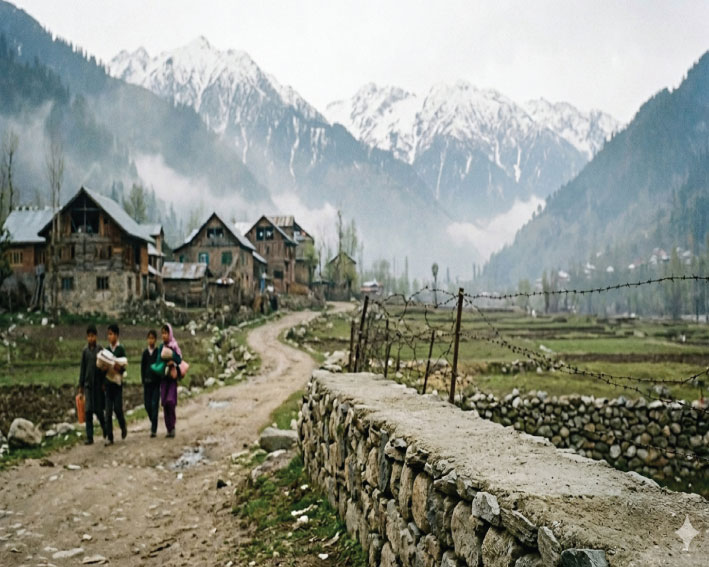
There are conflicts that scar maps, and then there are those that scar the conscience of humanity. Kashmir belongs to the latter. For seventy-eight years, its valleys have not only echoed with the sounds of militarization but with a deeper, more haunting silence—the silence of deferred justice, abandoned promises, and a people suspended between hope and history.The United Nations, conceived as the custodian of global peace and justice, stands as both witness and, regrettably, participant in this inertia. Its resolutions remain archived testimonies to a moral position it has failed to enforce. Institutions that were meant to arbitrate have instead become observers, issuing statements while realities on the ground harden into permanence.
The Organisation of Islamic Cooperation (OIC), representing a collective voice of the Muslim world, has often echoed concern—but rarely translated rhetoric into tangible action. Its
declarations, though symbolically significant, have not altered the lived realities of Kashmiris. The gap between words and will has rendered its position increasingly ceremonial.
Meanwhile, India and Pakistan remain entrenched in a narrative that prioritizes sovereignty over humanity. For India, Kashmir is an “integral part,” a constitutional assertion reinforced through political and military means. For Pakistan, it is an “unfinished agenda of partition,” a cause deeply embedded in its national identity. Between these positions lies the Kashmiri people—too often spoken for, but seldom truly heard.
A poet in me, “They drew borders across my land, but none across my grief.” Salman Khan.
The international community, particularly powerful Western states, has largely approached Kashmir through the lens of strategic interest rather than ethical responsibility. Trade, security alliances, and geopolitical balancing have overshadowed human rights considerations. In this calculus, Kashmir becomes negotiable—its people, unfortunately, expendable.
Yet perhaps the most uncomfortable reflection lies closer to home: within the diaspora and activist circles that claim to represent the Kashmiri cause. Fragmentation, ego, and performative activism have diluted what should be a unified moral front. Conferences become stages, solidarity becomes spectacle, and the cause risks being overshadowed by personalities.
There is a growing perception—painful but necessary to confront—that some activism has shifted from substance to symbolism. Photo opportunities replace sustained advocacy. Titles replace transformation. And in this quiet drift, the urgency of Kashmir is reduced to periodic outrage rather than persistent engagement.
As the African proverb reminds us, “When there is no enemy within, the enemies outside cannot hurt you.” Disunity has, in many ways, become an internal vulnerability for Kashmir and Kashmiris.
The tragedy of Kashmir, therefore, is multilayered. It is the failure of decolonization to deliver justice. It is the inability of international institutions to uphold their own principles. It is the entrenchment of state narratives over human realities. And it is, at times, the fragmentation of those who seek to champion the cause.
But history is not static. It is shaped by those who refuse to accept its injustices as permanent. The question, then, is not only why Kashmir remains unresolved—but whether the world still possesses the moral courage to resolve it and if Kashmiris diaspora are prepared to move away from egoism, narcissism and self-entitlement toward collectivism and genuine liberation from neo-colonial structures. As the key to the Kashmir liberation lies in the hands of Kashmir diasporas living in a luxury lifestyle across globe.
To speak of Kashmir today is to confront uncomfortable truths. It is to ask whether international law is truly universal or selectively applied. It is to question whether solidarity is genuine or performative. And it is to recognize that justice delayed is not merely justice denied—it is justice transformed into memory.
In the words of a statesman, “Peace is not the absence of conflict, but the presence of justice.” Until justice finds its place in Kashmir, peace will remain an illusion—spoken of in halls of power, but absent in the valleys that need it most.
Seventy-eight years on, Kashmir does not ask for sympathy. It demands sincerity. It does not seek attention. It seeks accountability.
And above all, it reminds us that silence, too, is a form of complicity.
Author: Salman Khan. Paul Harris Fellow, T.I, Chairman SAKAG & KCAU, South African Kashmir Action Group Kashmir Centre for African Union and Executive member Kashmir Diaspora Coalition KDC.
