The question of a regulatory framework for Lethal Autonomous Weapon Systems (LAWS) has been under discussion for a long time. The Group of Governmental Experts (GGE) were gathered in Geneva in March 2026 under Convention on Certain Conventional Weapons (CCW). This gathering of GGE on Emerging Technologies (ET) in the Area of LAWS under the CCW is the main multilateral forum i.e. international negotiating platform, for discussing LAWS also known as the “killer robots.” These are sophisticated weapon systems that can independently select and engage targets including human beings with little or no meaningful human control over critical decisions. This year is important because 2026 is the final timeline to conclude a meaningful and comprehensive regulatory framework for LAWS.
In Geneva, the first session was scheduled for March 2026 during which the UN High Representative Izumi Nakamitsu delivered a video message on 2 March urging states to accelerate progress. The second session is expected to take place between August and September 2026. The goal of these two sessions is to finalize a consensus report and submit it to the Seventh CCW Review Conference for comprehensive regulatory framework on LAWS.
The CCW is a treaty formed in 1980 under United Nations Office for Disarmament Affairs (UNODA). Currently, it includes more than 126 states known as High Contracting Parties (HCPs) i.e. states legally bound by a treaty. CCW aims to ban or restrict conventional weapons that cause unnecessary suffering or indiscriminate effects. The effects came for weapons which cannot distinguish between combatants and civilians. For example, CCW introduced protocols which include regulating blinding lasers, cluster munitions protocols etc., within this framework. LAWS are AI-driven systems where machines make life or death decisions with critical functions such as target selection, and engagement by itself. Therefore, because of these implications, GGE has been holding meetings for the last seven years to debate construction of a comprehensive regulatory framework for LAWS. The central debate concerns whether humans must always retain meaningful and have human control or judgment over the operation of LAWS. Other debates consists of its inherent risks.
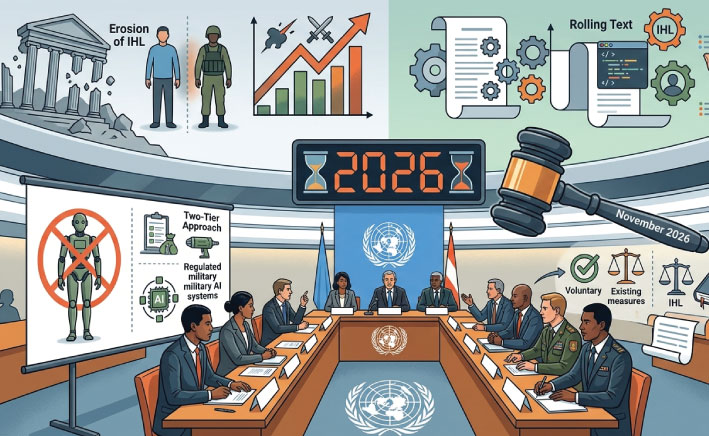
These killer robots raise several risks that include loss of accountability, conflict escalation, proliferation to non-state actors, bias in algorithms for AI decision making, and erosion of International Humanitarian Law (IHL). Within the paradigm of IHL, these risks relate to the principle of distinction (between civilian and combatants), proportionality (of use of force to advantage), and precaution (minimizing damages). For these concerns, during 2018-2019 sessions, the CCW has come up with eleven Guiding Principles. It affirms that IHL fully applies to autonomous weapon systems. It also confirms that human operators and states remain legally responsible for its development and deployment during military missions.
The CCW discussions on autonomous weapons started with expert meetings between 2013 and 2015. Subsequently, the formal GGE meetings started in 2017. However, progress has been slow. Largely because decision making requires consensus i.e. all states must agree. Due to consensus, any state can block the whole process resulting in delay of the regulated frameworks. Nevertheless, some developments have taken place between 2017 and 2025. For instance, states have gradually reached incremental agreements on guiding principles. One important step was the creation of a ‘rolling text.’
Rolling text is a continuously updated draft negotiation document. This document outlines potential elements for a future possible legal protocols or regulatory instrument on LAWS. During 2023 CCW mandate, there was a formulation of a set of elements for an instrument and other possible risk mitigation measures by HCPs. By late 2025, a rolling text had been further developed and updated. This updated document includes proposed definition of LAWS, IHL compliance, human judgement and human control in weapon operations.
Despite these developments, other political and normative challenges continue to slow the process. Many states and Non-governmental Organizations (NGOs) such as Stop Killer Robots, ICRC, and Humans Right Watch etc. advocate a two-tier approach. This approach proposes, firstly, an outright prohibitions on fully autonomous anti-personnel systems and secondly, strict regulations for other type of autonomous systems. This two-tier approach will prevent the most dangerous forms of autonomy while allowing limited regulation of other military AI systems. However, some strong military states prefer voluntary measures or reliance strictly on existing IHL inside CCW. Other states support a new legally binding treaty as a significant comprehensive regulatory framework against the emerging autonomous weapons risks. These diverging positions between major military powers and regulatory advocates remain one of the main obstacles preventing consensus within the CCW negotiations.
These challenges exist alongside parallel political pressures. For instance, in the UN General Assembly one hundred and fifty six states passed a resolution for supporting 2025 rolling text. Additionally, Secretary General set a deadline for a treaty by the end of 2026 by making this year important for getting results. It is crucial for international community to decide and come to a conclusion for a regulatory framework as reports are indicating increasing number of development and deployment of autonomous systems in ongoing global conflicts.
The growing deployment of autonomous and AI-enabled military systems in contemporary conflicts have intensified the demand for clearer international rules. With all these simultaneous challenges and pressures on the CCW in the area of LAWS, 2026 represents the final year for negotiation before the Seventh CCW Review Conference in the November 2026 sessions. Therefore, future regulatory framework of LAWS will likely emerge through a combination of agreements within the CCW, parallel diplomatic initiatives, and evolving interpretations of IHL. The CCW debates on LAWS represent a broader struggle to adapt global governance mechanisms to the realities of AI driven warfare. The CCW process has also demonstrated that international consensus on regulating emerging military technologies is possible, but often gradual and incremental.
Author: Muhammad Ali Baig, Research Officer, center for International Strategic Studies, Islamabad.
