Recent US-Israel attacks on Iran, code-named Operations Roaring Lion and Epic Fury, have sharply escalated regional tensions. Thousands of strikes have reportedly targeted Iranian leadership, military assets, and civilian infrastructure, using both kinetic and psychological tactics to pressure Iran. While Israeli Prime Minister Benjamin Netanyahu framed the campaign as a catalyst for internal collapse, Tehran has shown unexpected resilience while retaining significant missile and drone capabilities that have thwarted Israeli and US attempts to throttle it into submission. Despite attempts to cripple Iran’s nuclear and defense sectors, its capacity for asymmetric warfare has surprised both Washington and Tel Aviv. The future of the conflict escalation or de-escalation now hinges on Iran’s sustained strategic response and the durability of its Islamic government which so far has shown that it will pass the test.
It increasingly appears that the United States and Israel may eventually have to negotiate ‘face saving’ terms to find an exit from the ongoing conflict. One should not forget that it takes two sides to negotiate; Iran’s consent will also be required, particularly after the loss of key leadership figures and infrastructure. Under such conditions, Tehran may perceive little incentive to enter negotiations prematurely. As one scholar aptly wrote, “you cannot keep peace where there is no peace to keep.” Reducing Iran’s incentives for diplomacy may prove to be a strategic miscalculation for both Israel and the United States. In the current circumstances, Iran may increasingly resort to asymmetric warfare, potentially leading to prolonged global economic instability.
Both Israel and the United States have openly acknowledged their objective of ‘regime change’ in Iran. Through digital media campaigns and political messaging they have also encouraged Iranian citizens to challenge their government. However, by raising expectations of regime collapse, anything short of that outcome may ultimately be perceived as a defeat and political setback for Washington and Tel Aviv. Many analysts remain doubtful that such a collapse will occur in the near future.
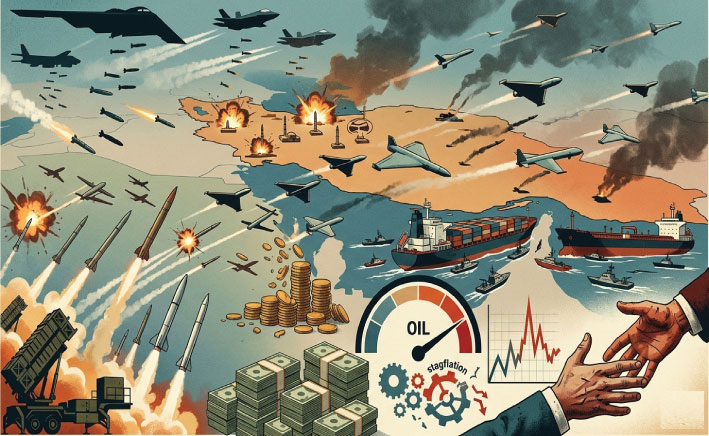
Israel reportedly deployed approximately 200 fighter jets to strike hundreds of targets across Iran, including air defence installations and missile launchers, in what has been described as its largest sortie to date. The United States simultaneously conducted Operation Epic Fury, employing Northrop B-2 Spirit bombers, F-35 Lightning II aircraft, Tomahawk cruise missile, and drones to carry out strikes aimed at dismantling Iranian command centres and ballistic missile infrastructure. In retaliation, Iran reportedly launched more than 170 ballistic missiles on the first day alone. Since then, it has consistently launched missiles and Shahed-136 kamikaze drones, effectively striking Israel and damaging US military bases across the Gulf region, including those in Qatar, the UAE, Bahrain, Kuwait, Iraq, Jordan, and Saudi Arabia.
When examining the asymmetrical nature of this war, the cost-exchange ratio deserves special attention. Iranian loitering munitions such as the Shahed-136 are relatively inexpensive, typically estimated to cost between $20,000 and $50,000 per drone, with some estimates reaching $80,000 depending on components and guidance systems. By contrast, defensive systems used by Israel and the United States are considerably more expensive per interception. Israel’s Iron Dome Tamir interceptor costs roughly $40,000–$100,000 per launch, while interceptors for David’s Sling are estimated at around $1 million each. For long-range threats, the Arrow 3 interceptor costs approximately $3–4 million, similar to the US Patriot PAC-3, while the THAAD interceptor may cost $10–13 million per launch. This disparity creates a structural imbalance in which relatively inexpensive drones or missiles compel defenders to expend significantly more costly interceptor systems with finite interceptors. Consequently, even limited attacks can impose disproportionate financial and logistical burdens on technologically superior militaries, particularly when executed through large-scale saturation tactics. During recent exchanges in the region, analysts estimate that air defence operations cost between $1.2 and $3.7 billion within the first hundred hours, largely due to the heavy reliance on advanced interceptor missiles. Such dynamics increasingly shape contemporary warfare, where adversaries aim not only to inflict physical damage but also to strain defensive inventories and economic sustainability over prolonged conflicts.
The regional conflict has reached a critical flashpoint following the assassination of Ali Khamenei, as the long-standing confrontation between Israel and Hezbollah has officially transitioned into a full-scale ground invasion. On March 16, 2026, Israeli forces launched “limited and targeted” operations into southern Lebanon to dismantle Hezbollah infrastructure, supported by a relentless campaign of airstrikes across Beirut that has displaced over one million people.
Apart from Iran’s unexpected and strong counter-strategy, which has put the US and Israel on the back foot, it has also blocked the Strait of Hormuz. This move marks a decisive turning point in the war and a visible blow to US global hegemony, signaling, for many, the arrival of a multipolar world. President Trump’s call for an international coalition to reopen the strait was met with refusal from key allies, from London’s strategic distancing to Berlin’s blunt declaration that this is “not NATO’s war”, a historic break from the post-1945 security order. The closure disrupts roughly 20% of global oil flow, about 20 million barrels per day, stranding hundreds of vessels and fueling fears of global recession. Brent crude surged past $100 per barrel, and war-risk insurance premiums tripled, making transit economically untenable. Analysts now estimate a geopolitical risk premium of around $18 per barrel. With Brent near $103, Bank of America and Iranian officials warn that prolonged closure could push prices to $130–$200, threatening the most severe energy shock since the 1970s. Sustained prices above $120–$150 would likely ignite global stagflation, forcing central banks to halt rate cuts and intensifying inflationary pressure.
Despite possessing a technologically superior military, Israel faces several strategic vulnerabilities in a prolonged conflict. Its small geographic size, densely populated urban centres, and proximity of critical infrastructure to front lines limit its strategic depth. The Iran–Israel 12-day war of 2025 revealed limitations in Israel’s multilayered missile defence network. Systems such as Iron Dome, David’s Sling, and Arrow faced challenges against adaptive Iranian tactics and saturation attacks. The current “interceptor gap” has shifted the strategic calculus from a matter of technological superiority to a brutal war of industrial attrition, where the math simply no longer favors the ‘defender’. With Israel’s stockpiles of Arrow and David’s Sling interceptors reportedly reaching critical lows following sustained Iranian salvos, the Iron Dome is no longer a permanent umbrella but a depleting resource. As the cost of a single defensive launch continues to dwarf the price of the incoming drone or missile by a factor of nearly fifty-to-one, Israel and its allies face a sobering reality that you cannot win a 21st-century conflict if the enemy can manufacture threats faster than you can build the bullets to stop them.
In response to these vulnerabilities, Tehran seeks to preserve its forward defence doctrine by maintaining proxy networks capable of projecting power without a full-scale invasion. Iran’s broader strategy involves widening the battlefield by targeting US bases in the region and blocking Strait of Hormuz by strangling the global economy to raise the cost of war for the US. This would not only give a strategic upper hand which they have at the moment but also that future incentives to attack Iran would also diminish greatly to a great extent.
Similarly, if looked at the Iran’s military approach to this war, central to this approach is Iran’s Decentralised Mosaic Defence (DMD) doctrine, which distributes operational authority across highly autonomous military units. Following leadership losses, Iranian officials confirmed the full activation of this doctrine on March 2, 2026. The doctrine restructures the IRGC into 31 independent operational units, each capable of conducting missile launches, drone operations, or guerrilla warfare without direct authorization from Tehran. By decentralising command, Iran seeks to ensure military continuity even in the event of leadership decapitation.
As an immediate neighbour of Iran and a strategic partner of Saudi Arabia, Pakistan must swerve this evolving crisis with considerable caution. Islamabad has maintained strategic clarity by condemning Israeli actions, affirming Iran’s right to self-defence under United Nation Charter Article 51, and offering diplomatic mediation. While some observers speculate that Pakistan could become a future target of Israeli action after Iran, officials have dismissed such concerns. Pakistan maintains credible conventional and nuclear deterrent capabilities capable of addressing any potential miscalculation. At the same time, Islamabad continues to balance its relationships with Gulf allies and the United States while extending diplomatic support to Iran. Domestic protests in cities such as Karachi reflect public outrage but have not altered official policy. Pakistan may nevertheless occupy a unique diplomatic position as a potential mediator between Iran, the United States, and Gulf states such as Saudi Arabia, emphasising dialogue to reduce escalation risks. As a neighbouring state, Pakistan must also prepare for possible spillover effects, including economic shocks resulting from disruptions in the Strait of Hormuz.
Author: Dr Asma Shakir Khawja, Executive Director, Center for International Strategic Studies, AJK. The author can be reached at @asmakhawaja5 on X
The views are of her own.
