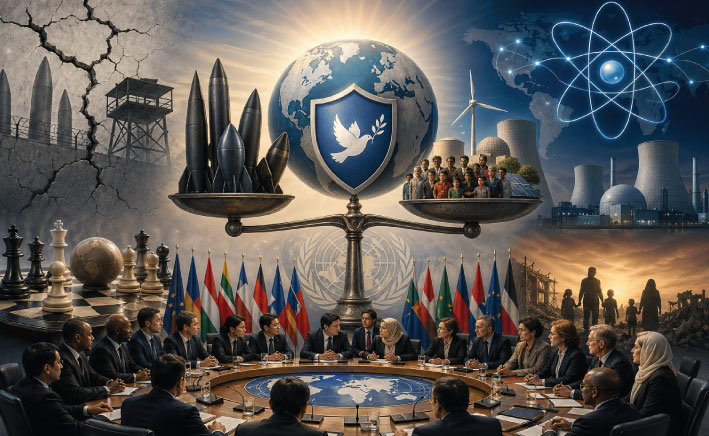
The Nuclear Non-Proliferation Treaty (NPT) remains the linchpin of the global nuclear order, embodying a “grand bargain” that trades non-proliferation for disarmament and peaceful nuclear energy access. Yet, entering its seventh decade, the regime confronts a colossal legitimacy crisis that threatens strategic stability. The core pathology lies not in deficient rules but in their asymmetric enforcement, creating perceptions of “nuclear apartheid.” To forge a resilient order amid multipolar nuclear diffusion, the NPT must transition from selective privilege to universal equity.
The Strategic Paradox of Tiered Enforcement
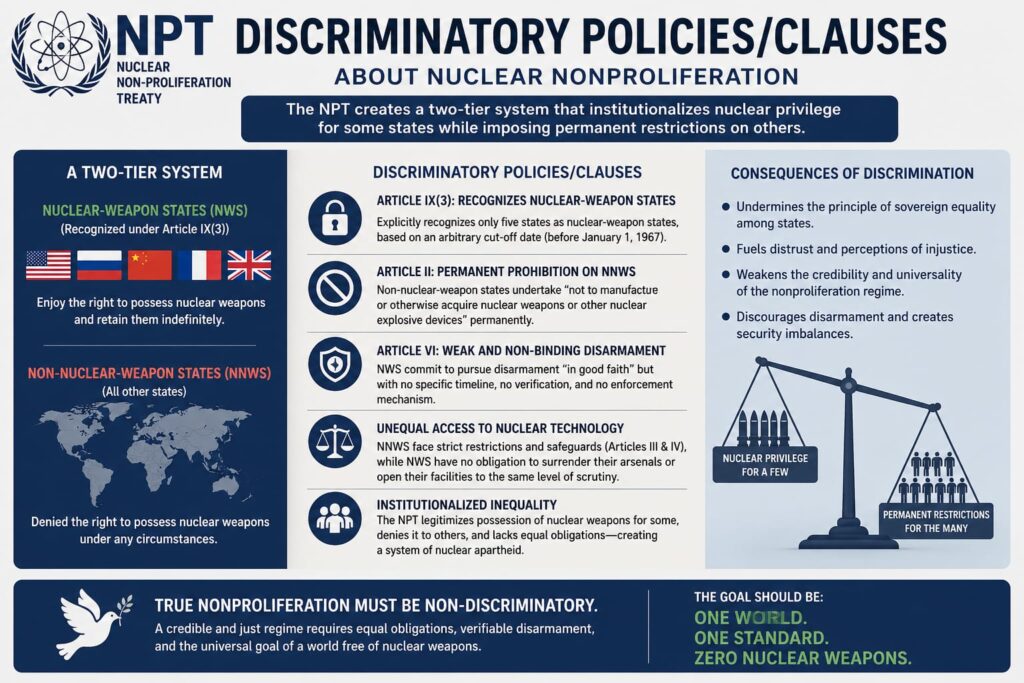
With 191 states parties, the NPT boasts near-universal adherence, yet its architecture stratifies actors into nuclear-weapon states (NWS), the P5 and non-nuclear-weapon states (NNWS). Article I and II ostensibly freeze this divide as a provisional step toward disarmament, but NWS have entrenched it, leveraging the treaty to legitimize their arsenals while proscribing others. This selectivity undermines deterrence stability by signaling that proliferation norms bend for strategic allies.
India’s 2008 Nuclear Suppliers Group (NSG) waiver exemplifies this. Despite non-signatory status and nuclear armament, New Delhi gained civil nuclear trade privileges, a leniency unavailable to, say, Iran (NSG 2008). Such exceptions erode regime legitimacy, incentivizing hedging behaviors in the Global South and accelerating fissile material diffusion in a post-unipolar era.
Imbalances Across the NPT’s Pillars
The treaty’s tripartite pillars are non-proliferation, disarmament, and peaceful uses of nuclear technology, strain under equity deficits, with cascading strategic effects:
a. Disarmament Stagnation: Article VI obliges “good faith” negotiations “at an early date,” yet NWS pursue costly modernization (e.g., U.S. Sentinel ICBMs, estimated at $141 billion; Congressional Budget Office 2023). NNWS view this as bad-faith perpetuation of dominance, fueling TPNW support among 70+ states.
b. Asymmetric Access: Article IV affirms NNWS rights to peaceful nuclear technology, but “gold standard” restrictions, demanding renunciation of enrichment/reprocessing, disproportionately burden developing states, while NWS retain full fuel cycles. This hampers energy security in the Global South, breeding resentment.
c. Uneven Verification: IAEA safeguards are comprehensive for NNWS but minimal for NWS, creating a two-tiered monitoring regime that invites accusations of double standards (IAEA 2022).
These imbalances risk normative collapse, as non-NPT actors like India, Israel, Pakistan, and North Korea exploit perceived hypocrisy.
Charting a Universalist Path Forward
Sustaining the NPT demands strategic adaptation to multipolarity therefore Policymakers should prioritize:
a. Verifiable Disarmament Benchmarks: Replace Article VI ambiguity with timed, monitored reductions, drawing on TPNW verification models and U.S.-Russia New START precedents (UNGA 2017).
b. Universalized Safeguards: Extend IAEA Additional Protocol requirements to all nuclear facilities, harmonizing standards to rebuild trust without compromising deterrence.
c. Humanitarian-Strategic Reframing: Integrate humanitarian impact assessments into NPT review conferences, subordinating narrow national deterrence to collective risk reduction.
Critics may decry universalism as naive amid great-power rivalry, yet history shows discriminatory regimes, like the pre-1968 patchwork, prove brittle. Equity enhances compliance, deters proliferation cascades, and enhances crisis stability.
The NPT was never meant to be a static document for managing a permanent nuclear status quo. Its survival depends on whether it can transform into a truly universal regime, one where security is not a privilege of the few, but a right shared by all. The NPT’s endurance hinges on reinvention from NWS entitlement to shared security, integrated deterrence, nuclear umbrella etc. It is pertinent to understand that absent reforms, strategic drift toward a fragmented nuclear order looms, where equity’s absence may invite chaos.
The international community is witnessing a shift where non-nuclear states are questioning whether NPT membership offers any genuine protection. The NWS watch the Iran-US war, which reinforces the idea of long-term abandonment of the non-proliferation norm in favor of independent deterrence. When the “rules-based order” is perceived as discriminatory or selectively enforced through kinetic power, the treaty loses its legitimacy, inviting the very chaos that characterizes the modern, fragmented nuclear era.
Author: Dr. Asma Shakir Khawaja, Executive Director, Center for International Strategic Studies, AJK.
