
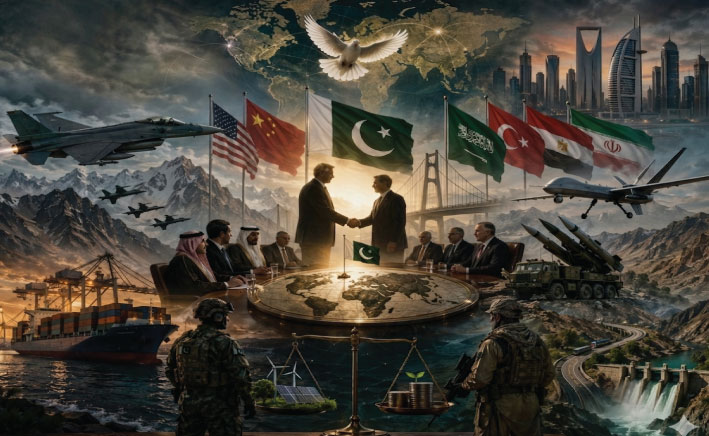
Pakistan has emerged as an important diplomatic player in the recent Gulf crisis. With the support of regional states, it is trying to position itself as a bridge between competing actors at a time when direct communication and trust remain fragile. Few countries today maintain good relations with all the major players involved in this crisis, yet Pakistan does. It has ties with the United States, China, key Middle Eastern states, and Iran. Recently, foreign ministers from countries such as Saudi Arabia, Egypt, and Turkey visited Pakistan, while Pakistan’s military leadership also engaged with US President Donald Trump. Whether these diplomatic efforts ultimately produce lasting results remains to be seen, but one thing is already clear: Pakistan’s relevance is rising beyond this crisis. At the same time, this growing importance does not erase the serious challenges it continues to face at home.
Pakistan’s importance to the US is not new. Since 1947, relations between the two countries have moved through phases of close cooperation, mistrust, and renewed engagement. Pakistan was a US ally during the Cold War, supported Washington during the war on terror, and even played a role in facilitating the opening between China and the United States. Yet in recent years, Pakistan’s value in Washington had narrowed significantly, often reduced to counterterrorism concerns. This perception now appears to be changing.
After Operation Sindoor, where Pakistan’s military was seen to have performed effectively and reportedly shot down Indian aircrafts, including Rafale jets, Islamabad moved quickly to acknowledge President Trump’s role and even nominated him for the Nobel Peace Prize. On the surface, some may see this as simple political appreciation, but deeper strategic factors are also at work.
Although India has built a strong and expanding partnership with the US, recent remarks by the US Deputy Treasury Secretary were revealing: “Won’t make same mistake with India we did with China so you beat us at commercial things.” While the statement was framed in economic terms, it points to something larger. The primary American objective remains the preservation of its global position. Washington would prefer to sustain a unipolar order, but even where that is no longer fully possible, it still seeks to retain the widest possible range of policy tools to shape the behaviour of rising powers such as India.
This is why US policy in South Asia may become more complex in the coming years. Earlier, the dominant logic was straightforward: support India to contain China. This approach is now likely to evolve. The US may continue backing India in the broader strategic contest with China, but at the same time it may also seek to engage Pakistan in ways that preserve leverage over New Delhi.
This matters because, despite India’s effort to present itself internationally as a major power and a serious competitor to China, Pakistan still occupies a central place in India’s politics, media, and strategic imagination. Even during Indian elections, Pakistan often receives more attention than many larger global issues. In that sense, Pakistan may increasingly become useful to both Washington and Beijing as a state through which India can, in different ways, be influenced or constrained.
Pakistan’s role is also becoming more significant in the Gulf. It has signed a defence pact with Saudi Arabia, and even before this crisis there were reports that Turkey was interested in joining such an arrangement. This raises the possibility that a new regional security architecture could gradually take shape after the war. But building such an architecture will not be easy. The recent crisis has again shown how difficult it is for Pakistan to balance its long border and necessary relationship with Iran on the one hand, and its defence commitments and strategic closeness with Saudi Arabia on the other. Pakistani officials, including the Deputy Prime Minister and Foreign Minister, have said that Islamabad remained in contact with Tehran throughout the crisis, but maintaining that balance is becoming more difficult, not less.
The symbolism of Pakistan’s military engagement with Saudi Arabia has also not gone unnoticed. When Pakistan’s Chief of Defence Force visited the Kingdom, the images that emerged showed him in combat uniform rather than ceremonial dress. That was widely interpreted as a sign of Pakistan’s willingness to stand by Saudi Arabia if required. However, there are also strong reasons why Pakistan would avoid direct military confrontation with Iran. The US and Israel have already employed immense firepower, including advanced missiles, aircraft, and even artificial intelligence-enabled targeting against selected sites inside Iran. Even so, Iran absorbed the pressure and continued to respond. From both Pakistani and Saudi perspectives, diplomacy may therefore appear a more effective path than escalation if the real objective is to preserve Saudi security without widening the conflict further.
At the same time, Pakistan’s growing importance is not limited to diplomacy alone. It is also beginning to matter more in defence markets. Islamabad has reportedly held talks with 13 countries, six to eight of them at advanced stages, over deals involving JF-17 fighter jets jointly produced with China, along with training aircraft, drones, and other weapons systems.
Pakistan also maintains workable relations with the European Union. It enjoys GSP Plus status and has signed legal migration pathways with European countries such as Italy, Spain, and Greece. These developments suggest that Pakistan’s external relevance is broadening across both security and economic domains.
Still, none of this means Pakistan’s rise in diplomatic relevance is without limits. Serious structural weaknesses remain. Pakistan is still dependent on IMF programmes, while its economic growth continues to lag behind regional states such as India and Bangladesh. It faces persistent border-related security pressures, and its economy remains highly vulnerable to climate shocks. These are not secondary issues. If Pakistan wants to convert temporary geopolitical relevance into a more sustainable international role, it will need to address these internal vulnerabilities with much greater seriousness.
Even so, Pakistan is likely to remain important well beyond the present crisis. Christopher Clary captured this well in a tweet: “Over a decade, most (not all) major US think tanks let their Pakistan expertise disappear. India was the partner of the future and Pakistan did not fit into any Indo-Pacific plans. That neglect was always a mistake. Whether friend or foe, Pakistan continues to matter to the US.” That is perhaps the most accurate way to understand Pakistan’s place today. Whether seen as a partner, a problem, or simply a strategic necessity, Pakistan is not disappearing from the calculations of major powers. On the contrary, this crisis has shown that it still matters, and may matter even more in the years ahead.
Author: Nimra Javed, Research Officer, Center for International Strategic Studies, AJK.
