Arms control debates rarely feel urgent until a crisis forces them into relevance. Yet the latest report by the Organization for the Prohibition of Chemical Weapons Scientific Advisory Board’s Temporary Working Group on Artificial Intelligence arrives as a quiet disruption rather than a loud warning. It does not trade in familiar anxieties about emerging technologies. Instead, it offers a finely detailed account of how artificial intelligence is already reshaping the relationship between chemistry and security, subtly but decisively altering the foundations on which the Chemical Weapons Convention was built.
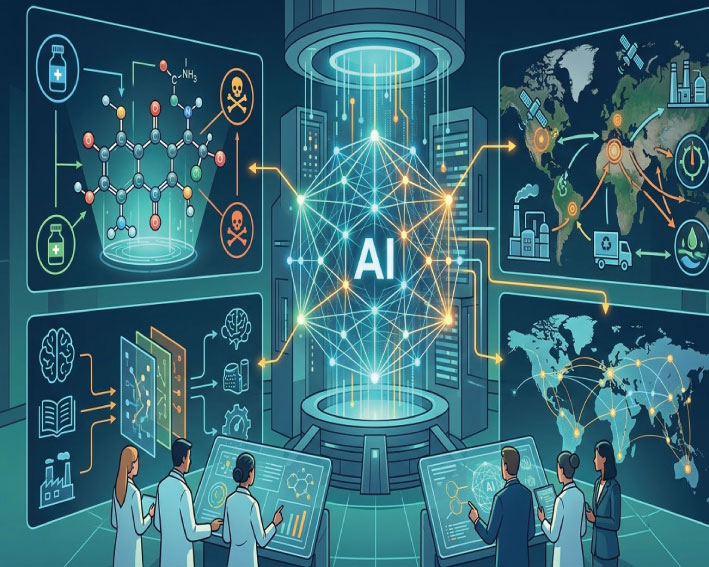
At its core, the report recognizes a duality that policymakers often struggle to articulate. Artificial intelligence is not simply a tool. It is an accelerator of chemistry itself. Machine learning systems can now predict molecular properties, design synthesis pathways, and optimize reaction conditions with a speed that was inconceivable a decade ago. This fundamentally alters the traditional barriers to entry in chemical research. Tasks that once required years of tacit knowledge and laboratory iteration can now be compressed into computational workflows driven by predictive models.
This is where the report becomes technically consequential. It highlights how AI-driven retrosynthesis tools, generative molecular design, and autonomous laboratory platforms could enable both beneficial innovation and malicious misuse. The same algorithms that help pharmaceutical companies design life-saving drugs can, in principle, be repurposed to identify toxic compounds or optimize their synthesis. The concern is not hypothetical. It lies in the convergence of open chemical databases, cloud-based computation, and increasingly accessible machine learning architectures.
Yet the report resists alarmism. Instead, it reframes the problem as one of governance and verification. Artificial intelligence, it argues, can strengthen the implementation of the Chemical Weapons Convention just as much as it can challenge it. AI systems can process vast datasets from inspections, environmental sampling, and open-source intelligence, identifying anomalies that human inspectors might miss. Pattern recognition models can enhance chemical forensics by linking trace signatures to production pathways or geographic origins.
One of the most technically compelling insights is the role of AI in chemical attribution. Traditional forensic methods rely on isotopic ratios, impurity profiles, and degradation products. AI can augment this by learning complex, multidimensional relationships across datasets, effectively turning chemical forensics into a data science problem. This could significantly improve the evidentiary basis for attribution in cases of alleged chemical weapons use, an area that has long been politically contested.
The report also points to the emergence of what might be called algorithmic verification. Instead of relying solely on physical inspections, future compliance mechanisms could incorporate AI-enabled monitoring of industrial activity, scientific publications, and even supply chain patterns. Natural language processing systems can scan vast volumes of scientific literature to detect emerging trends in toxic chemistry. Similarly, anomaly detection algorithms can flag unusual procurement patterns in precursor chemicals.
However, these capabilities introduce new risks. AI models themselves can become vectors of proliferation if trained on sensitive datasets. The report raises concerns about model inversion and data leakage, where trained systems inadvertently reveal information about hazardous compounds or synthesis routes. It also highlights the governance gap surrounding open-source AI tools, which are not bound by the same regulatory frameworks as traditional chemical industries.
This is where the report’s normative contribution becomes important. It calls for a culture of responsible innovation in chemistry, extending the long-standing norm of responsible science into the age of artificial intelligence. This includes ethical guidelines for AI-assisted chemical research, safeguards for sensitive data, and stronger collaboration between scientists, regulators, and industry.
For Pakistan, the implications are both strategic and practical. First, there is an opportunity to leapfrog in chemical safety and compliance. Pakistan, as a State Party to the Chemical Weapons Convention, already maintains a National Authority and vigilant regulatory framework. Integrating AI into these structures could enhance monitoring and reporting capabilities. For example, AI-driven data analysis could improve the tracking of dual-use chemicals across industrial sectors, reducing the risk of diversion while streamlining compliance processes.
Second, Pakistan can benefit from AI in chemical forensics and emergency response. Developing indigenous capabilities in machine learning applied to spectroscopy, environmental sampling, and toxicology would strengthen the country’s ability to respond to chemical incidents. This aligns directly with the OPCW’s emphasis on capacity building and assistance and protection.
Third, there is a research opportunity that Pakistan has yet to fully exploit. The OPCW has already launched initiatives such as AI research challenges and technical workshops aimed at Member States. Pakistani universities and research institutes can position themselves within this emerging field by focusing on AI applications in green chemistry, toxicology prediction, and industrial process optimization. This would not only contribute to global nonproliferation efforts but also support domestic industrial innovation.
Fourth, and perhaps most importantly, Pakistan must engage in the governance debate. The rules that will shape AI in chemistry are still being written. If developing countries remain passive, the regulatory frameworks may reflect the priorities of technologically advanced states alone. Pakistan should actively participate in OPCW discussions on AI governance, advocating for equitable access to technology while supporting safeguards against misuse.
The deeper lesson of the report is that the future of arms control will not be negotiated solely in diplomatic chambers. It will be coded into algorithms, embedded in datasets, and shaped by the invisible architectures of machine learning systems. The Chemical Weapons Convention, often seen as a legacy instrument of twentieth century disarmament, is now being reinterpreted in light of twenty first century technology.Artificial intelligence does not weaken the Convention by default. It exposes its blind spots and expands its possibilities. The challenge is not to resist this transformation, but to govern it intelligently.
Author: Abdul Rehman, Research Officer, Center for International Strategic Studies, AJK.
