
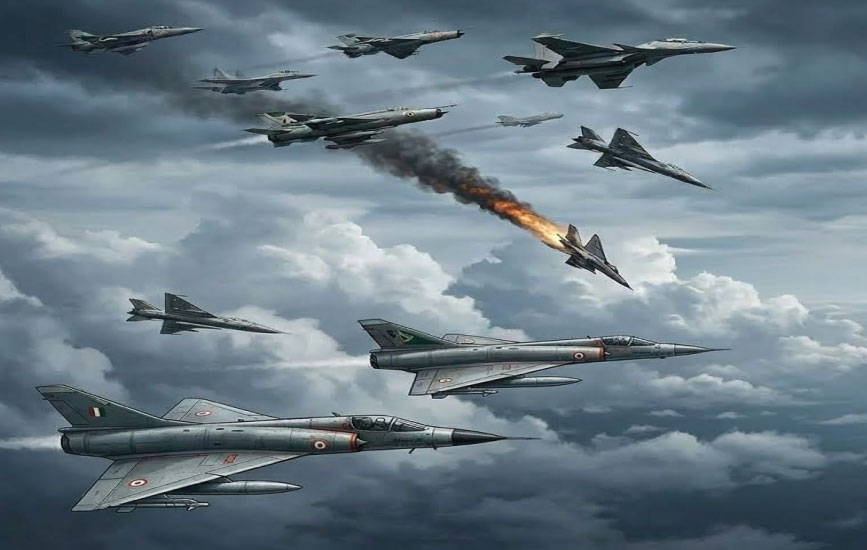
India’s claim of having imposed a “new normal” in South Asia began on the night of February 26, 2019, when Indian aircraft violated Pakistan’s airspace near Balakot under the pretext of counterterrorism. Marketed domestically as a decisive break from restraint, the strike was less a strategic innovation and more a political spectacle timed conveniently ahead of national elections. Pakistan’s swift and measured military response the following day downing an Indian MiG-21 and capturing its pilot punctured New Delhi’s narrative almost immediately. What India called deterrence, Pakistan exposed as escalation without dominance. Yet New Delhi persisted. For years after Balakot, Indian strategic discourse rested on the belief that Pakistan could be coerced below the nuclear threshold through limited conventional strikes amplified by media hysteria and diplomatic lobbying. This illusion survived not because it was credible, but because it was not decisively tested until May 2025.
India’s military humiliation in May 2025 was not an aberration; it was the logical endpoint of a flawed doctrine. Despite massive defence spending, imported platforms, and relentless claims of conventional superiority, India failed to impose costs or control escalation against Pakistan. The episode laid bare what Balakot had already suggested: India lacks the operational depth, jointness, and command-and-control coherence required for sustained military pressure. Rhetoric substituted for readiness, and spectacle for strategy. Pakistan’s response framework, by contrast, has further developed. Rather than chasing escalation for prestige, Islamabad demonstrated restraint coupled with credibility. Its responses were precise, proportionate, and clearly communicated reinforcing deterrence rather than destabilising it. The message was unmistakable: Pakistan neither seeks escalation nor fears it.
This contrast became even sharper with Pakistan’s resolutory strikes against militant sanctuaries in Afghanistan. Unlike India’s 2019 theatrics, these actions were driven by necessity and grounded in international law’s principle of self-defence. They highlight a doctrinal difference that India has long tried to obscure: Pakistan’s use of force is threat-driven and calibrated, whereas India’s is increasingly performative, shaped by domestic politics and ideological signalling.
The Balakot episode also marked a turning point in crisis management. The United States, traditionally a stabilising actor during India-Pakistan crises, abandoned even the appearance of neutrality. Statements by India’s National Security Adviser Ajit Doval, suggesting American recognition of India’s “right” to strike Pakistan, reinforced Islamabad’s concerns that Washington had compromised its role as an honest broker. This perception was not theoretical. Former Pakistani foreign secretary Tehmina Janjua later disclosed that Pakistan had tracked multiple Indian missiles during the crisis evidence of how close South Asia came to catastrophe under the guise of controlled escalation. India’s domestic exploitation of the crisis further heightened risks. Then-Prime Minister Narendra Modi openly weaponised the capture of Indian pilot Abhinandan Varthaman during the 2019 election campaign, warning of mass casualties had the standoff continued. Such rhetoric was not deterrence; it was brinkmanship aimed at voters. On both sides, military planners reportedly discussed pre-emptive options, injecting an unmistakable nuclear dimension into what India claimed was a limited conventional exchange.
Emergency diplomacy particularly intervention by then U.S. Secretary of State Mike Pompeo helped defuse the immediate crisis. But this intervention was reactive, not institutional. It highlighted a dangerous reality: crisis stability in South Asia increasingly depends on ad hoc firefighting rather than robust mediation frameworks. As global power competition intensifies, external actors are less willing—and less able to manage regional escalations triggered by domestic political calculations. The events of May 2025 have now stripped away the last remnants of India’s Balakot-era bravado. India’s strategic culture defined by media-driven militarism, inflated threat perceptions, and ideological posturing has collided with operational reality. Structural weaknesses in joint warfare, logistics, and command integration can no longer be concealed behind press briefings or cinematic airstrike claims. The notion that India can dominate escalation against a nuclear-armed Pakistan has been empirically disproven.
For Pakistan, the lesson is equally clear but fundamentally different. Deterrence stability is preserved not through silence or appeasement, but through credible response options and strategic clarity. Islamabad’s conduct from 2019 to 2025 demonstrates an understanding that restraint is meaningful only when backed by capability. Its actions have repeatedly restored equilibrium without courting uncontrolled escalation.
The broader implication for South Asia is sobering. As long as India continues to treat military force as an extension of electoral politics and ideological assertion, the risk of miscalculation will persist. The collapse of the “new normal” does not automatically produce stability; it merely removes a dangerous illusion. What replaces it depends on whether New Delhi internalises the lessons of repeated failure—or doubles down on rhetoric divorced from reality. From Balakot to May 2025, the pattern is unmistakable. India escalates to signal strength, Pakistan responds to restore balance, and international actors scramble to prevent disaster. This is not a sustainable equilibrium. Stability in South Asia will not emerge from myths of escalation dominance or manufactured nationalism, but from acknowledging limits, restoring credible crisis management mechanisms, and abandoning the politics of spectacle. Until then, the region remains hostage not to deterrence failure, but to strategic delusion.
Author: Abdul Basit, Associate Research Officer at Centre for International Strategic Studies AJK, a graduate of National Defense University Islamabad and an alumnus of NESA, NDU Washington.
