
International Women’s Day is celebrated every year on March 8 as a global occasion dedicated to honoring the women’s rights movement and raising awareness about important issues such as gender equality, socio-political rights, and the fight against violence and abuse. Around the world, it is celebrated in different ways; some countries recognize it as a public holiday, while others observe it through community events and initiatives that highlight women’s achievements and contributions.
The United Nations also observes the day each year by focusing on specific themes related to women’s empowerment and gender equality. However, for the women living in Indian illegally occupied Jammu and Kashmir, who daily write the stories of resilience and strength, the opportunity to celebrate this day often feels distant and meaningless.
Resistance and resilience have become synonymous with the women of Kashmir. Indeed, women are a vital component of society, contributing to all spheres of life. Their role is undeniable in driving domestic, socio-cultural, political, educational, and economic reforms within society. Historically, Kashmiri women have played a significant role in societal structures and have earned recognition for their contributions.
The renowned Kashmiri author Prem Nath Bazaz authored several books about Kashmir. One of his remarkable books, “Daughters of Vitasta” (A History of Kashmiri Women from Early Times to the Present Day, 1959), discusses the role of Kashmiri women throughout history.
He highlights the mythical golden age in which Kashmiri women achieved unparalleled glory. The book contains vignettes of outstanding Kashmiri women who flourished from early times across various social fields. Among them, the role of Lal Ded (Lalla Arifa), the Sufi poetess of Kashmir, not only wrote religious verses, but also highlighted domestic violence during the 14th century. Her literary contributions to the history of Jammu and Kashmir cannot be neglected. Born into a common family and married into a traditional household, she used her poetry to resist societal norms and social taboos, eventually becoming the first female poets of Kashmir. Her poetry remains unmatched and a symbol of unparalleled resistance.
This tradition continued, and the fertile land of Jammu and Kashmir produced numerous women who stood strong and contributed to society’s well-being, such as Habba Khatoon, another remarkable poets of Kashmir.
One of the most powerful kings of the Muslim Shahmiri dynasty, Sultan Sikandar, was supported by his mother (Hoora Bibi) in many of his endeavors. After her husband, Sultan Qutab-Ud-Din, passed away, she not only raised a powerful king, Sultan Sikandar, but also served as the guiding force behind his decisions for the state.
Historically, Kashmiri politics has seen influential figures like Begam Akbar Jahan, Fatima Bibi, Zooni Gujari, and Fazli Begam, and many others. The emergence of conflict in society further shaped and nourished the character of women as symbols of resistance, leading them to take the lead on several occasions.
The conflict gave them a dual role: contributing to the freedom movement while enduring multiple forms of trauma. The term “half widow,” a unique concept found in Indian illegally occupied Jammu and Kashmir, refers to women whose husbands disappeared, leaving them uncertain of their fate.
Victims of sexual violence have endured the worst forms of trauma. The women of Kashmir have witnessed several episodes of “Mass rape,” e.g., Kunan Poshpora mass rape, Wavoosa Mass Rape, Chak Saidpora Mass Rape, and many more rape cases, leaving thousands of women in perpetual pain. The victims of Kunan-Poshpora are still waiting for justice despite the passage of almost three decades. Hundreds of cases of rape and harassment against Kashmiri women have been reported, yet not a single Indian army personnel has been held accountable for this heinous crime.
Women in IIOJK have suffered terribly at the hands of Indian occupation forces, and they were subjected to the worst kind of physical and mental torture. In a patriarchal society like South Asia, rape victims are ostracized, considered “sinful,” or objectified. The trauma of being raped clings to their lives, and everyone associates them with that incident.
Despite social disgrace, many victims or survivors of this mass rape case refused to be silent; they came out, sought legal action, interacted with journalists and activists, and insisted on documenting their case.
This is the courage and determination of the Kashmiri women who bravely chose to be visible rather than invisible. They turned their suffering into a protest by raising their voices against the cruel conduct carried out by the Indian military. Their courage has the power to uplift and shield numerous other women who are subjected to similar injustice. It is the fight to be heard across decades. By doing this, Kashmiri women turned their individual trauma into a type of group resistance.
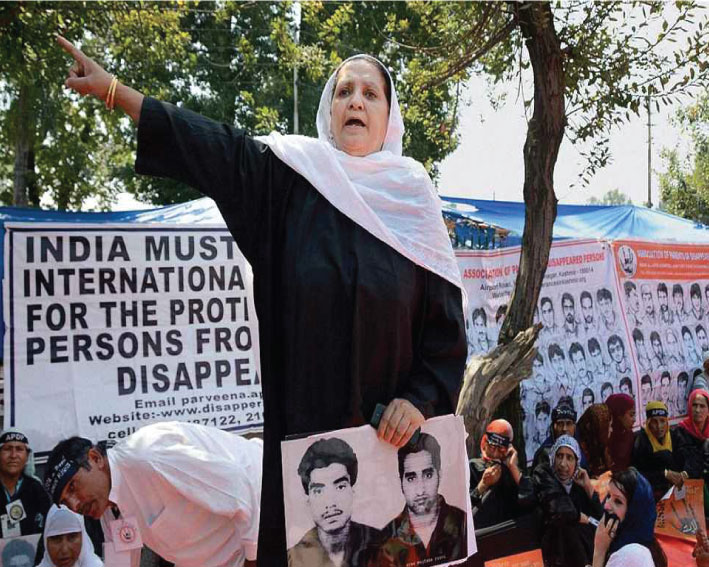
However, there are additionally multiple examples of women joining the resistance movement alongside men. The face of nonviolence in Kashmir is represented by Parveena Ahangar, whose son disappeared at the hands of Indian forces.
Her tireless search for any news of her beloved son led to the formation of an association for relatives of missing individuals in Kashmir. In her little two-room house, she helps and supports these families while advocating for the sons of hundreds more Kashmiri families in addition to her own. Despite the fact that she was unable to get her son back, her endeavor has won praise from all around the world. The current uprising in IIOJK has involved a large number of Kashmiri women.
Led by the situation and a desire for liberation from Indian occupation, many women have become significant figures in the ongoing struggle in IIOJK.
Women who have actively engaged in resistance, such as Asia Indrirabi and Fareeda Behanji, Zamurad Habib, and Naheeda Nasreen, have witnessed the repressive tactics of the Indian government. Despite harsh legislation, imprisonment, and being cut off from their loved ones, they never gave up on their fight.
It is quite ironic that the Indian state, which presents itself as a progressive society, is ruthlessly using rape as a weapon of war against Kashmiri women. The struggle in IIOJK continues despite the brutal tactics of the Indian government, with women participating in every aspect of the movement. Kashmiri women are unwavering in their roles in academia, politics, and society. The highest form of resilience is overcoming the trauma while continuing the struggle. And that is what Kashmiri women have consistently demonstrated.
The experiences of Kashmiri women remind us that empowerment is incomplete without accountability, protection, and recognition of lived realities shaped by conflict and marginalization. Therefore, honoring this day meaningfully requires transforming solidarity into sustained advocacy for equality, dignity, and the fundamental human rights of all women.
The history and lived experiences of Kashmiri women reflect a profound legacy of resilience, resistance, and contribution to society, from the spiritual strength of Lal Ded to the courage of contemporary voices. International Women’s Day must therefore serve not only as a celebration, but as a reminder to uphold justice, accountability, and human dignity for women everywhere, especially those living in conflict-affected regions.
Author: Saba Ghulam Nabi, Research Officer at the Center for International Strategic Studies, AJK.
