
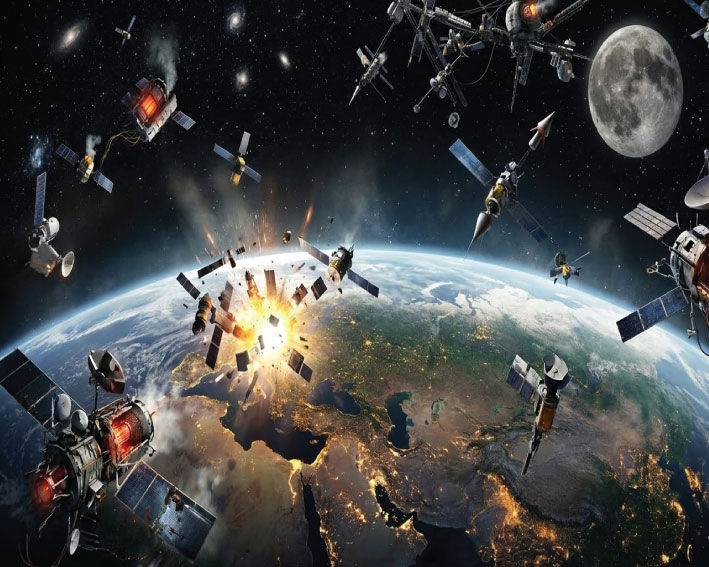
For most of the nuclear age, something resembling order prevailed. It was never a comfortable order, the logic of mutually assured destruction was always one of managed terror but it was order nonetheless. Treaties constrained the numbers, inspectors verified compliance, and the then two superpowers maintained channels of communication designed to prevent a crisis from spinning out of control before anyone could think clearly. The 1967 Outer Space Treaty added a crucial dimension that it declared space a global commons, free from nuclear weapons and other weapons of mass destruction. Over 115 states ratified it. The taboo held.
The global nuclear landscape in early 2026 has entered a volatile “Third Nuclear Age,” defined by the collapse of decades-old diplomacy and a shift toward multipolar instability. With the formal expiration of the New START Treaty on February 5, 2025, the world’s two largest nuclear powers, the US and Russia, are operating without legally binding limits or on-site inspections for the first time in over fifty years. This transparency vacuum coincides with a dramatic war in the Middle East following the February 28, 2026, when US and Israeli begun to carry out strikes in Iran in the midst of the nuclear negotiations.
The impact of this building disorder will also shift to Outer Space, for which the existing legal framework was never designed and to which it applies, at best, ambiguously. The term that best describes what is emerging is Astro Nuclear Disorder. It is a condition in which nuclear capabilities, dual-use technologies, and strategic ambitions are migrating into the space domain faster than any governance framework can keep pace with them, creating new vectors of instability that are poorly understood, largely unpublicised, and almost entirely unregulated.
WHY STATES ARE GOING NUCLEAR IN SPACE
As the global aerospace community transitions from intermittent exploration to a permanent presence in the high frontier, the energy requirements of orbital infrastructure are undergoing a radical shift. The next generation of space systems is no longer “lightweight”; the integration of 6G telecommunications and AI and Quantum data systems demands a massive increase in both physical and digital density. These technologies require persistent, high-wattage edge computing to manage complex tasks ranging from autonomous lunar mining to real-time deep-space navigation. Furthermore, future satellite constellations will serve as “heavy” orbital data hubs, physically larger and more power-hungry as they satiate the Earth’s data requirements. Relying on intermittent solar power for such energy-intensive, high-bandwidth systems is comparable to attempting to run a modern data center on a standard household battery. Consequently, space-based nuclear fission represents the only sustainable solution capable of providing the constant, high-output energy density required to fuel this digital revolution.
This is why, in February 2026, NASA and the US Department of Energy signed a memorandum of understanding committing the United States to deploying a fission surface power system on the lunar surface by the end of the decade — a 100-kilowatt reactor, capable of powering around 80 homes. China and Russia reached their own agreement to build a joint nuclear power station on the moon by 2035. The race is real, official, and accelerating.
The stated objectives are entirely civilian. Power for habitats, rovers, scientific instruments, and eventually mining operations. Nothing in international law prohibits peaceful nuclear power in space, and the Outer Space Treaty does not address it. But the strategic logic is inseparable from the science. The first country to anchor a nuclear reactor at the lunar south pole will, in the words of NASA’s own acting administrator, be in a position to declare a de facto keep-out zone. Infrastructure is influence. Presence becomes precedent. That is where the engineering problem becomes a political one.
WHAT ASTRO NUCLEAR DISORDER ACTUALLY MEANS
Astro Nuclear Disorder is not a single event. It is a structural condition characterised by four overlapping features.
The first is technological ambiguity. The same reactor that powers a lunar habitat can, in modified form, support orbital weapons platforms, electronic warfare nodes, or directed-energy systems. The same fissile material that fuels a civilian generator can, in different configurations, fuel a warhead. There is no bright line between peaceful and military nuclear capability in space, and the existing legal framework, such as the Article IV of the Outer Space Treaty (OST), built around a distinction between “weapons of mass destruction” and everything else, has no mechanism for addressing the grey zone between them.
The second is institutional stagnation. The bodies nominally responsible for governing space, the UN Committee on the Peaceful Uses of Outer Space, the Conference on Disarmament, have failed to produce a binding instrument on space security in decades. The Open-Ended Working Group on Reducing Space Threats, which met four times in 2022 and 2023, could not agree on a final consensus report.
The third is the collapse of verification. The Outer Space Treaty bans nuclear weapons in orbit but provides no mechanism for confirming compliance. There are no inspectors, no mandatory transparency obligations, and no agreed technical standards for distinguishing civilian from weapons-capable nuclear payloads. In a domain where launches are announced by press release and payloads are classified, trust cannot be built and doubt cannot be resolved. In this context, the treaty relies on voluntary compliance rather than technical enforcement.
The fourth is the accelerating pace of deployment. Space powers are not waiting for governance frameworks to catch up. They are building, launching, and establishing facts above the Earth at a rate that leaves diplomacy permanently behind.
The lunar reactor race also seems to have begun. In August 2025, NASA’s acting administrator, as aforementioned, warned explicitly that if China and Russia reached the lunar south pole first with a functioning nuclear power plant, they could establish a keep-out zone that would fundamentally compromise the United States’ ability to build its own base in the same area. The strategic subtext was blunt that whoever plants a nuclear reactor on the moon first controls the most valuable location in the inner solar system. That competition is now formally underway, with deadlines measured in years rather than decades. The example is not an aberration. It shows the current state of the domain.
WHY THIS IS A THREAT TO INTERNATIONAL SECURITY
The implications run in several directions at once, and none of them are comfortable.
The most immediate is the vulnerability of satellite infrastructure. Modern economies and modern militaries are comprehensively dependent on satellites. GPS, banking systems, emergency communications, early-warning networks, agricultural monitoring, climate observation, all of it routes through orbit. A nuclear detonation in low Earth orbit would not destroy cities in the conventional sense. It would generate an electromagnetic pulse and a surge of radiation capable of disabling or destroying a significant fraction of the roughly 9,500 commercial and military satellites currently in orbit. Analysts describe this as the potential for indiscriminate catastrophe. The importance of satellite connectivity is to modern warfare cannot be emphasized enough.
The second implication is escalatory risk. The absence of communication channels specifically designed for space crises means that ambiguous events, a malfunctioning reactor drifting toward another state’s assets, an unexplained manoeuvre by an unidentified satellite, cannot be rapidly clarified. The Cold War at least had a hotline. Space has no equivalent. In the compressed timeframes of a developing crisis, miscalculation is not merely possible; it is structurally facilitated.
The third is the erosion of deterrence stability. The existing nuclear deterrence architecture rests, among other things, on second-strike capability, the confidence that a first strike cannot eliminate an adversary’s ability to retaliate. A nuclear anti-satellite weapon capable of degrading or destroying early-warning satellites at scale would undermine that confidence. If one side fears that its early-warning capacity could be neutralised in a first strike, the incentive to launch ‘pre-emptively’ in a crisis increases significantly. Astro Nuclear Disorder therefore does not merely add a new domain of competition. It corrodes the stability of the terrestrial nuclear balance.
The fourth implication is the precedent problem. Technology transfers downward. The nuclear power systems and dual-use space technologies being developed today by the major space powers will, over time, become available to a broader range of actors. A governance framework adequate to three or four state actors is already struggling. One adequate to ten or fifteen does not yet exist in even conceptual form.
WHAT GOVERNANCE MIGHT ACTUALLY LOOK LIKE
None of this is inevitable. The disorder is real, but it is a product of political choices, not physical laws. And the experience of arms control, for all its imperfections, demonstrates that states with sharply opposed interests can, under sufficient pressure, agree on frameworks that serve their mutual survival.
The most urgent requirement is pre-launch transparency and verification. Any state launching a nuclear-powered system to orbit or to the lunar surface should be required to submit to pre-launch notification, technical disclosure of power system specifications, and third-party inspection. The International Atomic Energy Agency already has the institutional competence to develop and administer such a regime. What it lacks is the mandate. Giving it that mandate requires a treaty and that treaty requires political will that does not yet exist among the major space powers. But neither did the Non-Proliferation Treaty, until the conditions that made it necessary became sufficiently obvious.
The second requirement is a binding no-first-placement instrument. The existing Outer Space Treaty prohibition on nuclear weapons in orbit needs to be modernised, with clearer definitions of what constitutes a weapons-capable nuclear system, and with legally binding obligations not to deploy weapons-capable nuclear systems in space under any circumstances.
The third requirement is crisis communication architecture. Space powers need dedicated, continuously staffed communication channels specifically designed for space anomalies, channels through which an unexplained satellite manoeuvre or a drifting nuclear-powered object can be clarified in real time before it generates a crisis. This is not a radical proposal. It is a Cold War lesson that has not been applied to a new domain.
The fourth requirement is mandatory end-of-life protocols for nuclear-powered space systems. Any fission reactor launched to orbit or to a celestial body should be required, by international agreement, to have autonomous disposal systems that guarantee it exits sensitive orbital zones at the end of its operational life and does not re-enter terrestrial atmosphere uncontrolled.
None of these proposals resolves the underlying competition between space powers. They do not eliminate ambition or distrust. But they create the possibility of communicating clearly, verifying compliance, and avoiding the worst outcomes of miscalculation. That is what governance is for. It does not change human nature. It channels it.
The history of the nuclear age is, in large part, a history of near-misses and last-minute restraints. The Cuban Missile Crisis. The 1983 Able Archer exercise. The Petrov incident. In each case, catastrophe was averted not by the perfection of the systems involved but by specific individuals making specific decisions, under conditions of incomplete information, not to pull a trigger. The governance frameworks that followed those near-misses were built in the shadow of how close things had come.
We may not have the luxury of waiting for the equivalent near-miss in space before taking the question seriously. A nuclear detonation in orbit does not offer the same window for reflection that the thirteen days of the Cuban Missile Crisis provided. It acts immediately, indiscriminately, and irreversibly.
The disorder is building. The question is whether the political will to address it can be assembled before the next near-miss is one we cannot walk back from.
Author: Moneeb Mir, Associate Research Officer, Center for International Strategic Studies, AJK.
