
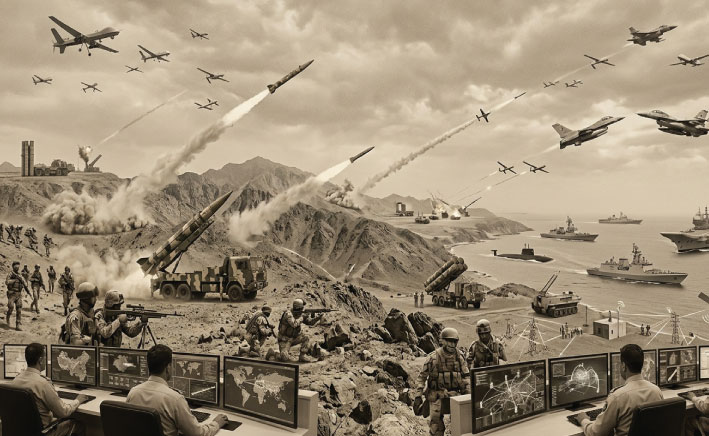
One year has passed since Operation Marka-e-Haq, a watershed moment in South Asian military history that fundamentally altered the regional deterrence paradigm. Launched in May 2025 as a multi-domain response to Indian military aggression, named “Operation Sindoor,” Pakistan’s counter-offensive, Operation Bunyanum Marsoos (Solid Structure), served as the decisive anchor of this broader strategic campaign. Triggered by the Pahalgam incident, the conflict evolved into one of the largest air engagements in modern history and the first documented “drone war” between two nuclear-armed states.
A Doctrinal Shift: From Punishment to Denial
The 2025 conflict effectively debunked the long-standing myth of India’s conventional superiority and its “new normal” doctrine of un-answered cross-border strikes. In its place, Pakistan validated its Full Spectrum Deterrence (FSD) through a Quid Pro Quo Plus (QPQ+) strategy. This marked a profound shift from “deterrence by punishment,” a model often reliant on escalatory retribution to a Pakistan-led model of “deterrence by denial.” This framework posits that stability in a nuclearized environment is best maintained by demonstrating the credible capability to deny an adversary’s objectives at every level of the escalation ladder.
Technological Frontiers: EDTs and Cyber Paralysis
The conflict was characterized by the intensive use of Emerging and Disruptive Technologies (EDTs). Pakistan’s utilization of indigenous loitering munitions and advanced electronic warfare (EW) proved pivotal, successfully disabling Indian surveillance clusters. In a staggering display of “hard and soft kill” capabilities, Pakistan neutralized over 70 Indian drones, including numerous Israeli-made Harop systems.
Simultaneously, the integration of Artificial Intelligence into Intelligence, Surveillance, and Reconnaissance (ISR) and command-and-control systems allowed for unprecedented operational tempo. Pakistan’s Cyber Command executed a sophisticated non-kinetic campaign that reportedly paralyzed 70% of India’s power grid and disrupted vital military communications. By synchronizing these cyber operations with kinetic strikes, Pakistan induced a state of “strategic paralysis” within the Indian war machine, targeting the digital and satellite infrastructure essential for modern counter-offensives.
Conventional Precision and the Army Rocket Force
A key kinetic component was the deployment of the Fatah-I (140 km range) and Fatah-II (400 km range) precision-guided missile systems. These conventional vectors allowed the Pakistan Army to strike 26 high-value military nodes including airbases and S-400 missile batteries with surgical accuracy. The establishment of the Army Rocket Force Command (ARFC) following the conflict institutionalized this capability, providing a robust non-nuclear long-range strike option that effectively raises the nuclear threshold.
Maritime and Information Dominance
At sea, the Pakistan Navy’s Anti-Access/Area Denial (A2AD) strategy forced the retreat of the carrier INS Vikrant, successfully pre-empting a potential naval blockade. Meanwhile, in the information domain, Pakistan’s “fact-versus-propaganda” approach secured a narrative victory, leading to India’s relative diplomatic isolation as the international community called for restraint.
The New Nuclear Flashpoint: Water Terrorism
A critical and dangerous dimension of the crisis was India’s unilateral attempt to hold the Indus Waters Treaty (IWT) in abeyance. This “water terrorism” posed an existential threat, prompting Pakistan to declare any interference with its water shares a casus belli (act of war). This development underscores that water has emerged as a primary “nuclear flashpoint” in the region.
Strategic Lessons for the Future
The legacy of Marka-e-Haq offers several vital lessons for regional stability:
- India must abandon the illusion of conventional superiority and recognize Pakistan’s proven resolve to defend its sovereignty.
- The “saffronization” of Indian military and foreign policy—which religiously sanctifies hostility—must be replaced with pragmatic, secular engagement to prevent miscalculation.
- Lasting peace remains unattainable without a just resolution of the Jammu and Kashmir dispute.
- There is an urgent need for dialogue on AI safety, cyber norms, and space transparency to manage “algorithmic warfare,” where decision cycles are compressed to seconds.
- Vital resource treaties, such as the IWT, must remain de-linked from political signaling to ensure regional survival.
Ultimately, Operation Marka-e-Haq demonstrated that a “Deterrence through Denial”combining military readiness with disciplined restraint, calibrated denial and international legal compliance can prevent South Asia’s “Doomsday Clock” from reaching midnight. The path forward lies in revitalized dialogue, conflict resolution of Jammu and Kashmir and credible measures to reduce the fragility of strategic stability in the nuclear age.
Author: Dr. Asma Shakir Khawaja, Executive Director, Center for International Strategic Studies, AJK.
