
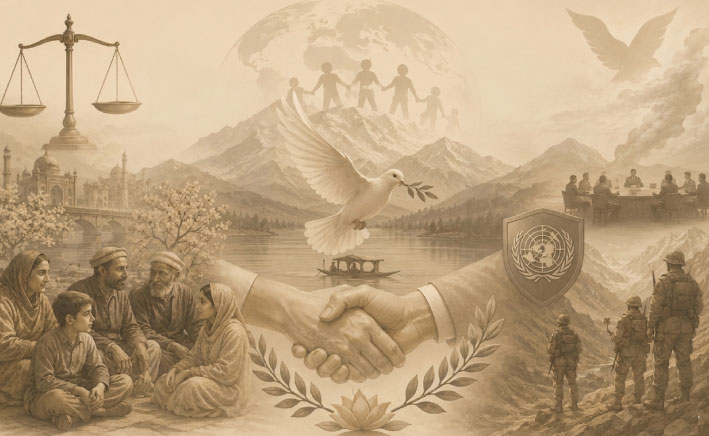
The Pahalgam incident of April 2025 intensified tensions between two neighboring nuclear countries. It was a deliberate attempt, launched by India, and designed to affect Pakistan’s position internationally, weaken the Kashmiriyat, the composite ethos of the region, and undermine the fundamental right to self-determination of the Kashmiri people.
This was not only a conflict involving weapons, but also a war of narratives, a digital struggle involving media, allegations, and perceptions, along with an attempt to isolate Pakistan internationally and link the freedom movement of Kashmir with terrorism.
The government of India, within no time after the incident, pointed fingers toward Pakistan without initiating a proper investigation. Indian media, which is also described as propaganda-driven and aligned with the ruling party’s narratives, began circulating false claims, audio clips, and fabricated videos to create confusion and also started to defame Kashmiris.
Kashmiris in Indian illegally occupied Jammu and Kashmir were subjected to collective punishment without investigation, based merely on suspicion. Their homes were demolished, they were harassed, detained, and beaten, not only in IIOJK but across India, for crimes they had not committed.
Pakistan offered a joint and impartial investigation, but India refused. The situation escalated further on 7th May 2025, when India initiated a military operation “Operation Sindoor”. India took this step without fully anticipating the consequences, assuming that it could harm Pakistan and Azad Jammu and Kashmir.
From 7 to 9 May 2025, India carried out attacks on different parts of Azad Jammu and Kashmir, and Pakistan destroyed Bilal Masjid and civilian infrastructure near the LoC in AJK, which created an atmosphere of fear. Meanwhile, the Indian media focused on broadcasting false claims that major Pakistani ports and other significant locations had been destroyed. Pakistan, on the other hand, responded with restraint and a strategic approach, warning India to halt what it described as reckless actions that could push both countries toward a nuclear war.
The Vice President of the United States, JD Vance, stated, “India and Pakistan should de-escalate tensions, but the U.S. cannot control the nuclear-armed Asian neighbors,” while U.S. President Donald Trump referred to the Kashmir dispute, the root cause of the conflict, as a “thousand-year-old issue.” Pakistan expressed recognition of international diplomatic initiatives towards crisis de-escalation, while India refrained from formally acknowledging the role of the United States.
Pakistan had also clearly stated that it would not accept any breach of its sovereignty, but India failed to give due weight to these warnings. Consequently, on May 10, 2025, Pakistan, in retaliatory measure to India’s “Operation Sindoor”, launched Operation “Banyan-Ul-Marsos” and taught India a lesson it would always remember.
Following this phase, the dynamics of the conflict began to shift. India pursued diplomatic outreach across multiple countries to consolidate international support; however, it faced challenges in securing clear endorsements against Pakistan, reflecting the cautious stance adopted by much of the international community.
This perspective highlights Pakistan’s emphasis on measured decision-making and adherence to its stated position. Furthermore, Donald Trump, the president of the United States, has continued to acknowledge and praise Pakistan’s approach.
Since partition, India has always been attempting to weaken Pakistan and has used Kashmir as a place where it has conducted a series of false flag operations, attributing them to Pakistan, considering this strategy successful for its own objectives. Furthermore, India has disregarded all bilateral agreements with Pakistan as well as United Nations Resolutions concerning the Kashmir conflict.
Pakistan has emphasized its position on Kashmir as a matter of self-determination and International Law. The people of Kashmir have consistently expressed a desire to be with Pakistan. India, on the other hand, through power and other brutal means, illegally occupied the region.
In the aftermath of the May crisis, India adopted more offensive measures to harm Pakistan. The Modi-led government took several aggressive measures through the Cabinet Committee on Security (CCS) in addition to these diplomatic offensives, which had a major influence on bilateral relations with Pakistan. The suspension of the Indus Water Treaty (IWT) marked a major escalation in the crisis. India did everything to harm and defame Pakistan, but the outcome was beyond India’s expectations.
India wanted to defame Pakistan, but Pakistan gained more fame throughout the international community because of its courageous, strategic, and diplomatic actions.
India has long attempted to link Pakistan with terrorism, but during the May crisis, Pakistan’s response and actions presented the world with a different picture. Pakistan has positioned itself as a proponent of peace. During the recent US-Iran crisis, Pakistan played a constructive role as a mediator and hosted peace talks in Islamabad.
India has often criticized Pakistan by claiming it is incapable; however, the May crisis demonstrated that actions speak louder than words. Despite India’s senseless claims, the global community has seen the developments that challenge this perception, particularly in terms of Pakistan’s defense capabilities and diplomatic and strategic approach.
Moreover, India refused to discuss Kashmir mainly after 2019, labeling it an internal matter and an integral part, but the Kashmir issue has once again gained international attention. The world recognizes this issue as a serious concern between two nuclear-armed countries. As a result, there is renewed pressure on India to resolve this issue.
The recent military conflict between these two South Asian neighbors is likely to have lasting consequences. It has been shown that lasting peace cannot be achieved through one-sided actions, coercive measures, or misleading narratives. Actual regional stability depends on addressing deep-rooted disputes such as Kashmir, upholding sovereignty, and pursuing genuine, credible diplomacy.
At the same time, the international community has an important role to play in a fair and balanced manner. Its focus should be on preventing escalations and supporting a structured path toward sustainable peace in South Asia and beyond.
Author: Saba Ghulam Nabi, Research Officer at the Center for International Strategic Studies, AJ&K
