
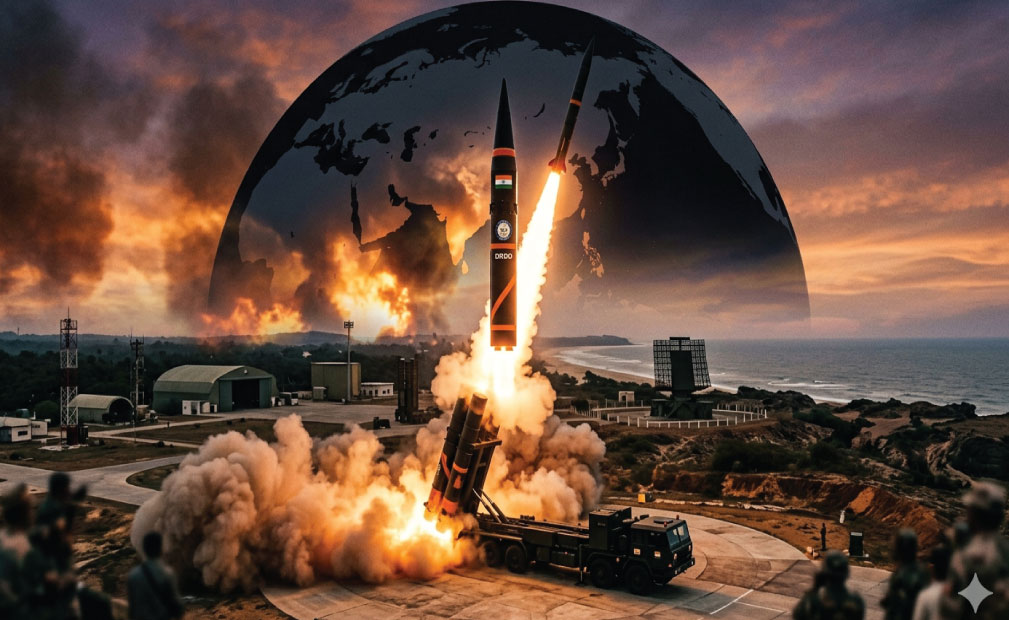
Indian DRDO Chairman recently claimed that India is all set to test its nuclear capable CBM Agni-VI with ranges estimated up to 12000 km with capability to carry multiple warheads. With these ranges, India has the capability to reach not just China, Middle East and Europe but also West, United States and Canada. This kind of threat to the US/ West came from erstwhile Soviet Union and then from Russia and China. Third in the que, India imposes a grave threat to deliver a nuclear weapon all the way to the US/Canada/West.
Notably Agni-VI has intercontinental range, estimated at 10,000–12,000 km, which would place much of Asia, Europe, and parts of North America within India’s reach. In strategic terms, this significantly expands India’s deterrent envelope and reduces the possibility that any adversary could believe it has sanctuary from retaliation. A missile with multiple-warhead would increase survivability and penetration potential against advanced missile defenses. Nuclear strategy is often about convincing opponents that retaliation will be certain and unacceptable. Agni-VI strengthens India’s second-strike capabilities, signalling her capacity to respond after absorbing a first strike.
Agni-VI also contributes to the geopolitical status and prestige driven strategy of India. In international politics and security structure, missile programs and capability are not only signal military power but it is a symbol of the intent and strategic manifestation. A system of this range places India in a small club of states with intercontinental delivery capability, reinforcing its image as a revisionist power rather than a regional actor as claimed by Indian policy makers. Moreover, this capability can translate into diplomatic weight, especially in arms control debates, export controls, and strategic partnerships.
Indian policy makers cannot ignore the India’s record as a responsible state actor. They should realise that greater capability needs more accurate and effective command and control system otherwise, the capability would become a strategic burden and could generate greater instability. A missile with inter-continental reach may be intended for deterrence, but it can also be interpreted as evidence of more ambitious strategic intent, and should be perceived as a sign of expanding coercive capacity. In nuclear affairs, perception is often as important as doctrine.
Long-range nuclear systems do not exist in isolation; they operate within doctrines, command structures, political rhetoric, strategic ambitions and military signalling environments. Hyperactive nationalist rhetoric or confrontational messaging by Indian leadership would lower the threshold for escalation, even if formal doctrine remains restrained resulting into crisis escalation. The more assertive the political climate, the more a powerful missile can be read as a tool of aggression rather than deterrence.
India’s stated doctrine of credible minimum deterrence and retaliation has historically projected restraint, but this development of more sophisticated systems with longer reach may appear inconsistent with the “minimum” part of that doctrine leading to strategic ambiguity. This can weaken doctrinal clarity and create uncertainty among both domestic and foreign audiences. Strategic ambiguity may provide flexibility, but it can also erode confidence in restraint while multiplying probabilities of escalation.
Agni-VI allows India to strengthen strengthens its strategic relocation vis-à-vis west. As it no more be relying solely on shorter-range systems that may be vulnerable to pre-emption or interception. In a strategic environment marked by border tensions, naval competition, India’s prestige driven strategic ambitions and broader Indo-Pacific rivalry, a long-range survivable system enhances India’s bargaining position as a revisionist state. India could use the development of advanced strategic forces to redefine its nuclear posture, with poor command-and-control safeguards, signalling offensive revisionism.
In a nuclear South Asia, even conventional operations can carry escalatory risk because opponents may interpret military moves through a nuclear lens. If India is simultaneously fielding more advanced nuclear systems and conducting assertive conventional operations, adversaries may perceive a broader pattern of brinkmanship. That makes miscalculation more likely while endangering the world peace and stability.
A 12,000 km-range nuclear-capable missile is not just a regional matter. It will be read in Washington, Moscow, Beijing, Paris, Toronto and London as a strategic signal. This capability itself changes how India is categorized in global security discourse. It can trigger concerns about arms racing, strategic duplication, and the erosion of non-proliferation norms.
With acquiring more capable systems, India’s nuclear program should be understood in terms of warfighting rather than deterrence. India would not only abandoned restraint, but it has shifted toward more coercive and aggressive strategic posturing. This is especially concerning if nationalist politics elevate military power as a tool of ideological assertion. It is considered as doctrinal slippage. India’s long-range missile systems are evidence that deterrence is moving beyond South Asia, an act of counterbalancing strategy. Either reaction can fuel arms modernization and reciprocal posturing. Even if Agni-VI is not aimed at immediate use, it can still contribute to regional arms competition.
Agni-VI should be read through the logic of deterrence theory, but with an important caveat that deterrence depends not only on capability but also on credibility, communication, and restraint. A missile of this range enhances India’s retaliatory reach and supports second-strike survivability. At the same time, it enlarges the strategic shadow India casts over the international system.
The classical deterrence model suggests that states build such systems to prevent coercion, not to invite war. Yet offensive realism reminds us that states often pursue capabilities that increase their relative power, even under the language of defense. That duality lies at the heart of the current debate over Agni-VI. It signals India’s changing strategic ambitions. Her military program is not threat based but founded on strategic ambitions. Here is question arises that which state in the west poses existential threat to India? If the answer is “none,” then why India intends to coerce them? Especially when Indian foreign minister while using undiplomatic language has threatened west on several occasions. For example in 2022-23 Indian EAM, Mr. Subrahmanyam Jaishankar explicitly rejected Western pressure to halt Russian oil imports, arguing that European nations, could not dictate terms to India, asserting that Europe’s problems are not the world’s problems. In June 2025 while speaking at Brussels, he stated that India would not accept lenient Western attitudes toward regional terror, highlighting a direct critique of Western policy in South Asia. In January 2026 during the visit of Polish officials to New Delhi, Jaishankar advised them and EU against fueling regional terrorism and criticized trade sanctions against India as “selective targeting,” reinforcing India’s refusal to align with Western foreign policy constraints. Not to ignore the statement by Mr. Rajnath Singh, Indian Defence minister, that India has “shifted from a defensive to a proactive” security posture. West should realise that wars begin not only from hostile intent but from misread intentions, flawed signaling, and overconfidence. That is why the combination of conventional assertiveness and expanding nuclear capability is so consequential.
Agni-VI is not simply a missile program; it is a strategic inflection point. Its strengths India’s offensive credibility, second-strike assurance, and revisionist agenda. Its weaknesses lie in flawed nuclear command and control, reduced space for decision-making processes, cognitive biases, poor perception management, doctrinal ambiguity, and escalation risk. The world cannot trust India even with BrahMos missile system, which was fired on Pakistan in 2022. Later India declared it an “accident.” However, no further evidences were presented in this regard. Everyone knows the cost of such act between two hostile nuclear states. Can the West afford any “accidental,” launch of Agni VI to their capitals?
Author: Dr. Asma Shakir Khawaja, Exective Director, Center for International Strategic Studies, AJK. The views expressed are of her own.
