
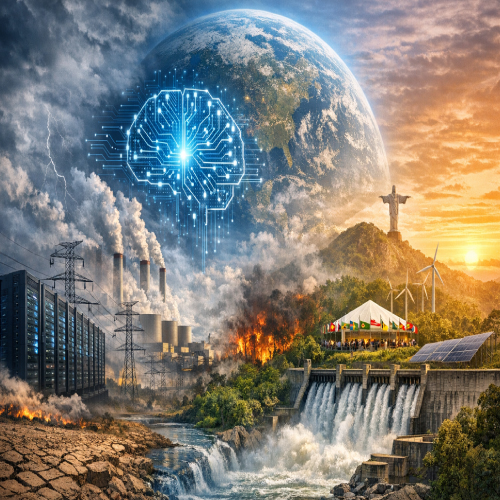
Chris Miller once wrote in Chip War that “the rivalry between the United States and China may well be determined by computing power,” and for a decade that idea seemed to orbit around chips, fabs, supply chains, export controls. It felt obvious that the future would be won inside cleanrooms. But as Jensen Huang warned, AI “will be limited not by chips, but by electricity,” and this warning hangs heavily over COP30, which is going on in Brazil. At COP30 in Brazil, delegations are working to accelerate global climate action.
Yet, at the same time, a new dynamic is emerging, where electricity itself is becoming the decisive resource that could determine who wins the AI race. When the competition for winning AI race depends on electricity, not just semiconductors, the global transition to clean energy might become harder. And in many regions, the pursuit of more electricity could slow the transition toward green energy and deepen stresses on water systems already under pressure, and accelerate water conflicts.
During COP30, AI emerged as an important topic and attracted a wide range of perspectives. Some delegates insist AI will strengthen climate action by improving energy forecasting, stabilizing grids, and detecting methane leaks. Others warn that its growing appetite is outpacing global decarbonisation.
The International Energy Agency reports that data center electricity use may more than double by 2030 to around 945 terawatt hours, a total “slightly more than the entire electricity consumption of Japan today.” DNV’s 2025 Energy Transition Outlook projects that data centers could quintuple to 5 percent of global electricity by 2040, with AI alone consuming 3 percent. North America may see data centers reach 16 percent of all power demand by 2040. These numbers do not sit comfortably beside climate deadlines.
The AI race itself has become explicit. The United States stated in its 2025 AI Action Plan that “the United States is in a race to achieve global dominance in artificial intelligence,” and added that whoever leads “will set global AI standards and reap broad economic and military benefits.” China expressed the same ambition years earlier. The State Council instructed the country “to seize the major strategic opportunity for the development of AI” and to pursue a “first mover advantage” in global science and technology. Both countries now treat AI not as a sector but as a building block of national power.
And this is where electricity becomes the new strategic currency. Because advanced AI systems do not simply need chips. They need enormous, steady, affordable power, and the ability to scale data centers at industrial speed.
China enters this phase with significant capacity. According to Goldman Sachs, China will likely have 400 gigawatts of spare electricity by 2030. This is three times more than the electricity needed to run the entire global data center fleet. After energy shortages in 2021 and 2022, China ramped up coal, solar, wind, and nuclear generation at a speed that left many analysts surprised. Goldman’s analysts said that “China’s spare capacity will remain sufficient to accommodate growing power demand.” This abundant electricity gives China the ability to build AI infrastructure on a massive scale. And when infrastructure scales, the cost of building and running AI systems tends to fall.
This is already visible in parts of China’s AI ecosystem. Moonshot AI’s Kimi K2 Thinking model, trained for roughly 4.6 million dollars, reached second place in global intelligence rankings and outperformed OpenAI in certain complex tasks. A partner at Menlo Ventures called it “a turning point in AI.” Jefferies analysts found that Chinese hyperscalers spent 82 percent lesson capital investment between 2023 and 2025 than their US counterparts. China’s capacity to scale data centers cheaply is becoming strategically important, even if electricity is only one part of that ecosystem.
The United States faces tighter constraints. Data centers already consume 6 percent of national electricity. Eight of thirteen regional grids operate at or below critical spare capacity. McKinsey estimates US data center demand will reach 35 gigawatts by 2030. All announced AI facilities worldwide would consume as much electricity as 44 million American households. And US data center demand may reach 8 percentof national power by 2030. Although current US administration does not follow climate goals; however, for the future administrations these tensions complicate climate goals and force policymakers to decide whether AI expansion or fossil fuel retirement should take priority in certain regions.
The challenge becomes global. As countries compete to build AI infrastructure, many will seek the cheapest and most reliable electricity available. In dozens of regions that often means hydropower. Dams provide steady, affordable energy, making them attractive for AI data centers. But dams also sit at the center of water politics that are already worsening. For instance, China’s construction of what could become the world’s largest hydropower project on the Yarlung Zangbo illustrates how energy, AI, and water can become intertwined. And similar dynamics are unfolding in several continents where states seek more electricity faster than renewables can supply.
The world is entering this moment with water systems already under immense stress. The Pacific Institute’s Water Conflict Chronology records over 1,900 violent incidents linked to water. Nearly 90 percent occurred after the year 2000. Between 2012 and 2021, the world saw roughly four timesmore water-related conflicts than 2000 to 2011. In 2023, violent water incidents surged 50 percentover 2022. And 2022 itself had almost twice as many cases as the previous year. Rivers are becoming chokepoints for geopolitical tension, and if AI pushes nations toward more hydropower, the pressure may intensify across the Andes, the Nile Basin, the Mekong, Central Asia, South and parts of Africa.
The climate research community adds its own warning. A study by Bonfiglioli et al. (2025), analysing twenty years of US data, found that regions with higher AI penetration experienced much slower reductions in carbon emissions. In some cases emissions fell 37 percent less than they would have without AI expansion. The reason was straightforward. To meet the constant load required by data centers, power plants in those regions shifted from renewables to fossil fuels. Proximity to data centers pushed grids toward more carbon intensive generation.
It is not surprising that climate groups at COP30 describe AI as “a completely unregulated beast.” They note that AI’s water consumption for cooling threatens regions already suffering from drought. They also argue that if AI continues expanding without guardrails, it risks derailing national climate commitments. Yet COP30 has also produced cautious optimism. Delegates from smaller nations described how AI tools helped them “level the playing field” in negotiations. Others highlighted new AI systems that model coastal erosion, predict crop failure, track deforestation, and improve disaster preparedness. The IEA notes that AI can “accelerate innovation in energy technologies such as batteries and solar PV.” AI, in that sense, can amplify the climate transition if the electricity beneath it is made cleaner.
And this is an important point. AI magnifies whatever energy system it sits on. If the system is carbon heavy, AI will slow climate goals. If the system becomes cleaner and more resilient, AI could strengthen climate progress rather than complicate it.
The global AI race is shifting from chips to electricity. This shift will make the climate transition more challenging and can intensify water conflicts in regions dependent on rivers for energy. But it does not have to undermine climate efforts. Nations can still act together to regulate data center footprints, accelerate renewable deployment, invest in nuclear and small modular reactors, improve water governance, and create electricity standards for AI infrastructure.
The hope lies in realising that the AI race and the climate race can no longer be separated. If countries build cleaner power systems for AI, they can protect the planet at the same time. The window is narrowing, but it is still open.
Author: Nimra Javed is a Research Officer at the Center for International Strategic Studies AJK, working on emerging technologies and holds an MPhil Degree in Strategic Studies from National Defence University Islamabad, Pakistan.
