
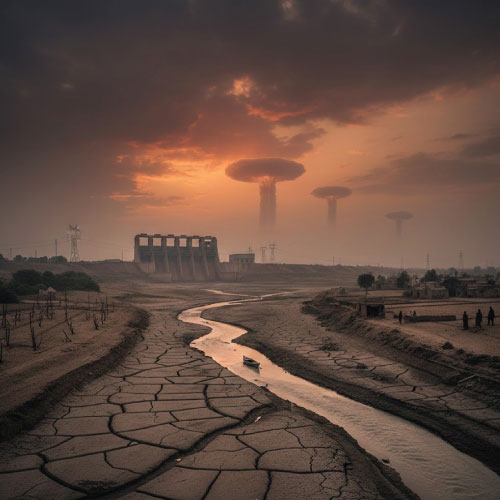
India’s decision to suspend the Indus Waters Treaty is a sign of a strategic rupture, one that directly threatens regional peace and stability in South Asia. For over six and a half decades, this water-sharing framework, brokered by the World Bank in 1960, stood as a rare and resilient example of cooperation between two nuclear-armed rivals. Even amid full-scale wars and frozen diplomacy, the IWT remained untouched, offering a thin but vital thread of continuity. With India now putting the treaty in abeyance, that thread has been severed.
The strategic calculus behind this move cannot be divorced from its implications. Indus River Basin is like the cardiovascular system for Pakistan. Nearly 80% of Pakistan’s agriculture, which accounts for roughly 25% of its GDP and employs close to 65% of the labor force, depends directly on the waters governed by the treaty. The country’s food security, rural livelihoods, and industrial base are all anchored to these flows. The treaty allocated roughly 80% of the Indus Basin’s waters (approximately 135 million acre-feet annually) to Pakistan, recognizing its status as the lower riparian. In a region where climate variability is accelerating and freshwater sources are dwindling, this allocation is existential.
India’s suspension of the treaty undermines that equilibrium. Already, reports from Pakistan’s Indus River System Authority (IRSA) indicate a 21% shortfall in water availability for the 2025 kharif season which will impact water-intensive crops like rice, cotton, and sugarcane. These shortages are not coincidental; they correlate with India’s upstream storage activities and changes in data-sharing behavior. With India ceasing transmission of critical hydrological data that it has traditionally shared—such as daily river flows and seasonal variations—Pakistan is left in the dark, unable to anticipate or plan for floods, droughts, or seasonal surpluses.
Beyond agriculture, the energy dimension is equally alarming. Hydropower constitutes about 30% of Pakistan’s total electricity generation. The flow regulation from Indian-controlled infrastructure such as the Baglihar and Kishanganga dams already reduced downstream water availability during critical months. In the short term, this may force Pakistan to pivot back to expensive thermal energy, increasing fuel imports and widening its fiscal deficit. In the longer term, the economic consequences could shave off up to 2% of GDP annually, according to some estimates by regional economists.
The legal implications are just as profound. The Indus Waters Treaty is a binding international agreement, rooted in the principles of the Vienna Convention on the Law of Treaties, which emphasizes that pacts must be honored (pacta sunt servanda). India’s unilateral decision to suspend it without exhausting the arbitration clauses, especially Article IX which provides for third-party mediation, violates this norm. It sends a dangerous signal—not just to Pakistan, but to the world—that international water-sharing agreements can be politicized or revoked at will.
But what makes this crisis even more volatile is the military context. By converting water into a tool of coercion, India has effectively moved it from the realm of hydro-diplomacy into the domain of hybrid warfare. Water infrastructure, once viewed as neutral territory, is now seen through the lens of tactical advantage. For Pakistan, any disruption to its water flows, especially in a war-like scenario, is a red line. Historically, even during the wars of 1965 & 1971, Kargil conflict in 1999 and the post-Pulwama standoff in 2019, both states kept the treaty intact. That red line is now blurred, and with it, the risk of unintended escalation increases manifold.
In the event that Indian water aggression escalates into a full-blown conflict, the nuclear angle of the conflict cannot be ignored. Both India and Pakistan are nuclear-armed states with doctrines that have historically attempted to maintain deterrence and strategic stability. However, the weaponization of water—a critical existential resource—could erode the thresholds that have traditionally prevented escalation. For Pakistan, a lower-riparian state heavily dependent on Indus waters, deliberate manipulation or suspension of river flows may be perceived not just as a hostile act, but as an existential threat—thereby invoking the logic of “existential deterrence.” Pakistan’s full-spectrum deterrence posture, under the aegis of its credible minimum deterrence policy, includes the potential deployment of tactical nuclear weapons in response to overwhelming conventional or hybrid threats. On the other hand, India’s evolving nuclear doctrine, which has shown increasing ambiguity on its No First Use (NFU) policy, further destabilizes the deterrence equilibrium. Any miscalculation or attempt at coercion through water denial could spiral into military mobilization along the border, prompting a high-alert status of nuclear command and control systems. The short decision-making timeframes, geographical proximity, and absence of robust crisis management mechanisms significantly heighten the risk of inadvertent escalation. In such a scenario, what begins as a dispute over water infrastructure could metastasize into a catastrophic nuclear exchange, with devastating consequences not just for the belligerents but for the broader South Asian and global environment.
The regional ramifications extend beyond India and Pakistan. China, as the upper riparian of the Indus River through its control over Tibet, is watching this development closely. India’s current behavior could invite reciprocal measures in the Brahmaputra Basin, where China holds similar upstream leverage. Moreover, South Asia already suffers from fractured regionalism, SAARC remains dormant, and trust among neighbors is in short supply. Undermining the IWT further erodes confidence in multilateral mechanisms and deepens the perception that bilateralism is a zero-sum game.
Climate change only compounds the crisis. In 1947, Pakistan had over 5,600 cubic meters of freshwater per capita annually; that figure has now plummeted to below 900 cubic meters—well below the water-scarcity threshold defined by the UN. Glacial retreat, erratic monsoons, and rising temperatures are already placing unprecedented pressure on the Indus Basin. The absence of a stable and cooperative water-sharing mechanism in such an environment is not just reckless—it is perilous.
To be clear, the World Bank has mechanisms to facilitate dispute resolution under the treaty. But India’s posture seems to preclude third-party mediation, especially under the current government’s muscular foreign policy framework. Without international pressure or regional diplomacy, this issue could fester into a chronic point of friction.What we are witnessing is not just a legal or hydrological dispute, it is a strategic shift with cascading consequences. The Indus Waters Treaty was not merely about rivers; it was about restraint, recognition, and responsibility. It is about catering the food security needs of 1.6 billion people of India and Pakistan. Its suspension by India means a shift towards brinkmanship, where even the most basic element of life—water—becomes a battleground.
If the region does not act with urgency and if diplomacy does not match the magnitude of the moment, South Asia may be pushed toward a future where rivers no longer connect civilizations, but divide them irreparably.
Author: Abdul Rehman, Research Officer, CISS AJK.
