
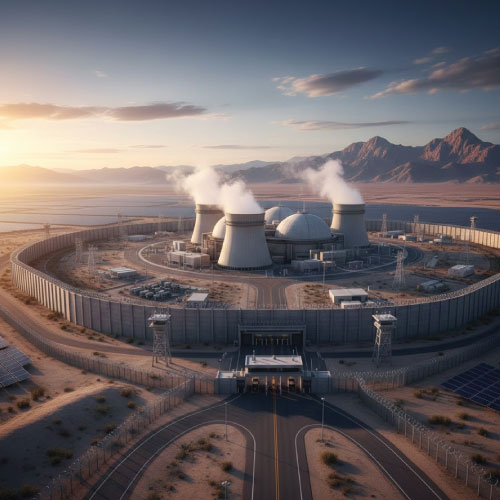
Pakistan regards nuclear security as a core duty of the state, integral to national resilience and public safety. Over time, it has built a disciplined nuclear safety and security architecture aligned with IAEA guidance and widely accepted international practices. A coherent body of legislation and regulation governs nuclear material, other radioactive sources, and all related facilities and activities from use to transport and storage. Independent oversight rests with the Pakistan Nuclear Regulatory Authority, which sets physical protection requirements, ensures compliance, and ensures flawless regulation through training, inspections, and periodic updates. This framework projects responsibility, credibility, and readiness against evolving threats.
PNRA’s regulatory framework operationalises nuclear safety and security through phased licensing, preventive site evaluation, defence-in-depth design requirements for nuclear power plants, continuous operational oversight, mandatory emergency preparedness, and enforceable inspection mechanisms that show the same institutional safety architecture promoted by the IAEA. Fair access to civilian nuclear energy is a legitimate right of every state, but it is never an unconditional entitlement. Because nuclear technology carries exceptional risks alongside its benefits. Thus, IAEA places greater emphasis on the establishment of an independent, competent regulator empowered to set licensing requirements for facilities, ensure inspection compliance, and enforce corrective actions.
Therefore, PNRA treats site evaluation as a decisive licensing threshold for nuclear installations, requiring evidence-based appraisal of external hazards such as seismic activity, flooding, meteorological extremes, geotechnical stability, and surrounding population patterns. This mirrors the IAEA approach, which frames site-related hazards as a primary safety determinant and requires that risks be identified, quantified, and shown to remain within defined safety margins before construction approval. The regulatory effect is to move safety to the front end of decision making, where unacceptable risk is avoided through informed site selection rather than managed later through compensatory engineering. In doing so, PNRA operationalises the IAEA’s preventive safety logic across the facility lifecycle.
Consistent with IAEA safety standards, PNRA treats nuclear safety as an obligation enforced through clear regulatory gates. Site evaluation functions as the first threshold, requiring a documented, evidence-based characterisation of external hazards and demographic factors so that unacceptable risk is avoided through prudent selection, not postponed for later mitigation. PNRA’s design regulation operationalises IAEA design principles by mandating defence in depth, redundancy, diversity, multiple barriers, design basis accident analysis, and protection against internal and external hazards, with construction barred until the design shows that no single failure can produce unacceptable consequences. Operational regulation extends the same logic into routine practice through Operation Limits and Conditions (OLCs), surveillance and testing, competent staffing, safety culture, and periodic safety reviews, making continued operation contingent on sustained compliance and performance.
PNRA’s operational safety regime treats safety as a continuing licence condition rather than a one-time authorisation. Plant operation remains contingent on sustained compliance with operational limits and conditions, disciplined maintenance, surveillance and testing, competent staffing, and an embedded safety culture supported by effective management systems. Routine regulatory inspections and periodic safety reviews ensure that operational experience, ageing effects, and updated safety knowledge are systematically incorporated into day-to-day practice.
Consistent with IAEA standards, PNRA embeds emergency preparedness, safety assessment, enforcement, and security as core regulatory functions rather than optional adjuncts. Emergency readiness is institutionalised through operator-led on-site plans, coordinated off-site arrangements with civil authorities, a graded emergency classification system, routine drills, and defined public protection measures, including communication, sheltering, and evacuation.
Regulatory decisions are then anchored in documented safety analysis, notably through Safety Analysis Report requirements and deterministic assessments that apply conservative assumptions and acceptance criteria, followed by independent PNRA review and mandated corrective actions.
Compliance is verified through routine and reactive inspections, with findings tracked to closure and backed by authority to impose conditions, restrict activities, or suspend licences. Finally, the safety security interface is reinforced through PNRA’S security regulations, such as PAK/925 and PAK/926, which require graded physical protection and threat-informed planning as licensing conditions, thereby integrating protection against theft, sabotage, and unauthorised access into normal regulatory oversight.
A central strength of PNRA’s regime is phased licensing, which releases authorisation in sequenced stages, including site, construction, commissioning, and operation, each contingent on verified safety assessments, inspections, and closure of regulatory findings. This approach aligns with the IAEA conception of licensing as an instrument of regulatory authority rather than a procedural formality. By tying permission to continuing compliance, PNRA converts safety and security requirements into enforceable operating conditions. Where deficiencies arise, the regulator can impose additional licence conditions, restrict activities, or suspend authorisation, thereby creating credible incentives for sustained performance. In effect, licensing constrains operational discretion until obligations are demonstrably met, embedding oversight within routine facility governance.
Pakistan’s improvement in the NTI Nuclear Security Index is most credibly read as the outcome of regulatory consolidation under the PNRA, rather than a persuasive narrative. NTI identified Pakistan as the most improved state among countries with weapons usable nuclear materials, attributing the gain to newly adopted on site physical protection and cybersecurity regulations, alongside strengthened insider threat measures. PNRA operationalised this direction through enforceable rules, notably PAK/925, which applies across physical protection of nuclear installations and nuclear material in use, storage, and related activities.It extended the same compliance logic to the radiological domain through PAK/926, which establishes mandatory security requirements for radioactive sources, consistent with IAEA oriented expectations for source security.
Author: Sana Ahmed is an MS scholar at the Center for International Peace and Stability (CIPS), NUST, and a researcher at the Islamabad-based independent think tank Strategic Vision Institute (SVI).
