
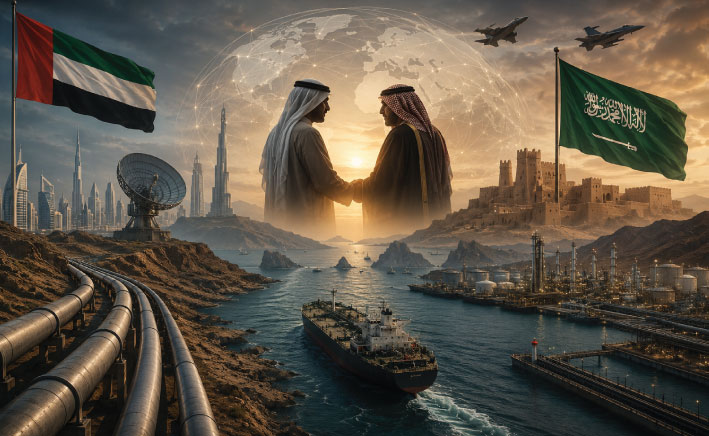
On Friday, UAE Crown Prince Sheikh Khaled bin Mohamed bin Zayed announced the acceleration of the West-East Pipeline project to “meet global demands” during an ADNOC executive meeting. The announcement came weeks after the UAE withdrew from OPEC. The country is fast tracking a new pipeline that will double export capacity through the eastern port city of Fujairah, bypassing the Strait of Hormuz. The UAE has long sought to pump above its OPEC quota, and now it can. But reading this solely as a dispute over barrels misses the bigger picture. At its core, the exit is about status. For decades, the UAE operated within a Saudi led Gulf framework, with Riyadh setting the tone on oil policy and regional security, treating Abu Dhabi as a capable but junior partner. The OPEC withdrawal and building of the pipeline that surpasses Strait of Hormuz is partly a rejection of that dynamic, an attempt by the UAE to assert itself as a Gulf middle power on equal footing with Saudi Arabia rather than beneath it.
The current conflict has sharpened that calculation considerably. The war has exposed real vulnerabilities in the UAE’s position. Its energy infrastructure has faced disruption, and the broader instability of the Gulf has underlined a risk that Abu Dhabi has long understood intellectually but now faces in practice, which is that proximity to the Strait of Hormuz is as much a liability as an asset. In this way, UAE has become more vulnerable to the economic pitfalls of the conflict, as its service-based, business-oriented, and foreign-invested economy faces grave challenges, so much so that analysts have started to question whether it can ever return to its pre-war sustainability. In this way, for UAE, more oil production would act as factor to keep the economy running and growing. This makes its oil shipment more crucial than ever for the country, however, being Hormuz dependent would be a great hindrance in this regard, as it also has the potential to remain under Iranian control, and any state whose exports depend entirely on passing through it is would never be able to build a sustainable economy.
The UAE’s strategic investment in the Fujairah refinery complex and the Abu Dhabi Crude Oil Pipeline (ADCOP) has evolved from a farsighted contingency to country’s relevance in the international energy market. As regional tensions continue to shadow the Strait of Hormuz, which the transits of roughly one-fifth of the world’s liquid energy, the UAE’s ability to bypass these waters has provided it an edge over other oil producing gulf nations. While neighboring states remain geographically locked within the Persian Gulf, the UAE’s bypass route to the Gulf of Oman allows for the export of up to 1.8 million barrels per day, effectively insulating a significant portion of its production from maritime blockades or regional volatility. This infrastructure does more than just secure national revenue; it positions Abu Dhabi as a resilient sovereign actor capable of maintaining energy flows to the Indian Ocean and beyond, even when traditional arteries are contested. Ultimately, the Fujairah complex serves as a unique “insurance policy” that fundamentally alters the strategic calculus of Middle Eastern energy security, offering a level of maritime flexibility that no other Gulf state currently holds to the same degree.
The ambition, however, goes beyond insurance. Abu Dhabi wants to be a significant player in the international oil market on its own terms, not as a member of a cartel managing collective output, but as an independent producer with the infrastructure, the partners, and the political relationships to set its own course. Leaving OPEC removed the last formal constraint on that. The UAE can now price, produce, and contract as it chooses, and its Fujairah position gives it the logistical credibility to do so from a location that the market regards as reliably accessible.
That ambition of UAE to become a middle power has been building for some time. The Abraham Accords, signed in 2020, were an early marker of it. Abu Dhabi gained direct access to American political capital, to Israeli defence and technology networks, and to a bilateral relationship with Washington that it did not have to share with Riyadh. Saudi Arabia’s reluctance to join the Accords was not simply about domestic politics or the Palestinian cause. It was also a recognition that the UAE was using the Accords to build a separate lane, one that gave it leverage in Washington independent of the broader Gulf relationship with the United States.
The war has reinforced that tendency. Rather than pulling back and hedging its bets, as a more cautious state might, the UAE appears to have concluded that the moment calls for deeper alignment. The direction it has chosen is toward Washington and Tel Aviv, and the logic, while not without risk, is coherent. It feels that it needs political and security patronage that would make it a sustainable place in a region marred by instability. The aspirations that used to be concealed before have been revealed by the vulnerabilities that UAE faced by war.
It is here that the comparison with Israel becomes relevant, and it is a comparison that Abu Dhabi is unlikely to make publicly but that almost certainly shapes its thinking. Israel’s relationship with the United States is qualitatively different from any other American partnership in the region or in the world. It involves technology transfer, deep intelligence sharing, political cover in international forums, and a degree of security commitment that has historically been unconditional in ways that American relationships with Arab states have not. The UAE appears to be working toward something closer to that model. Whether Washington is prepared to offer it on anything like those terms is a different question, but the direction of travel in Abu Dhabi’s diplomacy through the Accords, through the currency swap arrangement, through its defence procurement, the Israeli Prime Minister’s visit amid the war with Iran, and Israel’s provision of a sophisticated air defense system to the UAE, and through its open alignment with American and Israeli narrative suggests that this is what it is reaching for.
That said, the US has not been straightforwardly helpful to any of the Gulf states in terms of protection against Iran. Ironically, American bases, which were there to protect them in the first place, were damaged to a great extent by Iran. Moreover, the US’ approach to the region has been transactional in a way that complicates long-term security planning. The GCC countries have historically relied on American security guarantees, but the US tendency to treat relationships as deals to be renegotiated leaves its partners uncertain about what they are actually getting. The UAE’s bet on Washington and Tel Aviv may reflect genuine strategic alignment, but it carries real risk if the United States does not deliver on what Abu Dhabi expects in return, since security would remain its biggest concern after all. Without sound security, even alternative pipelines would be of little use, and energy and other infrastructure would always remain under threat.
The broader Gulf picture is similarly complicated. The GCC states do not have a common position on most of the region’s defining questions. On Iran, the divergence is striking. Oman has consistently sought a framework that brings Tehran in rather than shuts it out. The UAE’s posture has leaned toward deterrence. Saudi Arabia and Qatar want to find a middle ground. The result is that the GCC approaches Iran not with a single strategy but with several competing ones.
That division matters because the Iranian adversial relationship with US and Israel cuts to the heart of what all Gulf states actually need from any regional settlement. Freedom of navigation through the Strait of Hormuz is, for all of them, a more immediate and practical concern than any other issue in the region. A deal negotiated without meaningful GCC input, and that leaves Iranian leverage of controlling of the strait unresolved, would not address the core vulnerability these states share. The fear, which is well founded, is that the major powers will negotiate among themselves and that Gulf concerns will not be reflected in whatever arrangement emerges. Therefore, how the post war regional security arrangement turns out to be would matter.
None of this resolves neatly. But it does point toward one underlying reality that the current competition tends to obscure. The Gulf states are neighbours, and they cannot change that. Whatever their differences, they share geography, economic interdependence, and the basic vulnerability of living in a region where external powers have interests that do not always align with theirs. External partners, can provide them ‘support’ of various kinds, but they operate from different strategic worldviews and carry their own constraints. At some point, and probably sooner than the current moment of competition suggests, the Gulf states will need to find ways of dealing with each other and with Iran that reflect the basic fact of proximity.
Author: Moneeb Mir, Associate Research Officer, Center for International Strategic Studies, AJK.
