
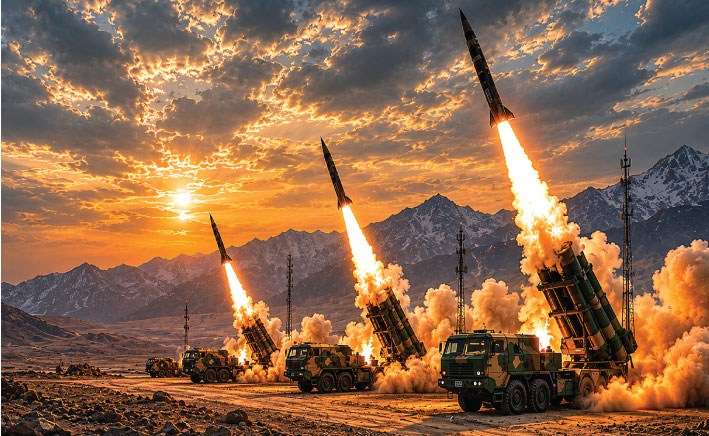
The nuclear balance in the South Asian subcontinent is not merely another instance of deterrence theory in practice; it is a structurally unique and perilous paradigm shaped by geography and Indian strategic culture. Unlike the transcontinental standoffs of the Cold War, where oceans and thousands of kilometres afforded decision-makers time to detect, deliberate and de-escalate, India and Pakistan face one another at a distance measured in hundreds of kilometres. New Delhi and Islamabad lie roughly 687 kilometres apart. That simple fact compresses warning times, shortens escalation pathways and radically reduces the margin for error.
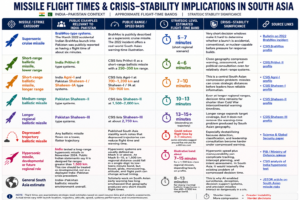
Proximity is not an abstract handicap. It places core political command-and-control nodes, state capitals, military headquarters and strategic assets, well within the operational envelope of short and long-range delivery systems. Theatre ballistic missiles can reach critical targets in 180–300 seconds. Cruise missiles and tactical systems further made it difficult for decision makers to identify well in time if the attack is conventional or not. In such a compressed timeline due to geography, technology and preparedness, the calculus of decision-making changes from hours and days to seconds. The psychological pressure on leaders to assume the worst and act pre-emptively is therefore far greater than those nuclear powers separated by oceans.
This dynamic creates several interlocking dangers. With C2 nodes and political leaderships within reach, the temptation to seek quick, disabling strikes during crises increases first-strike vulnerabilities and raises the risk of catastrophic miscalculation. The dual-capable delivery systems introduce acute target-discrimination problems. Ground-based radars and telemetry offer little reliable means to distinguish conventional from nuclear payloads in flight; absent comprehensive, space-based infrared warning systems, the verification window is narrow and fragile.
Operational failures exemplify these risks. The BrahMos cruise-missile launch 2022 that crossed into Pakistani airspace exposed critical institutional gaps. Without automated, real-time verification and robust crisis protocols, escalation avoidance depended on operational restraint and ad hoc communications rather than tested and reliable mechanisms. In a situation where seconds matter, underused hotlines and narrowly framed confidence-building measures magnifies strategic vulnerabilities.
South Asia is densely populated; urban centres, industrial hubs and critical infrastructure lie in easy striking range of forward-deployed forces. Even a small nuclear exchange could kill millions and carry catastrophic climatic effects, destructive of the habitat and livelihood of millions more. Geographical proximity has the potential to convert limited clashes into potential catastrophes.
Comparative frameworks help explain why South Asia cannot simply import Cold War answers. Europe and the U.S. and Soviet military competition evolved with geographic buffers and developed layered arms-control institutions, treaties, verification regimes and crisis communication channels that, imperfect as they were, created time and institutional pathways for de-escalation. South Asia lacks comparable, functioning mechanisms. Existing measures between Pakistan and India include exchange of annual list of nuclear facilities, missile-test notifications, an accord on reducing accident risks (2007) and a hotline but they are limited in scope and underutilised.
Geography also reshapes third-party incentives. External actors such as China, the United States, Russia, Gulf states etc have influence, but their interventions are constrained politically and strategically. Public mediation can backfire when it collides with India’s insistence on bilateralism and simultaneously refusal to hold bilateral talk or when great-power exhortations are seen domestically as external interference. Hence, proximity does not only compress time; it reconfigures the politics and space of outside engagement.
What then should policymakers in the region and the international community do? South Asia needs bespoke risk-reduction architecture, tailored to the realities of proximity, not recycled templates from distant theatres.
Avoiding catastrophe in South Asia requires policymakers to design institutional remedies that reflect the subcontinent’s distinctive operational realities: short flight times, ambiguous delivery systems and a scarcity of early-warning buffers. Only relying on restraint is a brittle strategy in a neighbourhood where the wrong assumption, the misread telemetry, or a single technical failure can spark a disaster.
Pakistan is fully cognisant of the above-mentioned reality. Recently at the IISS Shangri-La Dialogue, Lt Gen Nauman Zakaria of Pakistan highlighted the unique geopolitical danger of the India-Pakistan border, stating that its geographical proximity creates a “special case” where military reaction times are compressed from minutes into seconds. As a nuclear-armed neighbourhood, this hyper-proximity leaves virtually no margin for error or miscalculation.
Approximate Missile Flight-Time Bands Between India and Pakistan
Note: The table is for strategic analysis only. It uses public range and speed information and broad regional distance bands. It does not identify launch points, target points, routing, or operational calculations. Actual flight time depends on missile type, trajectory, altitude, payload, launch platform, and guidance profile.
The India-Pakistan nuclear relationship is not merely a function of weapons and doctrine; it is shaped by the lay of the land and the speed that land imposes on events. In that compressed space, prudence demands urgent, practical measures to widen the margins for judgment and to create the institutional breathing room that geography has denied.
Author: Dr. Asma Shakir Khawaja, Executive Director, Center for International Strategic Studies, AJK,
The opinions expressed are solely those of the author.
The author may be contacted directly via X (formerly Twitter) at @AsmaKhawaja5.
