
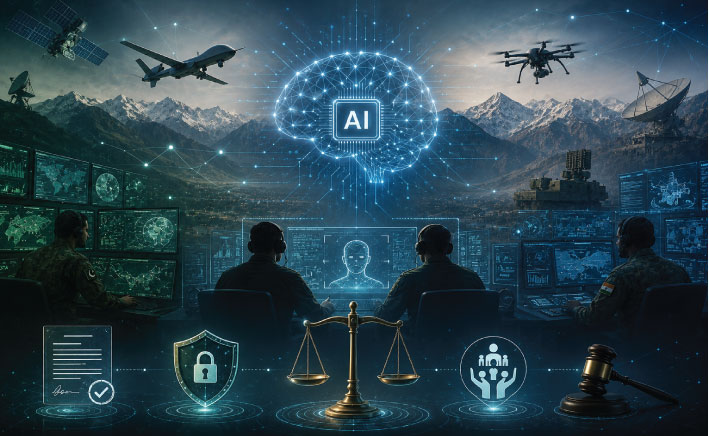
The pattern of warfare is being transformed by militarization of Artificial Intelligence (AI) which, ultimately, yields strategic dividends moral predicaments simultaneously. AI integrated military systems pose more problems in a region like South Asia that is centered around geopolitical tensions of nuclear capable states: India and Pakistan. The ensuing problems include: miscalculation, accidental escalation and violations of human rights. There is no denying a fact that AI enabled military infrastructure enhances the surveillance and decision-making capabilities of states; however, in view of the tense situation in South Asia, the integration of AI in military setting needs enunciation of solid ethical and legal protocols to guarantee protection of human rights, accountability and stability in South Asia. Militarization of AI in South Asia raises some ethical and legal challenges; therefore, the ethical and legal frameworks of AI militarization need to be structured around transparency, verification, technical validation at all stages, retiring protocols and AI specific regulations.
In contemporary times, AI-powered military modernization has assumed an important space in military discourse of South Asia and militarization of AI is driven by cyber warfare capabilities, autonomous drones, AI enabled spatial information and analytical tools for warfare strategy. Both India and Pakistan have ventured into militarization of AI with India leading the way by establishing an AI Task Force and Pakistan also boosting its defense cyber strategies. Moreover, China , an extra-regional power, is countering the US hegemony in AI-powered military system by establishing its own indigenous AI developments which is pushing regional actors of South Asia towards an AI-driven military system. The integration of AI in military has potential benefits; however, this process is not without the risks of miscalculation, accidental escalation and violation of international humanitarian law.
The integration of AI in military system in South Asia is not without challenges as it raises severe ethical concerns. AI-enabled weapons, for instance, autonomous drones function without active intervention of human ethics, emotion or moral logic. This can lead to unintended damages and also makes it difficult to hold any agent of action responsible for a war crime. The AI-powered weapons, in a region fraught with historical conflicts and diplomatic tensions, will speed up rather than slowing conflicts leading to escalation and unwanted conflicts. Being devoid of contextual and diplomatic mantle, autonomous weapons may respond to threats based on a fixed algorithm rather than strategic maneuvering. The AI weapons have the propensity to make errors in decisions based on inherent biasness installed in them to respond to specific threats. A single misclassification by a faulty AI machine can result in unjustified military actions and, consequently, war crimes. AI-led military monitoring raises serious concerns about human rights, personal freedom and space for democratic ideas as the weapons may be used for political control and suppression.
States in AI militarization are not legally restricted by constraints as states having a military muscle, including Pakistan and India, have yet to agree on AI-centered legal regulations. Unlike human trials where we have war laws including the Geneva Conventions, we don’t have legal frameworks to claim damages against the disproportionate action of AI-enabled war machines. The AI arms control and disarmament agreements are further hampered by lack of concrete verification mechanism. It is difficult to detect AI weapons, since they depend on flexible software and algorithms.
The ethical and legal risks produced at the time of AI-powered weapons development and deployment cannot be left to be patched at a later stage. The risks deferred to be patched later on becomes a “technical debt of responsibility“—the systems that are designed without proper consideration for human oversight or legal compliance; hence, these deficiencies introduced at an early stage remain structurally embedded and impervious to change. It is high time that the region of South Asia collaborates to frame regional agreements or protocols in order to determine the limits of militarization of AI. The agreements embodying regulations should be driven by a complete ban on completely autonomous weapons. There should be a provision for human monitoring over AI-powered military decisions to ensure accountability by highlighting the decision-maker.
In South Asia, Pakistan and India have low level of trust; given their trust issues, transparency in regulating AI-powered weapons becomes important to kickstart military to military dialogues, AI verification mechanism and the use of AI ethics for positive applications. For concrete results, the process of verification and assurance measures must be established parallel to the systems themselves. Technical validation should not be an afterthought and it must be incorporated throughout development stages. AI ethics should be integrated into military systems and committees be made to ensure training of military personnel in AI ethics. In person simulations, war and peace games workshops must be conducted to understand the dynamics of escalation and unintended disproportional harm. Interdisciplinary workshops with tech and policy experts can derive better results.
End-of-life reflections in AI militarization needs thorough exploration. While much discourse is focused on development and deployment, little attention is paid to military AI systems that reaches its outdated phase. Without stringent retiring protocols, we run the risk of unrestrained spreading through reckless technology transfer, security liabilities in aging military systems and accidental costs from refurbished technologies. Ethical and legal responsibility frameworks must extend the whole AI lifecycle— from initial design and procurement to installation and eventual phase out stage. We face the danger of perilous accountability gaps without an inclusive governing mechanism. There are telling human controlled regional and cultural episteme which, again, function around comprehensive methods devoid of singular worldview. Additionally, there is a dire need of frequent certification of military units that run AI-Decision Support System to minimize the options of invalid deployment. Documentation of AI system helps in building trust and reduces recurrence of errors
The defense setting of South Asia is shifting with AI-powered military systems, potentially paving the way for strategic advantages and vital legal as well as ethical challenges. In the absence of any concrete protocols, the AI-enabled military systems will likely erode regional stability, upsurge uncertainty between nuclear armed India-Pakistan, intensify inadvertent conflicts and might lead to compromise on human rights. The need of the hour is that Pakistan and India agree on instant establishment of legal and moral regulations to oversee AI in warfare, guaranteeing human involvement, accountability and synchronization with international practices. Sustained dialogue premised on linking technical, legal, ethical and humanitarian perspectives can avert AI-powered military conflicts and reinforce responsible use of AI in defense systems.
Author: Dalir Khan is Assistant Professor of IR in Abdul Wali Khan University Mardan.
