
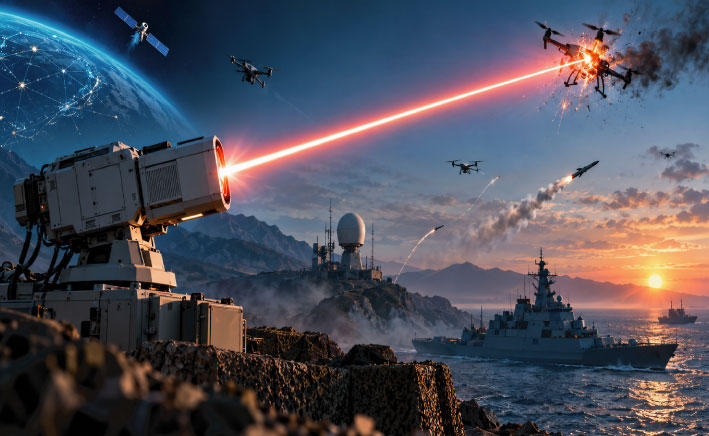
In the contemporary strategic environment and modern warfare, the innovations in High-Energy Laser weapons (HELWs) have transformed the understandings of warfare. These weapons are more lethal, more precise, less costly and more efficient than most of the conventional weapons. A laser weapon uses high concentrated laser beams to eliminate or damage the target instead of bullets, missiles and other arms. Powerful states like The US, China, Russia and many others have started working in this dimension and this technology has opened a gate towards a new technological arms race. The advancement in laser technology is raising concerns about strategic stability and escalation risks as it is moving from being used in experimental research to its effective use in operational defense system.
High-Energy Laser (HEL) beams attack multiple targets such as drones, rockets, small boats, some missiles and surveillance equipment at a time at the speed of light which although, target destruction still requires sufficient energy and time of engagement. This makes them an important defense tool for national security and survival. At the Association of US Army’s annual meeting in Washington Army officials informed Military Times that their Enduring-High-Energy laser program would be operational by early 2028 to counter drones. HELWs have not only reshaped the modern warfare but also created concern about strategic stability.
In recent years, powerful states have developed different HELWs such as HELIOS (US Navy High-Energy Laser System), LaWS (US Navy Laser Demonstrator), LW-30 (Laser Defense system of China), and so on. These weapons have gained pivotal importance in the 21st century as states are now focusing on directed-energy weapons which are cheaper than missile and other interceptors.
In South Asia, progress and developments in HELWs have also drawn attention of states like Pakistan and India. India is actively working on the next-generation warfare technologies including KALI. The Defense Research and Development Organisation (DRDO) and its Center for High Energy System and Science (CESS) are developing 300kW Laser system with the range up to 20 kilometers for eliminating wide range of threats such as drones, missiles, and high speed aerial targets. This directed-energy weapon system is land-mobile, could be transferred along with its control unit on multiple 8×8 vehicles which would strengthen air defense system. Pakistan is accelerating development in the field of HELWs mainly for anti-drone defense especially after 2025’s Pakistan-India conflict where low-cost drones and Loitering munitions exposed gaps in traditional air defense. Pakistan is interested in acquiring China’s newly developed LY-1 high-energy system for defense against drone swarms, low-flying cruise missiles and surveillance platforms with precision and at low cost which would realign South Asian Military dynamics. Through a tender published on February 4, 2026, Pakistan Navy formally proceed to attain high-energy laser system to ensure multi-layer defense against asymmetric threats in affordable manner as the cost per shot is estimated between1$and 10$.
The World Order has witnessed an evolving transformation since the end of cold war with the emergence of advanced technologies. Likewise, the next-generation warfare is demonstrating clear distinction from traditional ones because in modern warfare, new technologies are used simultaneously with military weapons. A state would use missiles, artificial intelligence, drones and other weapons against its adversary in short time span with pinpoint accuracy, and efficiency but wars are still unaffordable due to expensive defense systems. The accelerated adoption of directed-energy weapon by different states is adding a new feature in modern warfare and strategic stability. The use of HEL technology in defense systems is strengthening the states against drone attacks, some missiles and so on, as they are cost-effective, precise and damage or eliminate the target with the speed of light. But, it could also promote heavy reliance on systems which can change perceptions of military vulnerability.
Although, these weapons are not used by states as primary military tools yet. But their proliferation would raise strategic stability concerns and escalation risk. Like a state in a region is actively working on HELWs, it would compel the neighboring states to take measures regarding this issue as that state’s activity is considered as a threat to their national security.
In short, the emergence of new technology modifies the concept of modern warfare and strategic stability as its dual-use has attracted the attention of many states. The innovation of HELWs weapons introduced an up-to-date version of modern warfare which has pinpoint accuracy, time-efficiency and less expensive than many conventional interceptors. Therefore, in accordance with contemporary needs, there should be international regulations including transparency, confidence building measures, and norms for responsible deployment that would capable of addressing the issues.
Author: Munahil Jamil Khokhar, Research Intern, Center for International Strategic Studies, AJK.
