What Syria’s Chemical Cleanup Really Means
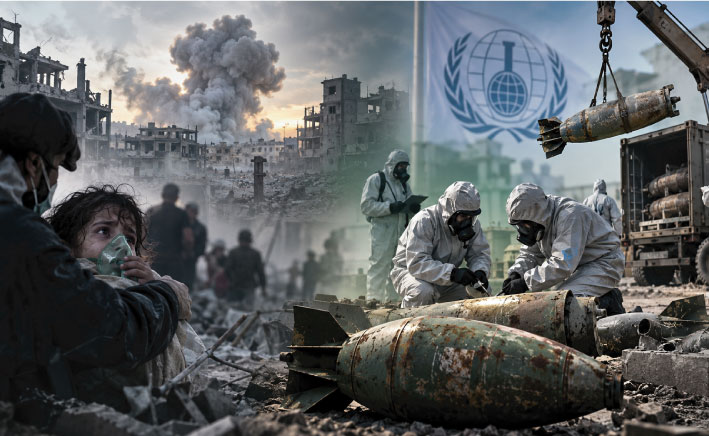
For over a decade, the world watched in horror as barrel bombs filled with chlorine gas rained down on civilians in Aleppo, Ghouta, Khan Sheikhoun. The images became the defining nightmares of the Syrian civil war. Now, in a twist that few analysts predicted even a year ago, the very country that once denied possessing chemical weapons is voluntarily tearing apart what remains of that arsenal.
The numbers sound modest at first glance. Forty two aerial bombs destroyed. A handful of storage facilities declared. One production site uncovered. But anyone who has spent time studying arms control knows that the significance of disarmament is never found in the arithmetic alone.
What matters is the signal.
Since the Organization for the Prohibition of Chemical Weapons first brokered a deal to strip Syria of its declared stockpile in 2013, the process has been mired in suspicion. Western intelligence agencies consistently argued that Damascus had hidden portions of its programme. The OPCW itself documented gaps in Syria’s declarations that it could never fully resolve. For years, the Assad regime treated chemical disarmament as a performative exercise, offering just enough cooperation to stave off military strikes while quietly preserving capabilities.
That era is over. Or at least, the new leadership in Damascus wants the world to believe it is.
The fact that UN High Representative Izumi Nakamitsu confirmed OPCW inspectors verified destruction on Syrian soil for the first time since 2014 is genuinely remarkable. It represents a rupture with the past that should not be taken lightly. When a post conflict government invites international weapons inspectors onto its territory to dismantle the most stigmatized category of armaments on the planet, it is making a deliberate political statement. Syria’s new rulers are telling the international community that they intend to be a different kind of government.
Yet we should resist the temptation to celebrate prematurely.
The discovery of previously undeclared facilities, a novel nerve agent precursor, plus empty munitions scattered across storage sites tells us something uncomfortable. The Assad regime’s chemical weapons programme was larger, more dispersed, more deeply buried than even the most pessimistic assessments suggested. Every new finding raises the same troubling question: what else remains hidden?
Arms control veterans will recognize this pattern. Iraq in the 1990s. Libya after Gaddafi. Disarmament is never a clean sweep. It is a painstaking, iterative process of discovery, declaration, verification, and then more discovery. The new Syrian authorities deserve credit for transparency so far, but the real test will come when the easy finds are exhausted. Will they maintain the same openness when the search turns up politically sensitive material linked to figures now embedded in the new power structure?
Then there is the Israeli complication, which adds a layer of genuine complexity that most Western commentary has glossed over.
Syria’s UN envoy Ibrahim Olabi did not mince words when he accused Israel of impeding search operations through repeated airstrikes. This is not mere rhetoric. Israeli strikes on suspected weapons sites inside Syria have been well documented throughout the conflict, often justified as efforts to prevent advanced armaments from reaching Hezbollah. But when those strikes hit locations where Syrian teams are actively trying to catalogue or destroy chemical materials, the result is counterproductive. You cannot secure a weapons site that keeps getting bombed.
The irony is thick. Israel has long argued that Assad’s chemical arsenal posed an existential threat to the region. Now that a new government is doing the hard work of dismantling that threat, Israeli military action is making the job harder. Jerusalem would do well to coordinate with Damascus on this specific issue, even if broader relations remain hostile. Chemical weapons do not respect political rivalries. Loose sarin precursors pose a danger to everyone.
Perhaps the most consequential development, though, is the one receiving the least attention. Eighteen suspects are in custody, including senior military officers, political figures, technical specialists allegedly involved in running the chemical programme. Court hearings are being prepared.
This is where the rubber meets the road. Destroying bombs is a technical challenge. Prosecuting the people who ordered those bombs dropped on sleeping families is a political one. The new Syrian leadership will face enormous pressure to sweep the worst atrocities under the rug in the name of national reconciliation. Every transitional government does. But chemical weapons use crosses a threshold that the international legal system has spent a century trying to reinforce. If Syria can demonstrate genuine accountability, it would set a precedent with ramifications far beyond the Middle East.
The world has a narrow window to get this right. The new Syrian government is motivated, the OPCW is engaged, and the evidence is relatively fresh. But motivation fades. International attention drifts. Funding dries up. We have seen this cycle play out in too many post conflict settings to be naive about the trajectory.
Forty two bombs destroyed is a beginning. It is not a conclusion. The real question is whether the international community will sustain the pressure, resources, diplomatic engagement necessary to ensure that Syria’s chemical weapons chapter is closed permanently, not just symbolically.
The people of Ghouta, Aleppo and Khan Sheikhoun deserve nothing less.
Author: Abdul Rehman, Research Officer, Center for nternational Strategic Studies, AJK.
