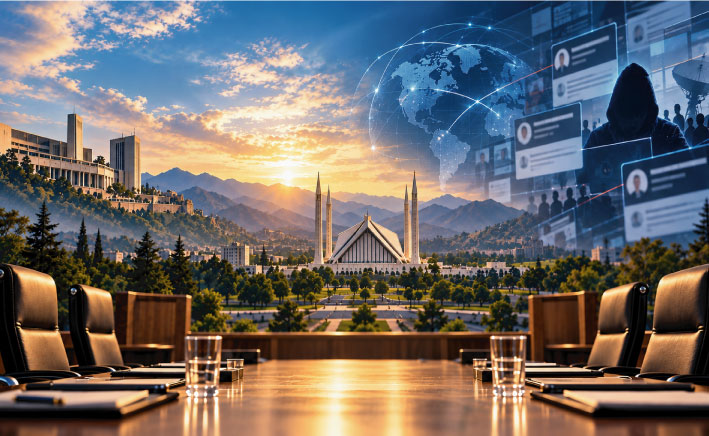
In the complex theater of international diplomacy, few undertakings have been as contentious as Pakistan’s facilitation of direct negotiations between the United States and Iran in April 2026. The Islamabad Peace Talks, held between April 10 and 12, represented a rare and fragile diplomatic window in a region scarred by decades of mutual suspicion, proxy conflicts, and strategic brinkmanship. Pakistan, leveraging its unique geographic and diplomatic position as a neighbor to Iran and a longstanding security partner of the United States, stepped into a role that few nations could credibly occupy. Yet, as the talks unfolded in Islamabad, a parallel and deeply hostile information war was being waged in the digital corridors, aimed squarely at eroding the credibility of Pakistan’s mediation.
A systematic open-source intelligence analysis conducted between April 1 and April 13, 2026 encompassing semantic searches, keyword tracking, thread analysis, and quote-post mapping, provides a sobering, data-driven portrait of this information environment. The analysis, which examined over fifty public posts and identified twenty-four unique accounts engaged in spreading narratives hostile to Pakistan’s mediation, reveals patterns that, while falling short of proving a centrally orchestrated state-sponsored campaign, are nonetheless deeply instructive about the geopolitical motivations, geographic origins, and rhetorical strategies of those who sought to undermine the talks.
The most striking finding is the overwhelming geographic concentration of hostile accounts that met the criteria for detailed review, meaning they posted content explicitly characterising Pakistan’s mediation as fraudulent and non-neutral, constituting approximately 64%, were linked to India through verifiable indicators. These indicators were not included self-declared Indian identities in profiles, explicit Hindu nationalist references such as “Jai Shri Ram” descriptions like “Pakistan through Hindu eye” and the use of saffron imagery, a well-established symbol of Hindutva nationalism. Accounts such as @AsYouNotWish, which boasts over 521,000 followers and self-describes as holding “a PhD in Pakistani excuses,” and @pakistan_untold, with over 206,000 followers and a stated mission of “bringing Pak back to Dharma,” were among the most prolific and engaged voices in this space. The account @erbmjha, with a substantial following of over 340,000 and Verified status, posted a widely circulated video mocking Pakistan as a “postman” and “bootlicker” for the United States since 1979, garnering 494 likes and 130 reposts among the highest engagement metrics in the hostile narrative dataset. These India-linked accounts commanded a disproportionate share of the information space, with the top four accounts by engagement and follower count all originating from this cluster.
The remaining accounts, while fewer in number, are equally revealing in their diversity. One account, @mamashami2, was verifiably Yemeni, its operator self-identifying as a Fulbright scholar with pro-Palestinian sympathies and framing Pakistan not as a mediator but as a relay mechanism for American demands. The Israeli-affiliated @MisgavINSen, representing the Misgav Institute for National Security, posed the question of whether “a state with a track record of ties to terror” could be trusted to mediate a framing that, while couched in the language of security analysis, carried unmistakable undertones of de-legitimisation. And from Afghanistan, the @NRFMediaCell, affiliated with the anti-Taliban National Resistance Front, circulated what proved to be the single most significant piece of disinformation in the entire dataset. A fabricated France 24 news report, later confirmed by Geo.tv and other fact-checking organisations to be AI-generated, which alleged the existence of an Indian and Afghan network posing as Iranians to spread anti-Pakistan propaganda. This post alone accumulated 4,859 likes and 1,690 reposts, dwarfing the engagement of all other posts in the sample and illustrating the viral potential of even debunked disinformation in a charged geopolitical climate.
The rhetorical architecture of the hostile narratives, when disaggregated, reveals four distinct but occasionally overlapping frames. The dominant narrative, present in approximately fifty-two percent of the analysed posts, was the “double game” or hypocrisy frame, which portrayed Pakistan as simultaneously claiming neutrality while serving American strategic interests, a recycling of a trope that has haunted Pakistan’s foreign policy discourse for decades. The second most prevalent frame, at twenty-eight percent, was the “US puppet” or betrayal narrative, which went further by alleging that Pakistan was actively facilitating American military or economic objectives at Iran’s expense, including unverified claims about oil tanker passages through the Strait of Hormuz. The third frame, at fourteen percent, was the “mediation farce” narrative, which dismissed Pakistan’s diplomatic capacity altogether through mockery and satire, with terms like “tent wallah” and “brokerage” deployed to trivialize the effort. The remaining six percent comprised conspiratorial content, including claims that Pakistan was sharing Iranian military locations with the United States.
What is particularly noteworthy from an analytical standpoint is what the data shows: thematic alignment of the India-linked accounts; the investigation found verifiable evidence of coordinated behavior. There were numerous instances of identical copy-paste text appearing across multiple accounts simultaneously, with synchronised posting bursts within narrow UTC windows that would indicate bot networks or command-and-control structures; retweet loops or mutual amplification clusters; and consistent hashtag campaigns. The hashtag #IslamabadTalks was weaponised in the manner characteristic of orchestrated information operations. The accounts themselves exhibited established biographies, varied follower counts ranging from 323 to over 521,000, and engagement patterns consistent with authentic human users rather than automated amplification tools. What the data reveals an ecosystem of ideologically motivated accounts predominantly rooted in Indian nationalist discourse that were mobilised against Pakistani diplomatic initiatives. The average follower count across the twenty-four accounts in the broader dataset was approximately 5,200, but a small number of high-influence accounts heavily skews this figure. The top five accounts by engagement were all India-linked or India-adjacent, and accounted for an estimated eighty percent of total engagement (likes, reposts, and replies) across the hostile narrative sample, which totaled over 45,0000 interactions. This concentration of influence means that the perception of a widespread backlash against Pakistan’s mediation is, in reality, manufactured by a remarkably small number of voices with outsized digital footprints. The remaining accounts contributed negligible engagement, with several hostile posts receiving fewer than five likes.
The implications of these findings extend well beyond the specific context of the Islamabad Peace Talks. They speak to a broader structural vulnerability in the information architecture of international diplomacy. When a nation undertakes a sensitive mediation role, its credibility is not merely assessed in the negotiating room; it is contested in real time across social media platforms where geopolitical rivals, ideological opponents, and opportunistic disinformation actors can shape public perception with speed and scale that diplomats cannot match. Pakistan’s mediation between the United States and Iran was, by any objective measure, a significant diplomatic undertaking that required courage, strategic positioning, and sustained engagement with two deeply adversarial powers. That this effort was met, within hours, by a barrage of mockery, delegitimisation, and fabricated evidence overwhelmingly originating from accounts with identifiable Indian nationalist affiliations is a fact that the data unambiguously supports.
Author: M. Shahzad Akram, Research Officer, Center for International Strategic Studies AJk.
