
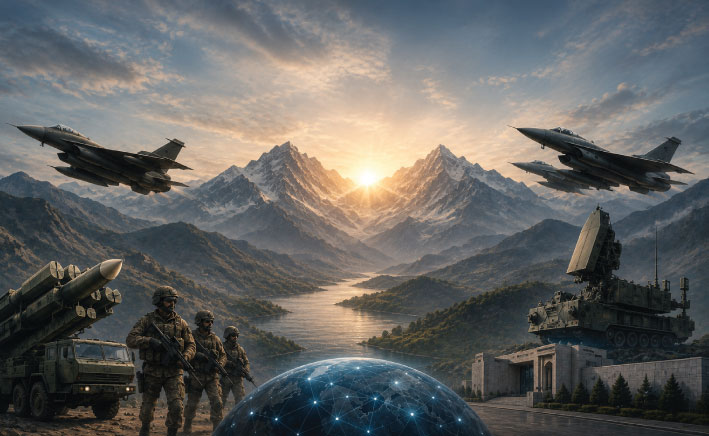
In 2026, Pakistan is celebrating its 79th Independence Day, commemorating the sacrifices of millions of people who contributed to the creation of the country. However, the journey of sacrifice continues, as Pakistan’s Armed Forces, with the support of the entire nation. They remain committed to strengthening the country’s defence and safeguarding its sovereignty. A recent example of this commitment was Operation Bunyan-al-Marsoos, which demonstrated Pakistan’s resolve and preparedness to defend its independence and national security.
On May 10th, 2026, Pakistan celebrated the first anniversary of Marka-e-Haq. It is one year of the epochal Operation Bunyan al Marsoos, which means ‘a fortified structure’ not just literally but also in real terms. Despite India’s provocation, Pakistan maintained escalation control through its resolve, discipline, and restraint, as symbolized by its name. Pakistan’s defense operation demonstrated a calibrated response and a prime example of exercising nuclear responsibility under escalating pressure. The Full-Spectrum Deterrence (FSD) enabled Pakistan to respond India across all levels of conflict and maintain strategic stability.
In contrast, India resorted to rapid escalation in May 2025 conflict and used nuclear rhetoric accompanied by military strikes. This crisis revealed the divergent behavior of two nuclear armed states under pressure. It provided a case study in which India’s doctrinal escalation threatened crisis stability, while Pakistan’s restrained military response and sustained diplomatic engagement played a crucial role in preventing the catastrophe and restoring regional stability. Such situations indicate that deterrence is shaped by perception, posture, and psychological signaling, rather than by a fixed set of redlines.
Indian crisis behavior encompassed aggressive strategic signaling that heightened the escalation risks. Indian Prime Minister Narendra Modi exercised an offensive military posture and granted the Indian armed forces full freedom to launch massive attacks against Pakistan. This “New Normal” that India attempted to establish involved using terrorist attacks as a pretext to conduct military strikes against Pakistan and carve out a space for limited war under the nuclear overhang. Furthermore, India did nuclear provocations by calling Pakistan’s nuclear deterrent capabilities as ‘nuclear bluff’, ‘nuclear blackmail’, whereas Pakistan did not engage in any nuclear signaling. Such a provocative communication during the crisis was fraught with risks as India attempted to weaken the established norms of restraints and crisis communication. Eventually, amidst the heightened risks of escalation, the space for the critical capability of diplomatic de-escalation in the nuclear-sensitive environment shrank.
On the other hand, Pakistan’s response was disciplined and structured escalation control under intense escalation pressure. Pakistan’s armed forces refrained from nuclear signaling and maintained deterrence through conventional means. They invoked Pakistan’s FSD posture which aims at preventing conventional war between the two nuclear-armed states. Operationally, Pakistan conducted successful defensive aerial actions and neutralized Indian threats through precision strikes, cyber-attacks and other non-kinetic measures against the military targets.
Pakistan also observed restraint in both vertical and horizontal escalation behavior. Pakistan thwarted escalation dangers by not deploying Babur cruise missiles even when India used BrahMos systems. Observing restraint, Pakistan’s strategy was quid pro quo plus and focused on achieving military objectives while avoided hitting civilian infrastructure. These decisions reflected no structural limitation, but the conscious management of escalation. It made Pakistan’s response precise, proportional and containing clear strategic boundaries aimed at preventing crisis escalation beyond the conventional threshold.
Another distinguishing feature of Pakistan’s crisis management strategy was its robust diplomatic engagement. The openness to diplomatic engagement aided Pakistan’s sustained effort for the crisis de-escalation. Right after the Pahalgam attack, Pakistan called for a neutral and transparent investigation, which was declined by India. Pakistan also supported and appreciated international mediation efforts led by the United States and other countries, which culminated in the ceasefire on May 10, 2025. Through its policy and actions, Pakistan emphasized the significance of sustaining dialogue, upholding confidence-building measures, and preserving the Indus Water Treaty (IWT) despite Indian abeyance. At the multilateral level, Pakistan supported consensus-based condemnation of terrorism at the United Nations General Assembly without accepting rhetorical attribution of responsibility by India. It also engaged international partners to emphasize restraint and the importance of avoiding escalation. Major international forums and powers did not endorse India’s attribution narrative but instead emphasized de-escalation, dialogue, and restraint, aligning more closely with Pakistan’s position. This diplomatic posture reflected Pakistan’s broader understanding of nuclear responsibility, extending strategic restraint beyond the battlefield into international legitimacy and crisis governance.
The 2025 crisis revealed fundamental differences in nuclear behavior between India and Pakistan under conditions of escalating pressure. India’s approach prioritized rapid attribution, expanded military strikes, and a doctrinal shift toward immediate use of force under its ‘new normal’ framework. This posture, while assertive, involves risks of miscalculation in a compressed decision-making environment. On the other hand, Pakistan combined conventional deterrence with strict operational restraint and avoided all forms of nuclear signaling. Its behavior demonstrates that nuclear responsibility is defined not by possession of nuclear weapons but by disciplined non-use and the avoidance of their political or strategic exploitation during crises. While India emphasized unilateral military responses and rejected mediation, Pakistan consistently supported dialogue, and commitment to peace with dignity and honor. These divergent approaches reflected fundamentally different interpretations of deterrence stability, where one side viewed escalation as a tool of compellence and the other resorts to escalation control as a strategic asset essential for stability.
The crisis highlighted the need for strengthened crisis management mechanisms between nuclear-armed states in South Asia. Existing frameworks, including DGMO hotlines, ceasefire agreements along the Line of Control, and ballistic missile notification regimes, require reinforcement and modernization to remain effective under contemporary threat conditions. The initiation of structured dialogue at the national security advisor and foreign secretary levels is essential to reduce miscalculation risks and improve communication during crises. Moreover, updated confidence-building measures addressing cyber conflict, emerging technologies, and communication failures are increasingly necessary in modern security environments. The continued weakening of institutional communication channels increases the risk of escalation driven by ambiguity and misperception. Strengthening these mechanisms is therefore essential to maintaining strategic stability in a nuclearized region.
The 2025 South Asian crisis demonstrated how rapidly conventional conflicts between nuclear-armed states can escalate into strategically dangerous situations. The episode highlights the enduring risk of miscalculation, particularly when diplomatic channels are weakened, and military signaling becomes ambiguous. India and Pakistan exhibited contrasting approaches, with one emphasizing rapid escalation and doctrinal assertiveness, and the other prioritizing restraint and controlled deterrence. Pakistan’s response demonstrated that nuclear credibility is derived not from escalation or demonstrative force but from disciplined behavior and measured capability under pressure. Eventually, the crisis underscores that nuclear stability depends not only on material capabilities but also on judgment, signaling discipline, and responsible state conduct. Sustaining regional peace requires institutionalized restraint, effective communication mechanisms, and sustained commitment to conflict de-escalation. In the nuclear age, the perceived space for war between nuclear-armed states remains an illusion, one that, if tested, carries inherently catastrophic consequences.
Author: Anam Murad Khan, Research Assistant, Center for International Strategic Studies, Islamabad.
