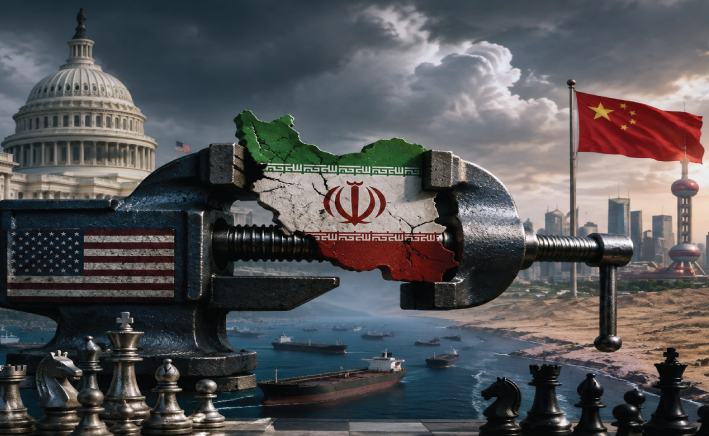
President Trump called it an “Economic D-Day.” Treasury Secretary Scott Bessent called it the “toughest sanctions in history” and, later, “the greatest coordinated economic isolation in the history of the world.” On Monday, Bessent is set to walk reporters through the specifics. Whatever the details turn out to be, the bigger question is whether any sanctions package, however aggressive, can still do what Washington wants it to do.
This is not sanctions policy in a vacuum. The United States and Iran are nearly six months into an active war, with a naval blockade already in place and the Strait of Hormuz effectively a standoff zone. Bessent has framed the new sanctions push as a substitute for renewed strikes, telling CNBC that “if we are doing the maximum economic pressure, then that means that likely there will not be a large-scale kinetic restart.” That is an important admission that the administration is not eager to escalate militarily again, and it is betting that financial pressure can finish what bombs did not. It’s a reasonable bet to make. It’s also one that runs into five stubborn realities.
Iran has already built a workaround economy
Years of sanctions pressure have pushed Tehran’s oil exports into a shadow fleet of tankers running under flags of convenience, doing ship-to-ship transfers away from Western satellites, and settling payments through non-dollar channels. None of that infrastructure appears overnight in response to a Monday press conference. It was built precisely because Washington has tried this numerous times before and Iran adapted each time.
China is the pressure point, and China isn’t budging easily
Chinese “teapot” refiners buy the bulk of Iran’s crude, paying largely outside the dollar system, which limits how much US Treasury tools can actually touch them. Bessent’s own argument for why Beijing should cooperate is tempting, as he noted that China gets roughly half its energy from the Gulf, meaning it wants the Strait of Hormuz reopened as much as Washington does. But wanting stability and complying with American secondary sanctions are two different things, and Beijing has opposed unilateral ‘illegal sanctions’ on Iran by stating that it has no basis in the international law.
There’s no UN mandate behind this
A unilateral American sanctions regime, even a sweeping one, is a different animal from a Security Council-backed embargo that closes off financing and insurance markets everywhere at once. With Russia and China could hinder sanctions on Iran, therefore, that kind of multilateral lid isn’t coming. What Washington is left with is extraterritorial pressure on third countries and banks, which tends to generate friction with allies as much as leverage over Tehran.
Iran’s economy is battered but adapted to being battered
Tehran’s currency has been through a real crunch. Bessent himself has said the dollar shortage created by US policies created helped fuel unrest inside Iran while Iran’s foreign ministry has called the new measures “economic terrorism.”. Iran has spent nearly five decades under some version of American sanctions, and it has built an economy of import substitution, subsidies, and informal trade that assumes isolation as the baseline rather than an emergency. Squeezing an economy that already expects to be squeezed produces pain, but not necessarily the kind to collapse. Bessent is promising when he says sanctions “worked in Venezuela” and are “working in Cuba.” But both of the countries are different when it comes to Iran. Iran borders several countries through which it can trade, has shipping ports, a sound educated population, less dependent on imports, manfactures a large segment of its goods. Therefore, more than anything, as aforementioned, has adapted to the decades of santions, in other words, it built an economy around that idea that it would be sequeezed by its adversaries so doing something that they have been already expecting would have less impact.
Oil markets are already pricing in the risk, and that cuts against Washington too
Brent crude has climbed for five straight sessions to around $94 a barrel as traders price in a real cut to Iranian supply, with the administration’s stated goal of pushing Iran’s exports from roughly 1.5 million barrels a day toward zero. It may sound an effective news for the pressure campaign’s credibility however bad news for anyone paying for oil or worried about inflation. The tighter the screws get, the more expensive the campaign becomes for the country applying them, and that math has ended sanctions pushes before.
The other side of the ledger
But there is a real gap between “this will hurt Iran” and “this will collapse the regime” or force Tehran back to the table on American terms. Iran’s government has said it won’t reopen the Strait until the blockade lifts, frozen assets are returned, and oil sanctions ease. Iran’s foreign minister has dismissed the whole campaign as a distraction from America’s own $40 trillion debt problem. Washington may well announce its toughest sanctions yet on Monday. Whether “toughest” translates into “decisive” is the part history should make everyone skeptical about. While it also remains to be seen how the sanctions work and how Iran would respond to it. Given Iran still allows some shipments to pass through the strait and remains open to diplomacy. However, in case of it tries throttle region more with completely blocking strait of Hormuz and Bab Al Mandeb, in that case, with the US response, the military escalation could spiral out of control thereby bringing more instability in the region that no one wants.
