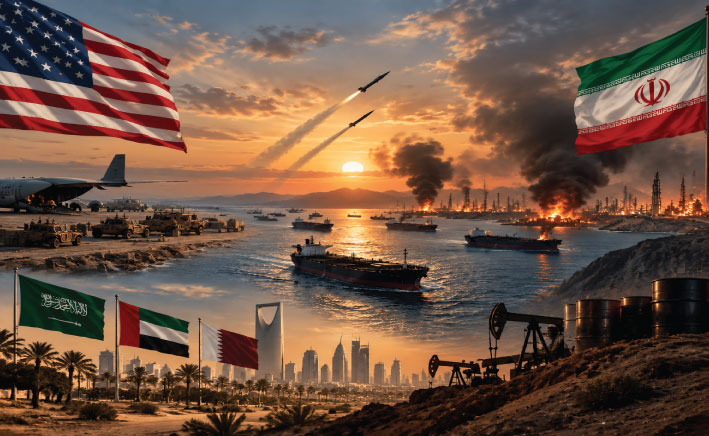
Recently, Pentagon planning reported by the Washington Post envisions moving forces out of the Gulf’s large, fixed bases, the ones Iranian missiles proved they could reach, toward Jordan, Israel, and Saudi Arabia’s Red Sea coast. Officials describe this as “prudent planning,” but the logic behind it is unmistakable that after absorbing Iranian strikes, Washington has decided the old posture is no longer worth defending in place. That is not the posture of a power that has broken its adversary’s will rather of a power managing its own exposure. As the war lingers on, the American strategic reserves are fast depleting which were supposed to insulate American consumers from exactly this kind of shock, the Gulf’s oil arteries are functioning at a fraction of capacity, and the Gulf Cooperation Council states, caught in the middle of a fight that is not theirs, are absorbing much of the economic damage. While there are reports of other countries using their strategic reserves to keep the oil prices down, however, if such a situation stays, the oil prices would shoot up in the last quarter of the year with having economic repercussion for the people around the world. In this way, it can be assumed that Washington campaign against Iran is not only failing but keeps eating the wrong side. Therefore, it also creates a scenario for Washington to make a quite accommodation with Tehran.
A war that produced burden-shifting, not victory
American plan to draw down forces from the Gulf is not the posture of a power that has broken its adversary’s will. It is the posture of a power managing its own exposure. Layer onto that the diplomatic choreography around the Mecca Agreement, the Saudi-led, Turkish- and Pakistani-backed security arrangement that the administration has openly encouraged. It is easy to asses that regional states are finally stepping up. It is also that Washington is taking off a security burden it can no longer comfortably carry alone, dressed up as regional empowerment. Either way, it happens to be the exact outcome Iran has been demanding for years, which is that fewer American forces in the Gulf. The war did not force Tehran to accept Washington’s terms. It nudged Washington toward Tehran’s.
The GCC is paying for a fight it didn’t start
The states absorbing the actual cost of this standoff are not the direct belligerents even though they host American Miliatry bases. Saudi and Emirati pipelines built specifically to bypass the Strait of Hormuz have themselves come under attack. Houthi strikes on Red Sea shipping have opened a second chokepoint on top of the first. Tanker traffic through Hormuz has reportedly collapsed to a fraction of its pre-war volume, and insurance premiums for anyone still willing to sail through it have spiked accordingly. None of that shows up on a ledger in Washington or Tehran. It shows up in Riyadh, Abu Dhabi, and Doha, where governments built their entire development strategy around the assumption that oil could move predictably and cheaply through their waters.
Meanwhile, the shock absorber that was supposed to protect ordinary American people from exactly this scenario is disappearing. The US Strategic Petroleum Reserve, created after the 1973 embargo for precisely this kind of moment, has been pushed toward its practical operating floor, with officials themselves acknowledging that only weeks of cushion remain. The same could be thought about the other strategic reserves of other countries. In this way, that is not a sustainable arrangement. It’s a countdown or rather ticking bomb.
Sanctions and strikes were supposed to be cheaper than this
The entire premise of a pressure campaign, sanctions, strikes, tanker seizures, the whole toolkit, is that it inflicts more pain on the target than on the party applying it. That premise is not holding up. Revoking Iran’s general license to sell crude did not quietly starve Tehran, escalation with Tehran triggered strikes on commercial tankers, forced rerouting through more defensible corridors, and helped push oil prices back toward $100 a barrel after a brief post-ceasefire dip. Every escalatory step, refinery strikes, pipeline attacks, the widening of Houthi operations in the Red Sea, has moved the fight further from Iranian territory and closer to Gulf infrastructure that Washington’s own partners depend on for their economic survival. The pain is real. It is simply landing on the wrong side of the ledger.
Is accommodation the only road left?
This is the uncomfortable question the last six months have forced into the open that if strikes degrade Iran’s capabilities but don’t produce a settlement, if sanctions squeeze Iranian oil sales but push prices up for everyone else, and if the actual cost is being paid by Gulf economies and depleted strategic reserves rather than by Tehran’s leadership then what exactly is the theory of victory here?
There’s also a case for staying the course: past Arab-led security arrangements, from the Gulf Cooperation Council itself to the Damascus Declaration to Trump’s own first-term Middle East Strategic Alliance, have collapsed under the weight of unresolved rivalries. A regional order without heavy American backing may simply be a mirage, and cutting Iran a deal now could reward the escalation cycle, tanker strikes, pipeline sabotage, and strikes on both sides’ territory, rather than resolve it. It should be argued openly rather than obscured behind talk of regional ‘self-sufficiency’ and Mecca Agreement diplomacy that happens to hand Iran the outcome it always wanted anyway.
Whatever the eventual endgame, a genuine drawdown, a quiet accommodation with Tehran, or a renewed push for hemispheric dominance; the strategy of squeezing Iran without a plan for absorbing the regional fallout has already produced its verdict. It has strained America’s own reserves, unsettled its closest Gulf partners, and left the war’s actual resolution no closer than it was six months ago. Continuing down that road on autopilot, without a genuine intention of resolution the conflict, the repercussions of the war could be detrimental for the world for a long time, however, it is still not too late to stop it here.
Author: Moneeb Mir, Associate Research Officer, Center for International Strategic Studies, AJK.
