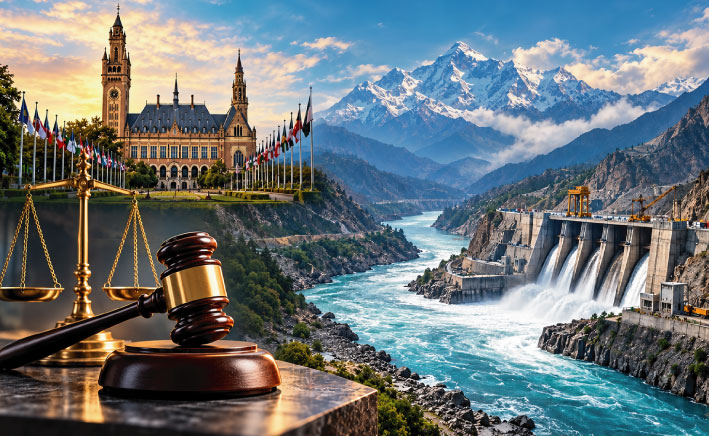
On 31st August 2026, the Permanent Court of Arbitration (PCA) in The Hague ruled in favor of Pakistan, rejecting India’s unilateral decision to suspend or hold the Indus Water Treaty in abeyance. In its unanimous decision, the arbitration court ruled that none of the reasons presented by India provided grounds for suspending or terminating the IWT. The ruling is the first time an international court has ruled on whether India’s decision to place the treaty in abeyance is legally valid. Pakistan has welcomed the decision made by the PCA; however, India has rejected it, raising questions about the benefits to Pakistan.
Pakistan approached the PCA in March 2026, resulting in the ruling that India’s hydroelectric projects must remain strictly within the parameters and exceptions provided under the IWT. The Treaty in not subject to unilateral interpretation or discretion. IWT has endured six decades and three major wars between the two arch-rivals. Over time arbitrations and neutral expert mechanisms helped contain the frictions, the underlying asymmetry means Pakistan remains vulnerable to Indian politicization of the Treaty, which has become increasingly pronounced under the Modi government. Even before the Balakot crisis, Indian officials between 2013 and 2015 intermittently questioned the Treaty’s fairness, portraying it as overly generous to Pakistan. This rhetoric sharpened after the 2016 Uri attack, when Modi stated “blood and water cannot flow together” signaling an unprecedented willingness to leverage the IWT as a tool of coercion. India escalated the matter into a coordinated campaign through official statements, media narratives and policy reviews in the aftermath of Balakot crisis. This move kept alive the threat of reinterpreting or even revoking the Treaty.
Since India was already looking for an excuse to suspend or abrogate the Treaty, consequently the Pahalgam incident in April 2025 provided that opportunity. By portraying Pakistan as a security challenge and an undeserving beneficiary of the shared water system, the Modi government pointed to the scrapping of the Treaty. Modi transformed the IWT from a legal instrument into a pawn of regional politics undermining its credibility and creating uncertainity over the very concept of water as an impartial domain of cooperation.
Pakistan has always emphasized the sanctity of of IWT in multilateral forums and objected India’s hydroelectric or storage projects on the western rivers raising concerns about compliance. The Baglihar and Kishanganga dams related cases exemplify this pattern: Pakistan disputed India’s interpretations pursued neutral expert and arbitral recourse and, despite mixed outcomes demonstrated confidence in Treaty’s legal architecture. Pakistan’s acceptance of these rulings even when politically challenging exemplify its commitment to International law and and treaty obligations. The IWT has been effective not because it eliminates disputes, but because it has prevented India’s upstream activities from completely eroding Pakistan’s rights through unchecked unilateralism. More than six decades on, despite the climate pressures and shifting regional politics, Pakistan continues to regard the Treaty as crucial and respect its obligations.
From suspending the Treaty to rejecting the PCA’s decision, the Indian intent remains intact with its strategic thinking. Water securitization has been one of the core strategies of the current Indian BJP government. The weaponisation of water resources uses the water resources as a tool of pressuring or influencing states. The Treaty has been a global model for managing water conflicts, but Indian belligerence has always resulted in catalyzing disputes. India’s revisionist moves therefore deteriorate the credibility of global legal norms that withstand transboundry water agreements. The dent is twofold, it erodes the IWT’s legitimacy by politicizing a legal instrument once insulted from conflict and undermines the broader normative shield of international water law, setting a dangerous pattern that any upstream states may invoke unilateral withdrawl when opportune. This behavior not only intensifies Pakistan’s insecurity as the lower riparian state but also being an agrarian economy endangers its existence as a state. Weaponisation and politicization of Treaty means attacking Pakistan’s human and food security as well as its essential economic welfare. India’s aggressive postures, terror tactics in IIOJK and weaponisation of water are closely linked to its quest to emerge as a regional hegemon. These irresponsible moves taken by India are placing the region in a perilious situation challenging international norms, law and multilatreralism. These developments have undermined the regional centric deterrence and strategic stability. Without permanently maintaining the sanctity of IWT in water resources shared between the South Asian nuclear rivals there are high chances of a disastrous conflict having repurcussions not only for the region but the entire globe.
Author: Abdul Basit, Associate Research Officer, Center for International Strategic Studies, AJK.
