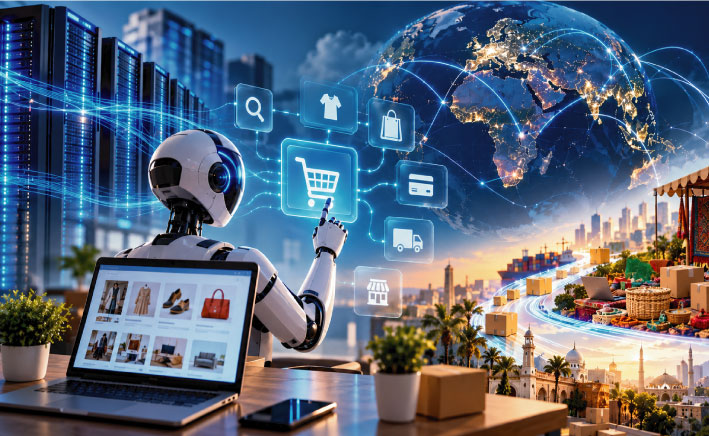
On October 6, Meta and the startup Sierra unveiled the Personal Agent Protocol: a rule that says how AI agents should act for consumers when they talk and interact with companies and businesses. The main question is when this AI software are allowed to log in, browse and buy things for us then who decides the rules about authorization, permission and accountability? This can bring a quite foundational shift in the global digital economy. These rules are being shaped by a few foreign companies and not by governments or global organizations. For Global South it could either open markets for small sellers and shoppers, or its gains could only go to few big firms and powerful countries. Therefore, there is a dire need to regulate the protocol in a way that it remains under human control and ensures safety and security of consumers.
Details which mostly seem minor, matter the most. The protocol is being built with Genesys, Instinct, Rocket, Shopify, Stripe and Walmart and anyone can use it. It runs on OAuth, the login standard that powers everyday app sign-ins. An agent begins as a guest, and the customer using the service can give it either read-only access or write access. Each business decides how the agent will work through its website, its APIs or an agent of its own. A first draft, version 0.1 is expected this month. The standard is co-authored by a platform company and its commercial partners. Stripe’s Kevin Miller have stated that their goal is to give businesses “a standard way to recognize their customers’ agents,” according to Sierra’s latest announcement. Just because a company is named as a partner does not mean its products already support the standard.
It is not the only contender. Shopify and Stripe have also joined Visa’s Trusted Agent Protocol and Walmart and Shopify participate in Google’s Universal Commerce Protocol. OpenAI co-created its Agentic Commerce Protocol in September 2025. This is small-scale standards battle. From shipping containers, to mobile networks these contests are rarely decided by technical skills alone. Whoever sets and creates the interface decides the terms of competition because everyone else has to adjust to it.
There can be a hopeful situation, as if the rules remain open and inexpensive then a small seller in Lahore, Nairobi or Dhaka could be discovered by buyers, beyond the local markets. An AI agent would handle the search and the paperwork. For businesses that have never had a marketing budget, this new integration matters a lot to them. But the starting position is uneven. UNCTADs 2025 report has discovered that just 100 firms, mainly present in the US and China account for 40 % of global corporate R&D spending. The report also found that 118 countries in the Global South are absent from major AI governance discussions and that fewer than one-third of developing countries have integrated AI strategies in their policies. UNCTAD warns that AI is not inherently inclusive. A standard drafted in those conditions is likely to only fit the firms present in the room. A small merchant that cannot afford to make its shop “agent‑ready” have high risk to never being chosen by an agent at all.
The draft of Personal Agent Protocol does not include payments because European Union rules on strong customer authentication need human verifications. A choice made by European regulators has already influenced a protocol that Global South merchants, freelancers and consumers might have to use and adapt to in the future. Jurisdictions not involved in the drafting process receive their rules automatically.
Pakistan has shown a useful example, by approving its National AI Policy in 2025. The National AI Policy National AI Policy that was approved in 2025 aims to train one million AI professionals by 2030 and to create 1,000 AI indigenous products in five years. Prime Minister Shahbaz Sharif made an announcement during the Indus AI Week; “Pakistan will invest $1 Bn by 2030 in the sector of AI. AI training will be provided for one million individuals and PhD scholarships around 1000 will be funded by it. It will be exclusively for the people who are not from IT sector.
On 31 July, Pakistan’s permanent representative to the United Nations argued that developing countries must have equitable access to data, computing capacity, models and expertise. These ideas are sound priorities, but they focus mainly on the basic inputs: talent, money and infrastructure. They do not explain how that power interfaces will connect to global markets.
The stakes are real and clear. The Global South AI sovereignty is in danger, because if more commerce and customer-services move to AI agents than individual peoples and if a small number of foreign platforms take control of the agent-to-business layer; the regional companies could end up as rule-takers. They would have to follow rules set by other foreign platforms: rules such as permission and liability, while simultaneously sending customer data into systems they don’t own or manage.
Right now, there are four simple things that we must urgently do. First, the developing countries should assign a small technical team to read, understand, compare and provide comments on version 0.1 and the competing versions while the drafts are still open for comments. This assignment should be carried out through groups such as the G7 instead of writing separately. Second, regulators such as Pakistan’s State Bank and all the telecom sector regulators should immediately start discussing issues about consent and liability when an AI agent initiates a transaction or makes a mistake. The domestic laws need to be in-place and prepared for such eventualities when corresponding international protocols are being developed.
Furthermore, it is important to build our own AI but it is also important to figure out three main loopholes. First of all how to connect this AI to businesses. Second, rules about its authorization and at last, about the responsibility for it when it fails. We need to step up while the draft is still open so we can also address our thoughts and concerns about the future about Global South’s developing countries digital economy.
Author: Sonia Amir, research Intern, Center for International Strategic Studies, AJK.
