
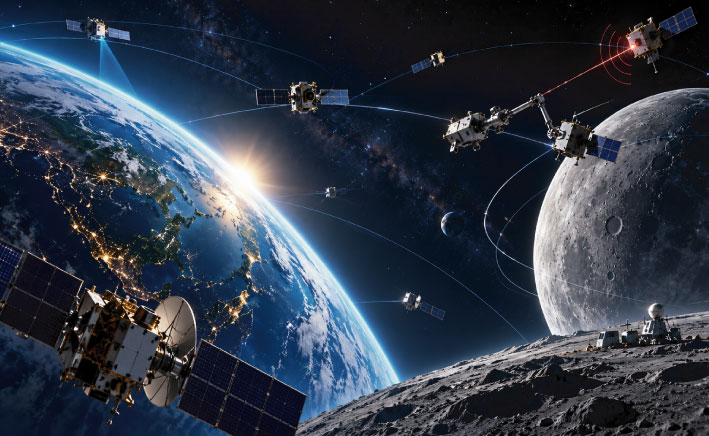
Cislunar space is the region between the Earth and the Moon. It is not a single orbit but a wider operational environment. The weaponization of outer space has become an important issue in international security as major powers develop new technologies in space to protect their national interests. Recently, on 10 October 2026, the United States publicly announce its deployment of a space-control weapon in orbit. According to the Air and space magazine the US Air force secretary Troy Meink states: “Today, we continue to ensure we remain ready to meet the challenges of evolving threats wherever they exist. This is why the United States now has on-orbit space-control weapons capable of defending the joint force against hostile adversary action.”
Following the United States’ announcement, an important question arises: how will states protect their national interests as competition in cislunar space expands? As major space powers, such as the United States and China, continue to develop their space programmes, they are investing in technologies to protect their spacecraft, satellites, and communication systems. These technologies may help countries detect potential threats, monitor nearby spacecraft, and safeguard critical space assets. From a national perspective, developing such capabilities is a way to protect national interests and maintain a strategic position in space. However, other countries may perceive these technological developments as threats to their own space activities. This difference in perception raises concerns about how defensive technologies could be interpreted as offensive by other states, particularly when the purpose and capabilities of new technologies are not fully transparent.
Communication and navigation systems, cargo transportation, and scientific facilities are becoming essential to sustaining human activity around the Moon. These systems require protection against accidents, interference, and potential hostile actions. As a result, states are increasingly investing in technologies that enable them to monitor the region and protect their space assets.
Concerns surrounding defensive technologies become more serious when other countries believe that these technologies could be used against them. In space, many emerging technologies have dual-use purposes: they can be used to protect spacecraft, satellites, and communication systems, but they may also be used to interfere with other states’ spacecraft or disrupt their operational satellites. Similarly, technologies designed to track objects in orbit can potentially be used to gather information about other countries’ space activities, including their military operations. As countries expand their capabilities in and around the Moon, particularly in cislunar space, future missions, navigation systems, and other strategic assets are becoming increasingly important. When states perceive these technologies as threats to their own space activities, they may respond by developing similar capabilities to protect their interests. The problem, therefore, lies not only in the development of new space technologies but also in the uncertainty surrounding their potential uses and intentions. This uncertainty can contribute to the emergence of a security dilemma, in which measures taken by one state to enhance its own security are perceived by others as threats, prompting them to take similar measures and potentially intensifying strategic competition.
This might create a cyclic process between two states: the United States announced the deployment of weaponization in outer space, this deployment of the weapon by the US might influence Chinese threat perception. As a result of this, China may also deploy weapons and more technologies in space to strengthen its security.
The expansion of activity in this region raises an important security question Could technologies developed to protect spacecraft and lunar infrastructure also create new security risk? A spacecraft capable of approaching or inspecting other spacecraft may be serve as a peaceful purpose but at the same time this capability of approaching other space craft can be used to interfere other space assets. One country defensive measure can be interpreted as a offensive capabilities by another countries. This can create increase mistrust among the countries and encourages states to develop countermeasures and creates a security Delima.
The potential security dilemma in cislunar space raises questions about whether existing international law can adequately manage growing military competition. Article IV of the Outer Space Treaty prohibits the placement of nuclear weapons and other weapons of mass destruction in orbit around the Earth, their installation on celestial bodies, or their stationing in outer space in any other manner. However, the treaty does not comprehensively prohibit all conventional weapons or military activities in space. This limitation raises concerns about the potential development and deployment of military technologies as states expand their space capabilities. Therefore, stronger international cooperation and effective institutional mechanisms are needed to promote compliance with existing international space law, improve transparency, and prevent an unwanted arms race in cislunar space.
The growing importance of cislunar space creates opportunity for scientific exploration and economic development and international cooperation but also raise concern about the future military competition.
In the current geopolitical environment, it might not be feasible to share the specific information about the nature of capabilities; nevertheless, some confidence building measures can be taken to prevent the security dilemma. Greater transparency, communication and international law will play an important role in reducing the risk and reducing the arm race between the states.
Author: Usva Shad, Research Intern, Center for International Strategic Studies, AJK
