
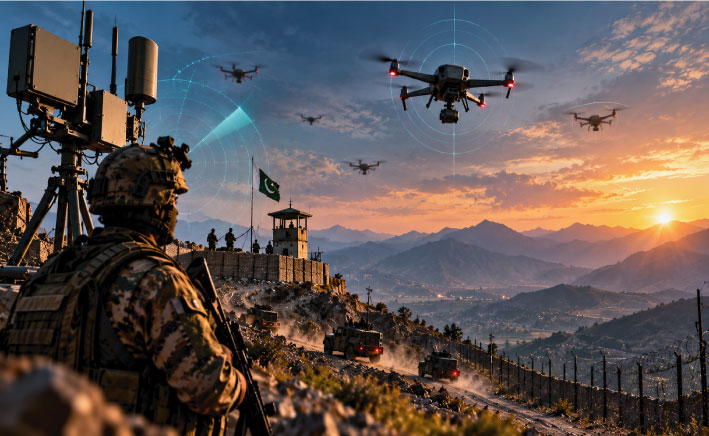
During the first half of 2026, the number of drone attacks attributed to TTP reached 341, while the latest attack occurred on Sept 23 in Torkhan and Kohat regions, where Pakistani authorities shot down eight commercial quadcopter drones of TTP. The TTP’s attacking strategy evolved from conventional military tactics of using unmanned armed vehicles (UAVs) to Chinese made cheap quadcopter drones in recent times. The TTP can acquire commercial quadcopter drones through local markets, civilian supply chains, and intermediaries. These drones originally design for civilian purpose, but can be modified to carry out surveillance and attacks. Access to affordable technology and technical expertise has made drone warfare increasingly accessible to militant groups, allowing them to develop new tactics without the resources required to manufacture advanced and sophisticated drones. In the context of Pakistan’s national security challenges, the integration of drones attacks with militant operations and propaganda demonstrates how non state actors can employ relatively cheaper and simple technologies to produce disproportionate damage.
Hybrid drones attack represent an emerging form of proxy warfare in which non-state armed groups use commercially available drones to target security forces and other installations, potentially with external assistance. In case of Pakistan, this concept provides framework for examining how India could use non-state actors, such as the TTP, as proxies to destabilize Pakistan without engaging into direct military confrontation. India’s alleged support for the TTP’s drone capabilities, intelligence networks and resources raises serious concerns about the use of hybrid warfare against Pakistan. Such support could enable indirect pressure on Pakistan by intensifying internal security challenges and stretching its counter terrorism capacity without conventional warfare.
The question concerns the origin of TTP’s drone capabilities, networks and funding that may facilitate this development. As Islamabad accused New Delhi for supporting anti Pakistan militias in order to destabilize Pakistan. But the allegations published by The News on Sept 19, 2026 shows coordination among India’ s RAW, TTP and Taliban government and pledge of $7.8 millions for coordinated military operations on Pakistan soil. Moreover, the increasing engagement between India and Taliban specifically, Taliban’s fourth minister’s visit to India has raised security related concerns in political landscape of Pakistan amid of environment where New Delhi does not recognize Taliban government yet. Nevertheless, the possibility of external facilitation has important implications for Pakistan’s national security policy.
Pakistan’s own counter terrorism response (COIN) also forms an important part of debate. The military operations, including Azm-e-Istehkam, Rah-e-Nijat, Zarb-e-Azb Ghazbe-lil-Haq, and Radd-ul-Fasad have sought to dismantle the militant infrastructure and reduce operational space for Terrorist attacks. These initiatives highlight the government efforts to address terrorism and protect state’s sovereignty and territorial integrity as early as possible but not particularly addresses the broader hybrid drone attack question. The emergence of weaponized commercial drones requires additional measures tailored to this evolving threat.
Pakistan, therefore needs the comprehensive counter drone strategy with mix of technological preparedness, intelligence and institutional coordination. In order to neutralize the threat before a drone reaches its target, Pakistan requires the coordination across the whole state machinery including military, Intelligence agencies, law enforcement agencies (LEAs), and the local population for intelligence services as emphasized by Sun Tzu in his Art of War for early warnings.
Peru’s campaign against the Shinning Path insurgency shows that intelligence not kinetic measures alone break militant networks. A small police unit, GEIN tracked supply chains and couriers of militant groups for over two years, and captured group’s leader in 1992. Moreover, the State also used local population for intelligence sharing in areas it could not reach. Yet Peru also shows limits in complete eradication of remnants of militias. For Pakistan, the lesson is to empower police intelligence, builds local trust, and pair security action with rights respecting governance. Pakistan should also establish forensic laboratories for supply chain investigations and attribution of drone attacks and a database where analysts gather all drone attack data to observe the patterns and improve preparedness and anticipate future attack patterns. Ultimately, the skies of Pakistan can only be secured when it we can in time are able to perceive the threat coming, trace it and act before it arrives.
Author: Noor ul Eman, Research Intern, Cneter for International Strategic Studies, AJK.
