
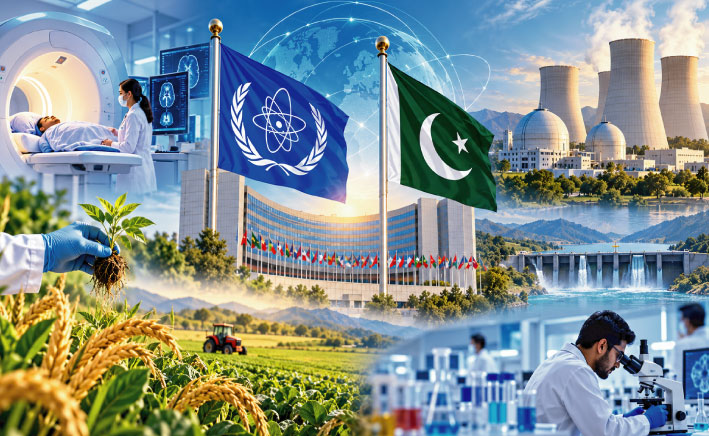
The International Atomic Energy Agency (IAEA) has recently declared Pakistan’s nuclear security regime as “robust,” following its first-ever International Physical Protection Advisory Service (IPPAS) mission to the country. Pakistanis scientists, decision makers and institution worked hard to achieve the trust of international institutions. They established rigours, structural and institutional mechanisms to ensure not only the safety and security of our nuclear program but its utilisation for the pubic good as well. This acknowledgment of Pakistan being a responsible state actor, committed to a peaceful world, reflects upon the hard work of all the institutions made it possible.
Notably, nuclear discourse in South Asia is traditionally analyzed through the lenses of structural realism: strategic stability, deterrence, and arms control. While these dimensions remain critical in a complex regional security environment, focusing solely on military deterrence overlooks a crucial aspect of nuclear governance, which is the utilisation of nuclear technology for human development. This civilian application of nuclear science and technology represents a sophisticated, non-strategic dimension of national capability and credibility. For developing nations, the peaceful application of the nuclear science is a critical driver for public welfare, economic productivity, and the fulfilment of the United Nations Sustainable Development Goals (SDGs).
Modern nuclear diplomacy is no longer confined to the verification of safeguards, application of regulations or crisis management; it acts as an instrument for technological cooperation, knowledge transfer, and institutional equity. In an asymmetrical international system, nuclear diplomacy bridges the gap between domestic developmental deficits and global technological regimes. This framework is essential for negotiating equal access to peaceful nuclear technologies between the Global North and the Global South. Nuclear diplomacy is the strategic application of diplomatic instruments to regulate, manage, and utilize nuclear capabilities. While frequently associated with crisis management, it serves as a vital framework for conflict prevention and global cooperative security.
Nuclear diplomacy creates a more peaceful world by preventing catastrophic conflict through strategic restraint, risk reduction protocols, arms control and verification frameworks, democratizing the “Peaceful Atom” to mitigate geopolitical grievances, fostering a rules-based international order, and through creating platforms for continuous dialogue.
Institutional Alignment: Pakistan’s Tenure on the IAEA Board of Governors
The International Atomic Energy Agency (IAEA) serves as the multilateral apex body regulating nuclear safety, security, and technical cooperation. Being one of its founding members, Pakistan secured its 21st term for the 2024–2026 periodduring the 68th Session of the IAEA General Conference in Vienna. Additionally, Pakistan has had the honor of chairing the Board of Governors thrice in 1962, 1986, and 2010.
Pakistan’s frequent election to the IAEA Board of Governors underscores its structural integration into global nuclear governance. This position allows Islamabad to actively participate in international policymaking while advocating for the socio-economic priorities of developing states.
Pakistan’s diplomatic credibility at the IAEA is backed by a highly developed domestic scientific infrastructure. Managed primarily by the Pakistan Atomic Energy Commission (PAEC), this network operationalizes nuclear science into quantifiable public goods, reinforcing human security across four primary sectors:
- Oncology and Public Health: Pakistan maintains an extensive infrastructure of nuclear medicine and radiotherapy facilities. PAEC cancer hospitals administer over one million diagnostic and therapeutic procedures annually, serving over 80% of the country’s cancer patients while addressing critical gaps in national oncological care.
- Agricultural Yield and Climate Adaptation: Agriculture contributes nearly a fifth of Pakistan’s total GDP and drives about 70% of its total exports. PAEC research institutes have engineered and released more than 150 climate and stress resilient crop varieties and have directly added value to the exchequer. These variants optimize agricultural yields and bolster food security in a region highly vulnerable to climate-induced environmental stress. According to independent estimates these varieties have boosted farmer yields by 15% to 30%, adding over 1,200 billion rupees ($7.4 billion) in cumulative economic value to the national exchequer.
- Isotope Hydrology and Water Management: Utilizing advanced nuclear techniques, Pakistani scientists conduct precise water-resource assessments. This data provides empirical pathways to manage acute water scarcity and optimize municipal and agrarian water distribution. It prevents soil degradation that would otherwise diminish industrial and agrarian land productivity.
- Energy Security: Persistent energy crises have historically cost Pakistan billions of dollars in annual GDP contractions. Nuclear power provides a reliable, uninterrupted baseload supply that stabilizes the industrial sector. Pakistan’s six operational nuclear power units (across Chashma and Karachi) generate over 3,500 MW of electricity, accounting for roughly 17% to 18% of the national energy mix. By providing base-load electricity without relying on expensive, imported liquid natural gas (LNG) or coal, the nuclear sector saves billions in foreign exchange reserves, directly preserving GDP value.
- Industrial Cost Reduction and Efficiency: In the manufacturing sector, nuclear tech optimizes industrial processes to lower production overheads. Radiation technology is heavily utilized in Pakistan’s high-value engineering, gas pipelines, and heavy manufacturing sectors to test structural integrity without damaging components, significantly reducing operational losses.
Demonstrating its transition from a technical recipient to a regional provider, Pakistan hosts several IAEA-designated Anchor and Collaborating Centres. These facilities specialize in cancer care, food security, and nuclear safety, acting as nodes for regional capacity building and institutional knowledge transfer.
The systemic legitimacy of a peaceful nuclear programme depends on its regulatory framework and safety culture. Pakistan’s adherence to IAEA-mandated safety practices, radiation protection standards, and emergency preparedness protocols forms the basis of its responsible nuclear stewardship. By integrating its technical experts into IAEA-coordinated global advisory missions and emergency exercises, Pakistan aligns its domestic security architectures with international best practices.
Analyzing nuclear policy through a singular strategic lens creates an incomplete understanding of national power. A comprehensive analysis must harmonize technical, diplomatic, ethical, and developmental frameworks nuclear science supports. Ultimately, Pakistan’s structured engagement with the IAEA demonstrates that responsible nuclear governance and human security are not mutually exclusive; rather, they are complementary pillars of sustainable state progress.
Author: Dr. Asma Shakir Khawaja, Executive Director at Center for International Strategic Studies, AJK. She can be reached at Asmakhawaja5 at X (Twitter)
