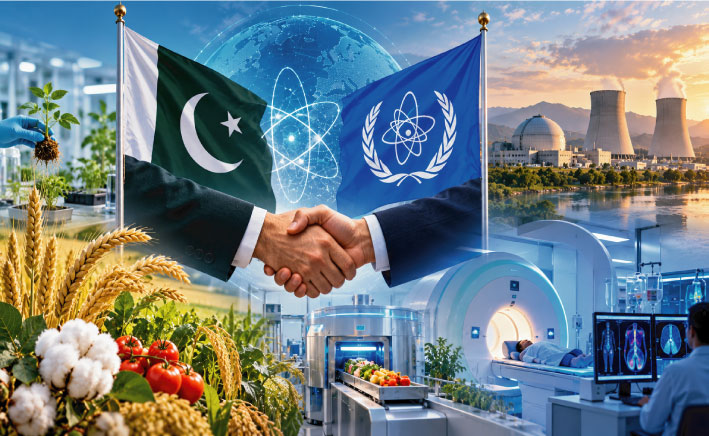
Pakistan was one of the founding members of the International Atomic Energy Agency (IAEA) when it was established in 1957. In the contemporary era, nuclear technology has become increasingly important due to its applications in the civilian domain, including healthcare and food security. The significance of peaceful nuclear technology is growing, particularly for countries like Pakistan. The IAEA’s role, therefore, is important in helping Pakistan harness this technology by supporting the development of facilities and providing the latest technical expertise. This enables the country to make the most of nuclear technology and address various challenges in the civilian domain. In this way, the partnership and cooperation between Pakistan and the IAEA extend beyond regulatory matters to address challenges across key sectors.
Food Security and Healthcare
According to the 2018 National Nutrition Survey, 36.9 was food insecure in 2018. In the 2023 Global Hunger Index, Pakistan ranked 102 out of 125 countries, presenting a dangerous level of hunger. Therefore, effective techniques are necessary to counter hunger and meet the needs of population. With nuclear technology, the production and yield of food can be increased by implementing various techniques. The most operative method is food irradiation, where seeds are exposed to gamma rays producing different seed varieties that have resilience to climate change and microorganisms. For example, Nuclear Institute for Agriculture and Biology (NIAB), in collaboration with IAEA, located in Faisalabad has developed climate change resilient cotton varieties having high tolerance to pests and microorganisms.
Similarly, Pakistan Atomic Energy Commission and IAEA joined forces and established two agriculture research facilities at Tandojam and Lyallpur, where scientists use radioactive techniques to conduct research. For example, these facilities produced a wheat mutant that had 19 percent more protein than regular wheat.
Postharvest loss is also a major setback to Pakistan due to spoilage, insects, biodeterioration by microorganism. According to Asian Development Bank report, Pakistan faces postharvest loss worth $1.3 billion per year. To preserve the food and minimize the loss, nuclear technology will prove very effective. According to research conducted at Tandojam and Lyallpur centres, gamma irradiation can disinfect wheat and rice and can also extend the shelf life of fruits.
Apart from the integration of nuclear technology in food security, Pakistan, in collaboration with IAEA, has also amalgamated nuclear techniques into healthcare. Nuclear technology brings forth many techniques that hold utmost significance specifically in diagnosis and curation. It includes advanced imaging techniques, such as Positron Emission Tomography (PET) scans, to create detailed images of internal organs and tissues for detection and treatment of ailments at their earliest stages.
Radiotherapy is another widely employed technique in the fight against cancer, utilizes ionizing radiation produced by nuclear reactors to target and destroy malignant cells. Currently, Pakistan operates 19 cancer hospitals under the auspices of the Pakistan Atomic Energy Commission (PAEC), which provides diagnostics and treatment to over a million patients each year. PAEC use innovative techniques such as gamma CT, LINAC, Cyberknife and theranostics to treat cancer patients.
IAEA offers its assistance by providing support to the research and development institutions. For example, it supports the Nuclear Medicine Oncology and Radiotherapy Centre in Abbottabad under its technical cooperation program. Their research and development in the field of medicine has proven beneficial in the treatment.
Future Goals
Apart from food security and healthcare, IAEA and Pakistan has also cooperated in the field of energy. Currently, Pakistan has six nuclear power reactors in Karachi and Chashma which have the capability to generate 3262 MW of electricity. But according to the state’s Nuclear Energy Vision 2050, 32 nuclear reactors are needed to fulfill the required energy demand. Therefore, a mutual partnership with IAEA is essential to accomplish this goal.
Also, Pakistan’s ambition of zero carbon emission in energy sector can only become a reality if IAEA would cooperate with it. Pakistan is the most vulnerable country when it comes to climate change even though it has less than 1 percent of carbon emission, therefore, to achieve the goal of zero carbon emission in energy sector Pakistan would require access to nuclear energy and technology. The safe and secure integration of nuclear technology will decrease the dependence on fossil fuels to shift towards clean energy.
Pakistan has followed all the necessary guidelines of IAEA and has always operated on the standard procedures and international norms so Pakistan should be allowed to access nuclear energy and technology. It will further exacerbate the growth and development with very less effect on environment.
As aforementioned, Pakistan and IAEA already have cooperative initiatives in the field of medicine, agriculture, energy which provides avenues for human development and nuclear security. They can further increase the partnership by introducing more capacity building initiatives and technical cooperation programs.
Author: Umar Iftikhar, Research Intern, Center for International Strategic Studies, AJK.
