
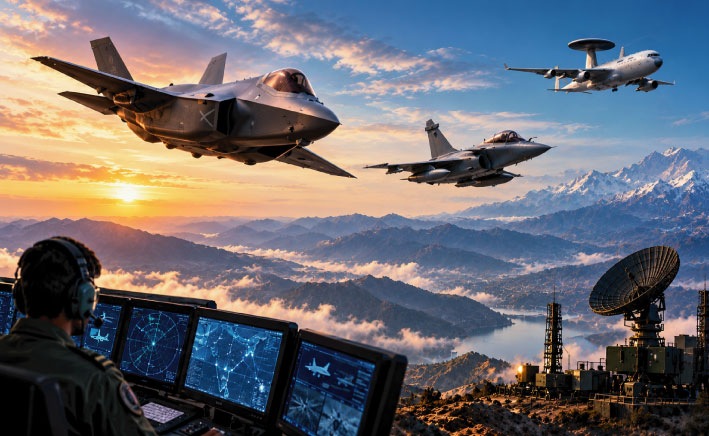
In order to gain an operational edge in network centric warfare in South Asian region, India is trying to integrate AI and other emerging technologies into its defense structure, particularly Intelligence Surveillance Reconnaissance (ISR) domain. India wants to respond quickly to security challenges and improve its ability to share information, coordinate military operations, and detect threats through these efforts. In pursuit of strengthening its air warfare capabilities, India is also investing in airborne early warning systems, integrated air command and control systems and partnership with other countries. However, In South Asian nuclear environment, these developments in Indian air power may increase military competition, which in turn could affect the regional security.
The Air Marshall Tejpal Singh gave a statement “Sense better, understand faster” in a seminar on surveillance, C4I2, and electrooptical systems in New Delhi to help India gain an operational edge. He stressed that “the military systems should have interoperability from the design stage itself. According to him, information superiority is becoming the most critical factor in the modern warfare. The future battles according to him, will not be won only through platforms and weapons but through network-centric operations, and quick decision-making.” Such an integration can lead to compress the decision time in the region.
According to Gabriel Honrada, India is showing interests in joining the French-led Future Combat Air System (FCAS) program reflecting a change of strategic necessity, because it needs a clear route to build next generation. Prime Minister Narendra Modi met with US President Donald Trump during his visit to Washinton in February,2025. He announced that US is paving a way for India to acquire F-35s which are fifth generation multi role fighter jet with AI -driven combat systems, advanced sensors, and data sharing capabilities.
India is also considering to enter into deal with Russia for Su-57E stealth fighter jet which is a fifth-generation aircraft. This deal over this acquisition of this stealth fighter have entered in advanced technical phase signals a long-term delayed effort to restore regional air power. This deal includes the delivery of 36 to 60 fully assembled 57E stealth fighters.
India rushes to sustain Jaguar fleet flying as UK transfer Retired RAF jets. India has acquired nine retired Royal AirForce SEPECAT jaguar aircraft from UK has which involved multiple single seat GR.1 and twin seat T.2 Jaguar along with more than 150 categories of spare parts. According to some defense planners, the Jaguar fleet is temporary but essential bridge until the Tejas MK1 MK2, and AMCA are ready.
India’s Ministry of Defense on 22 July, 2026, announced contract for MK-II and AEW& C program, which includes the upgradation of six A321 aircraft & the production and development of mission systems It aimed to enhance the secure communication, situational awareness, and command and control capabilities.
These developments for acquiring the next generation air warfare show that India may be trying to gain superiority in aerial warfare in the South Asian region. India’s growing developments in network centric warfare may have significant implications for South Asian security. This may improve India’s defense system but at the same time, it may also increase the uncertainty, escalation risks, arms race competition in the region. (The India’s belief that artificial intelligence, network centric warfare and advanced aircraft can create a critical advantage, may develop a false sense of superiority leading to miscalculations. Such perceptions are particularly risky in South Asian region because Pakistan’s security calculations are directly affected by these developments of India. If India is overconfident in technological progress and believes that it can control a conflict by gaining superiority in air power, it can lead to the increasing risks of escalation between these two nuclear armed states. Therefore, strategic strength lies in avoiding miscalculations, maintaining strategic restraint, and understanding their limitations, rather than just acquiring advanced capabilities. In the same context, management of crises as well as responsible military planning are crucial for technological superiority in a nuclearized region.
Pakistan should develop its international partnership to modernize its airpower. Partnership with China can help Pakistan to develop fighter aircrafts and transform its technology, whereas opportunities for industrial collaboration, aerospace research and participation in next generation aircrafts programs have been offered by Turkey. Russian cooperation can also be pursued in maintenance arrangements and engine support systems, which can be an affordable and practical option. Pakistan should not only be dependent on foreign investments but develop its own capabilities. Signing agreements with other countries is not just enough for the success of Pakistan but the actual success is whether these agreements deliver skilled personal, technology, stronger indigenous industries, and reliable maintenance. By adopting such a strategy would enable Pakistan to develop sustainable air power while reducing the strategic risks of excessive reliance on foreign suppliers.
Author: Amina Arooj, Research Intern, Center for International Strategic Studies, AJK.
