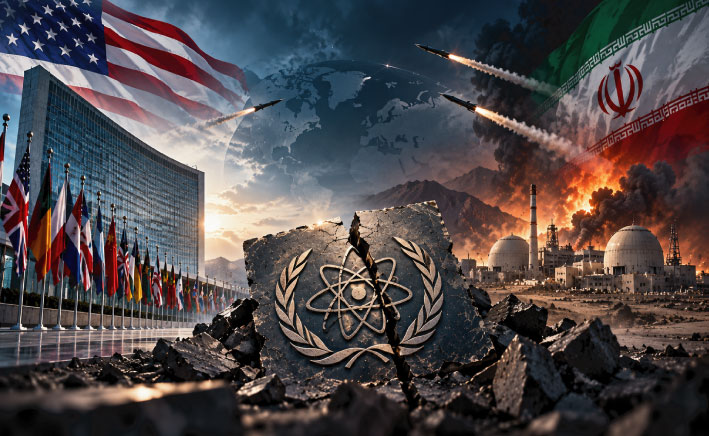
The US-Iran war has raised central debates about the credibility and effectiveness of Non Proliferation Treaty (NPT), a cornerstone of global nuclear governance aimed to prevent and spread of nuclear weapons, promote peaceful nuclear cooperation and advocate for disarmament. According to analysts, the US war on Iran and unprovoked attacks on Iran’s nuclear facilities has deepened mistrust, weakened confidence in international nuclear governance, and challenged the long-term credibility of the NPT regime. The following conflict therefore affect the NPT by raising concerns over nuclear latency (the ability to develop nuclear weapons without possessing them) risks and state’s compliance with its non- proliferation obligations.
The U.S. and Israel began a major bombing campaign against Iran on 28th February 2026. By October, the conflict has continued for 8 months, with negotiations deadlock. Beyond the direct human, economic and infrastructural costs, the conflict simultaneously aggravated the nuclear dimension of the crisis activities coupled with damage to key nuclear facilities. Against this backdrop, the joint Comprehensive Plan of Action (JCPOA) concluded important precedent for assessing current crisis. The agreement between Iran and the P5+1 in 2015, provides an restricted Iran’s enrichment level to 3.67 and enrichment stockpile to 300kg in exchange for the sanction relief and established extensive monitoring arrangements intended to lengthen the time required to produce enough fissile material for a nuclear weapon and improve the international community’s ability to detect prohibited activity. However, the unilateral U.S. withdrawal from the JCPOA in 2018 without a viable alternative and subsequent reinstatement of sanctions under its “maximum pressure” campaign weakened that effective diplomatic mechanism to deal with Iran. This mechanism was further undermined by 2026 ongoing military strikes.
Under the current circumstances the military escalation can worsen the conditions needed for nuclear diplomacy. As Iranian officials described their government’s reluctance to make concession with the US, may be to weaken Trump politically ahead of November’s US midterm elections and insisted that its other conditions (presented in 7 day proposal) should be met which includes lifting the US blockade, easing oil sanctions, releasing frozen assets and ending hostilities. On the Washington side, by making major concessions after military confrontation could be interpreted as rewarding Iran for resisting pressure, posing a threat of political paralysis to Donald Trump’s administration at home. Conversely, If Iran believes that compliance with NPT will not protect it from future attacks it may even think of changing nuclear doctrine which can further jeopardize the NPT regime. And as a lesson from Iran war, non-nuclear states may also seek to possess nuclear latency capabilities as a security hedge against threats.
Adding another drawback to the treaty, the NPT conference’s failure was a part of a longer pattern: the 2015, 2022, and 2026 all ended without consensus, the attacks on safeguarded Iranian facilities remained among the most divisive issues thereby raising concerns over NPT as a central pillar of international security. Hence, this conflict has damaged the trust mechanism on which NPT depends.
Moreover, Iran remains a party to NPT, but calls for withdrawal under Article X of NPT, have gained attention among Iranian hardliners amid the confrontation with the United States. Iran’s security chief Mohsen Rezaei publicly raised withdrawal from the treaty as one of the Iran’s strategic option in future, while committed to the fatwa of martyred Imam Ayatollah Ali Khamenei yet. Though Iran has not taken that step but increasingly discussion over withdrawal demonstrates how the war is affecting perceptions of the treaty’s value. The following crisis also exposes the NPT’s legitimacy and equality problem. Iran and many other non-nuclear states argue that NPT cannot remain credible if nuclear- weapon states continue to modernize their arsenals while demanding restraints over non –nuclear states.
The US- Israel war with Iran not only cause implications for peace but also greatly impacting NPT regime. The intense military preparation by each side and diplomatic deadlock does volatile the conflict and cause serious implications in the effectiveness of nuclear diplomacy. Reduced military confrontation, sustained U.S.-Iran diplomatic engagement and stable negotiations, supported by IAEA verification, sanctions relief and transparency in sensitive nuclear activities could help preserve the NPT as a credible and trusted framework for peaceful nuclear world. Moreover, addressing the wider perception of double standards of nuclear order could further enhance NPT’s credibility.
Author: Arooj Saghir, Center for International Strategic Studies, AJK.
