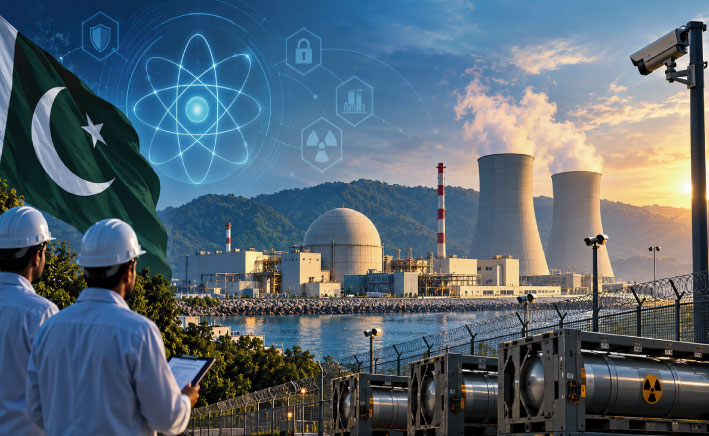
The first-ever evaluation of Pakistan’s legislative and regulatory framework for nuclear security covering both he nuclear material and facilities has been conducted by International Atomic Energy Agency (IAEA) International Physical Protection Advisory Service (IPPAS). During 12- day review, the IPPAS teams viewed that “Pakistan has established a robust nuclear security regime for physical protection of nuclear material and nuclear facilities, which was observed to be appropriately implemented at the facility visited. The regime is continually improved and sustained through periodic reviews, and Pakistan’s well-established capacity building infrastructure benefits national, regional and international expertise in nuclear security.” The mission team also visited the decommissioning project at Karachi Nuclear Power Plant Unit 1 (KANUPP-1). Pakistan’s first nuclear power plant (NPP), to examine the decommission procedures and spent-fuel storage arrangements, crucial for human health and environmental protection. Since the inception of its nuclear programme, Pakistan has consistently worked to strengthen the safety and security of its nuclear facilities. It has introduced various measures in line with established international nuclear security standards. The IAEA’s IPPAS mission further demonstrates Pakistan’s engagement with the international community in promoting and strengthening nuclear security.
The IPPAS review is significant for Pakistan as the security mechanism of its nuclear assets has always remained a subject of criticism in the western and international policy discourse. In this regard, the review has benefited Pakistan in various dimensions. First, an independent review presents facts instead of relying on opinions and claims. As mission included experts from several countries have evaluated Pakistan’s nuclear security mechanisms, making the assessment more balanced. These experts have also provided recommendations to enhance the nuclear security infrastructure and to strengthen it compliance with international standards. Second, nuclear energy plays a significant role for fulling country’s energy requirement. As per the current year it has contributed 18.5% in the energy mix. Hence, the review supports the international cooperations as it is primarily relied on confidence and trust in nuclear safety and security. Islamabad believes that all countries should be provided with equal opportunities to benefit from the peaceful uses of nuclear technology by adopting policies in line with the international standards. Also, a willingness to enhance nuclear security mechanism to strengthen this position. Third, such review enables Pakistan with an opportunity for a stronger position in global affairs. Through independent evaluations, professional skills, training and sharing its experiences with other nations, can show Islamabad’s commitment and its concern for nuclear security worldwide. These initiatives can provide Pakistan with opportunities to take part in discussions regarding international rules for nuclear safety and security. Also to have its say in international forums.
Although Pakistan is neither a signatory of Non-Proliferation Treaty (NPT) nor member of any export control regime (ECR) but still has an exceptional non-proliferation record and maintains world class nuclear safety and security standards. In this regard Pakistan’s efforts with international institutions and its participation on global initiatives reflects its commitments in strengthening its nuclear security framework and promote international corporation. Islamabad fully aligns with the already established nuclear order. It has placed its NPPs under the IAEA safeguards. It accepts the physical protection convention, its amendments and maintains export controls.
Based on the IAEA Nuclear Security Recommendation on Physical Protection of Nuclear Material and Nuclear Facilities (INFCIRC/225/Rev.5), Pakistan Nuclear Regulatory Authority (PNRA) in 2019 enacted “Regulation on Physical Protection of Nuclear Material and Nuclear Installation – (PAK/925). These regulations aimed to maintain the physical protection of its nuclear material against any unauthorised use, storage, transportation and ensuring the security of nuclear facilities. Also, to fulfill the requirement of the Convention on the Physical Protection of Nuclear Material (CPPNM). Moreover, in August 2018, PNRA issued a “Regulations on Security of Radioactive Sources – (PAK/926)”. These regulations were developed in line with the IAEA ‘Code of Conduct on Safety and Security of Radioactive Sources’ and its supplementary guidance on the ‘Import and Export of Radioactive Sources’ and the ‘Management of Disused Sources.’ The IPPAS mission provides an additional independent assessment of Pakistan’s nuclear security arrangements.
General Karine Herviou, an IAEA Deputy Director praised Pakistan for its efforts in enhancing the skilled professionals for nuclear safety and security. He also acknowledged that other countries can also benefits from this expertise. This expresses that Islamabad has not only emerged as the recipients of guidance from international organization rather shares its knowledge and expertise. The Pakistan-IAEA collaborated institutions such as National Institute of Safety and Security (NISAS) trains professional from both within and outside the country. The Pakistan’s cooperation with IAEA is also evident from the technical activities. The frequent workshops on various spectrums of nuclear safety and security add another layer of Pakistan’s serious commitment. Recently Pakistan Nuclear Regulatory Authority (PNRA) conducted a national workshop on commercial-grade item dedication. The workshop focused on addressing the challenges in nuclear safety. For instance, a difficulty in obtaining a specialised equipment when the NPP get old. In such scenarios the operators require reliable tools and methods to determine the components for safety related systems. These activities demonstrate Pakistan’s responsible behaviour to nuclear safety and its willingness to cooperate with the international community. They also show that Islamabad takes international reviews seriously to improve its nuclear safety practices rather than simply enhance its public image.
By following international standards, welcoming independent reviews, and cooperating with international organisations on nuclear safety and security, Pakistan demonstrates its openness to external assessments. Furthermore, its also shows Islamabad’s willingness to work on the recommendations for further improvement.
Author: Dr Rahat Iqbal, Associate Director Research, Center for International Strategic Studies, Islamabad.
