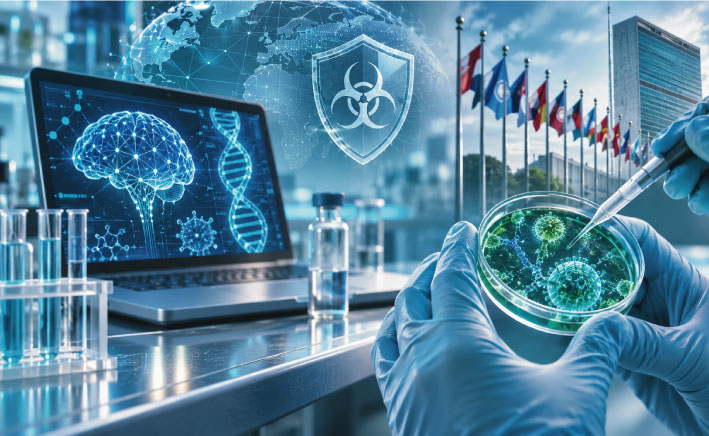
AI and synthetic biology are continuously transforming scientific research. AI helps analyse scientific data and supports biological research. On the other hand, synthetic biology plays an important role in understanding the design of different biological systems and their modification. Both AI and synthetic biology offer benefits for medicine, agriculture, and disease prevention. However, these technologies also raise concerns about the potential misuse of biological knowledge, as scientific developments can create security risks. This creates a tension between scientific progress and security. The challenge is not to stop technological progress but to ensure international security through biological arms control agreements and mutual trust among States. These efforts can help address the risks associated with emerging technologies.
An analysis of recent developments shows that AI is advancing biological research. For example, Google DeepMind’s AlphaFold is an AI-powered system that can predict protein structures and helps scientists predict protein structures in a much shorter time, significantly accelerating the process of protein structure prediction. This development has contributed to drug discovery and research into treatments for various diseases. However, it also creates a dual-use dilemma, as technologies developed for peaceful purposes may be misused if they fall into the hands of malicious actors. The challenge is to preserve scientific progress while managing the risks associated with the misuse of these technologies.
Recent international developments highlight the urgency of this issue. In January 2025, the United Nations Scientific Advisory Board published a brief on synthetic biology discussing recent scientific developments and associated challenges. Another 2025 working paper under the Biological Weapons Convention (BWC) also addressed developments in engineering biology, AI, and robotics. These discussions highlight how emerging technologies are challenging traditional approaches to biosecurity and emphasize the importance of improving cooperation among States to promote both scientific development and security. AI supports biological research, including the study of protein structures and diseases. However, the misuse of AI capabilities may also increase biological security risks. Therefore, as AI capabilities continue to develop, greater consideration should be given to their responsible use and the reduction of potential risks.
The Biological Weapons Convention (BWC), an international treaty adopted in 1972, prohibits the development, production, acquisition, transfer, and stockpiling of biological and toxin weapons. However, the Convention does not have a legally binding international verification regime to systematically verify compliance. Emerging technologies such as AI and synthetic biology are developing rapidly, highlighting the need for confidence-building measures among countries to assess scientific developments. In the age of AI and synthetic biology, the existing treaty requires stronger implementation, scientific assessment, and transparency.
In addressing the challenges posed by emerging technologies, the efforts of the international community cannot be overlooked. On 29 September 2026, the World Health Organization (WHO) provided updated practical tools and guidance on the responsible governance of life sciences and dual-use research. The main objective of these efforts is to manage risks without hindering scientific research. The next stage of negotiations is scheduled for December 2026, and this process is expected to contribute to scientific advice, international cooperation, and discussions on verification.
Pakistan recognizes these challenges and has been working within the BWC framework since 1972. According to the Ministry of Foreign Affairs, Pakistan supports multilateral negotiations aimed at strengthening the Convention. Recognizing the risks associated with developments in AI and synthetic biology, Pakistan has also taken steps to strengthen its national implementation of the BWC through the Biological and Toxin Weapons Convention (Implementation) Act, 2026. It is important to continue updating national biosecurity arrangements in response to scientific and technological developments.
The way forward requires both national and international efforts. The Member States of the BWC must strengthen its implementation and work towards effective arrangements for verification and compliance, as well as explore new agreements that address emerging technological developments. There is also a need to establish a new scientific advisory mechanism comprising experts from different disciplines who can assess developments in AI, synthetic biology, and other emerging technologies and provide timely advice to Member States. For Pakistan, it is important to improve coordination among research centres, laboratories, universities, and other relevant institutions. To address these challenges, developing countries must receive adequate support. Developed countries should provide technical assistance, training, and scientific resources to strengthen the capacity of developing countries to manage risks while promoting peaceful scientific research.
In essence, AI and synthetic biology are not only sources of emerging challenges but also important drivers of technological development. The risks associated with these technologies depend on how they are developed, governed, and used. There is a need to strengthen the BWC through effective cooperation at the domestic and international levels. Scientific innovation and biological security must advance together through effective safeguards, international cooperation, and responsible innovation.
Author: Syed Faizan Ali Kazmi, Research Intern, Center for International Strategic Studies, AJK.
