
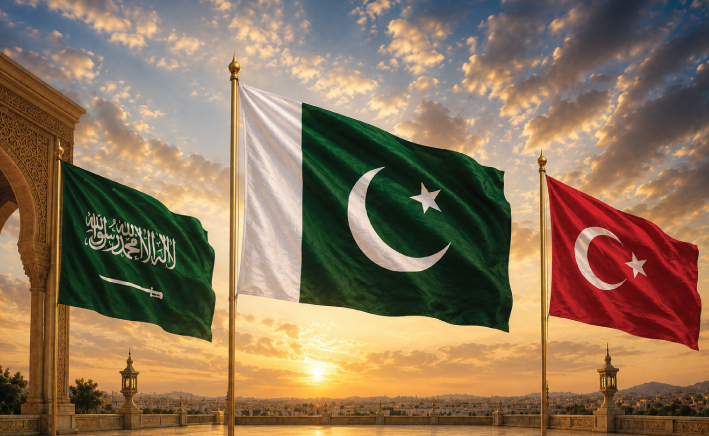
Earlier this month, Saudi Arabia, Turkey, and Pakistan signed the Mecca Joint Defense Agreement, an agreement stating that an armed attack on any one of the three countries will be treated as an attack on all three. The agreement builds on a bilateral defense agreement that Saudi Arabia and Pakistan signed in September 2025. Turkey, which had said in January it was considering joining, formally became a member seven months later. The deal has drawn wide attention because it brings together three major Muslim-majority powers, each with different strengths, Saudi Arabia’s financial resources while Turkey and Pakistan bring large military and defense industry.
What the agreement actually does. The core commitment is a mutual defense clause similar in language to NATO’s Article 5. Beyond that, officials have described the agreement as “purely defensive,” open to future members, and not directed at any specific country. Pakistan’s foreign minister and other officials have said the details of how the agreement will work in practice, including decision-making procedures and burden-sharing, are still being developed. Analysts note that, unlike NATO, the Mecca agreement does not yet have permanent institutions, joint command structures, or a clear enforcement mechanism, though these could be added over time.
Why it emerged now. The signing came amid heightened regional tension, renewed friction between the US and Iran, an expanded Israeli military footprint in the region, and continued instability tied to the Israeli genocide in Gaza and Houthi attacks from Yemen. Turkish Foreign Minister Hakan Fidan framed the agreement as a modest first step, noting that NATO has 32 members built up over decades, while this new grouping has three. He also said Turkish President Erdogan hopes to see the alliance expand, naming Egypt as one possible future member.
Different readings of what it means. Commentators are divided on how significant the agreement really is. Some, including the Council on Foreign Relations, have described it as evidence that the US-led security order in the Middle East is eroding, with regional states increasingly shaping their own arrangements rather than relying on Washington. Others, such as analysts have cautioned against overstating the shift as they note the agreement is not a NATO-style alliance, does not by itself replace the US security umbrella, and that all three signatories remain, for now, close US partners with deep military and economic ties to Washington. Notably, President Trump publicly welcomed the pact, calling it a positive sign that regional states are taking more responsibility for their own defense, rather than treating it as a rival to US influence.
Turkey and Saudi Arabia have historically competed for influence and leadership within the Sunni Muslim world, and analysts point out that this rivalry has not disappeared simply because of the agreement. Pakistan’s own strategic priorities remain heavily oriented toward its relationship with India rather than Middle Eastern security. Whether the agreement evolves into a more institutionalized alliance, expands to include countries like Egypt, or remains a largely symbolic declaration will depend on choices its members have not yet made public. Its long-term significance is something analysts will likely debate for some time, rather than something that can be settled at the moment of signing.
