
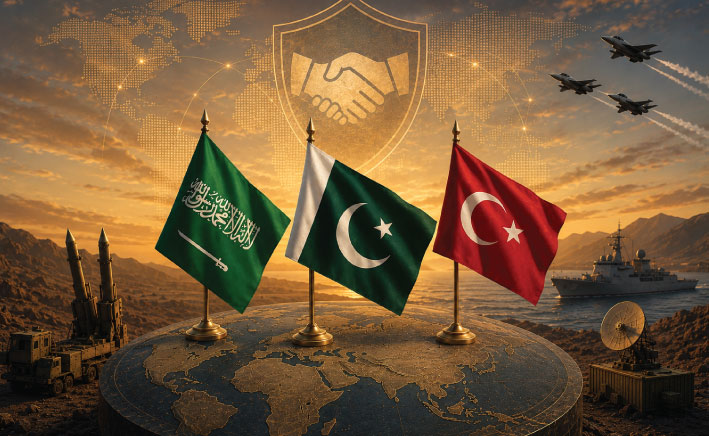
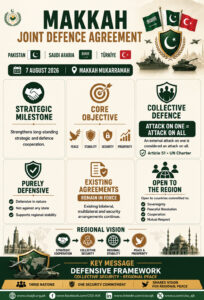
 The Mecca Joint Defence Agreement, signed on 7 August 2026 between Saudi Arabia, Türkiye and Pakistan, establishes a mutual-defence principle under which an armed attack against one signatory is to be regarded as an attack against all. Its significance lies in the emergence of a flexible, regional security network linking the Gulf, the Middle East, South Asia and the Indian Ocean. Notably their threat perceptions do not coincide but their will to resist aggression does. Resultantly the Mecca Agreement is a pertinent example of “collective security,” attempted by middle powers. The principal strategic value of the arrangement is therefore not the immediate aggregation of military power, but the creation of interoperability, resilience and strategic depth across multiple theatres.
The agreement is particularly significant because its three signatories operate within distinct regional security complexes and respond to different threat environments. Saudi Arabia is primarily concerned with security, attacks on critical infrastructure, missile and drone threats, maritime insecurity and regional competition with Iran. Türkiye’s strategic outlook is shaped by its NATO membership, autonomous regional ambitions, defence-industrial expansion and concerns regarding instability along its southern periphery. Pakistan remains focused on India-centric deterrence, strategic stability, maritime security and the protection of its economic development and diaspora’s interests in the Gulf. Their threat perceptions therefore do not fully converge. What unites them is a shared political vocabulary of sovereignty, resistance to external coercion and opposition to what they perceive as strategic domination or oppression.
The pact is best understood as strategic portfolio diversification rather than a complete break from existing alliances. Saudi Arabia remains dependent on the US military, technological and intelligence support; Türkiye remains a NATO member; and Pakistan maintains important relationships with China, the Gulf states and Washington. The agreement therefore adds another layer of deterrence without replacing or overshadowing existing partnerships. Its central logic is one of equivocation under conditions of systemic uncertainty. The signatories are attempting to reduce their vulnerability to the withdrawal, conditionality or politicisation of external security guarantees. Rather than choosing between competing great-power blocs, they are constructing overlapping partnerships that increase their strategic autonomy and strategic advantages. Moreover, by linking the Mediterranean, the Gulf, and the Indian Ocean, the treaty creates a continuous security corridor. This significantly expands the geographic and tactical “strategic depth” of each member state.
The pact’s greatest potential lies in this asymmetric complementarityprovided by the signatories. Saudi capital and geography, Turkish technology and Pakistan’s military manpower and strategic capabilities could generate cooperation in economy, diplomacy, air and missile defence, drones, intelligence, maritime security, logistics and defence production.
The pact reflects a wider movement away from security arrangements designed exclusively by external powers. Middle powers increasingly seek to become producers of security, not merely consumers of defence alliances. In this sense, Mecca defence agreement may represent a response by middle-powers to uncertainty with formation of a durable, and reliable political conditions to redefine contemporary security architecture.
The Mecca agreement’s clause that says, “An attack on one is an attack on all,” reflects upon the commitment that creates political and cognitive deterrence. It is important to note down that unlike NATO, the pact does not have integrated military command; automatic military intervention mechanisms; common bases or force deployments; a joint defence budget; or a clearly identified common adversary. Therefore, the agreement should not be treated as an operational alliance against any specific state or bloc equivalent to NATO as Indian and few foreign journalists have assumed and trying to build public perception around it.
For Washington, the pact presents both a challenge and an opportunity. It challenges the assumption that the United States must remain the sole organiser of Gulf security, but it also supports the American preference for greater burden sharing by regional partners. The likely US response will therefore be calibrated rather than confrontational: preserve bilateral security ties while encouraging the three states to contribute more to regional defence. It is expected that the pact may eventually produce a layered security architecture in which the US power, NATO connections, GCC arrangements and regional coalitions coexist. Nevertheless, Türkiye’s inclusion gives the arrangement a stronger political and conventional profile, while Pakistan’s participation adds strategic relevance and credibility.
Emerging security architect in Gulf may concern Israel for geopolitical and military reasons. As the possible outcome of the pact could be the, improved coordination in air defence and missile technologies; greater diplomatic coordination among Muslim-majority states; possible political support for Palestinian positions; enhanced Turkish influence in the Gulf and Red Sea; and the risk that a regional crisis involving Iran, Israel or allied forces activates the pact’s collective-defence clause.
The agreement could substantially improve Pakistan’s regional strategic profile. Islamabad gains a formal mechanism linking its military capabilities to Saudi security and Turkish defence technology. It also strengthens Pakistan’s diplomatic relevance in a region that supplies much of its energy, hosts millions of Pakistani workers and remains central to its economic and foreign-policy interests. Pakistan’s potential advantages include; expanded defence exports and joint production; greater access to financial support; increased military cooperation, diplomacy and training opportunities; stronger maritime cooperation in the Arabian Sea; enhanced diplomatic leverage; and a broader role in mediation during Gulf crises. Pakistan has become a security provider with a regional role extending from the Gulf to the Indian Ocean, enhancing her strategic position challenging India’s prestige based strategic designs.
Various scholars and journalists have envisioned primarily three broad scenarios. First, few perceived it as a limited compact pact, which would be symbolic mutual defence agreement, mainly focuses on bilateral exercises and diplomatic consultations resulting in increased prestige but modest military effect. Second scenario views it as functional security network, leading to cooperation in drones, missile defence, intelligence, maritime security and defence production, causing durable regional influence and stronger deterrence. Third scenario named it as a polarised bloc, which may threaten different hostile elements leading to higher arms competition, proxy conflict and escalation risks. However, a critical strategic assessment considers the second scenario as the most plausible near-term outcome. Its immediate function is to generate declaratory deterrence, strategic reassurance and diplomatic signalling. Its deeper significance lies in its potential to institutionalise a more autonomous and multipolar regional order in which middle powers combine resources, technology, geography and military capabilities to reduce dependence on external security providers.
The Mecca Pact is therefore important not because it has already created a unified military alliance, but because it represents a potential shift from alliance dependence to layered strategic autonomy. The pact proves that middle powers no longer need to rely solely on great-power security guarantees. They can independently orchestrate collective frameworks to stabilize their immediate neighbourhoods. Its central strategic effect may be the gradual emergence of a more interconnected security architecture spanning the Gulf, Türkiye, Pakistan and the Indian Ocean. The Mecca Pact is therefore important not because it immediately creates a unified military bloc, but because it connects three strategically different powers and would institutionalised a more autonomous, networked and multipolar security order.
The views expressed in this article are of her own.
She can be reached at @Asmakhawaja5 on X (Twitter)
