Pakistan and the International Atomic Energy Agency signed a Nuclear Security Cooperation Programme in 2005, and the arrangement has since moved from project assistance to institution building. The Nuclear Security Action Plan, begun in 2006, strengthened physical protection, the control of radioactive sources, detection and emergency response. Since 2014 the Centre of Excellence, which comprises PCENS, NISAS and PIEAS, has trained personnel from Pakistan and other states. In 2022 NISAS was designated an IAEA Collaborating Centre, the tenth in nuclear security worldwide.
Several milestones now fall close together. The NISAS designation agreement is valid until 2026 and therefore comes up for renewal. The IAEA is starting its 2026–2029 Nuclear Security Plan, and Pakistan has signed a Country Programme Framework for 2026–2031. This is a reasonable point to ask what the partnership should aim to achieve over the next decade, while renewing existing arrangements on their present terms.
From capacity building to emerging threats
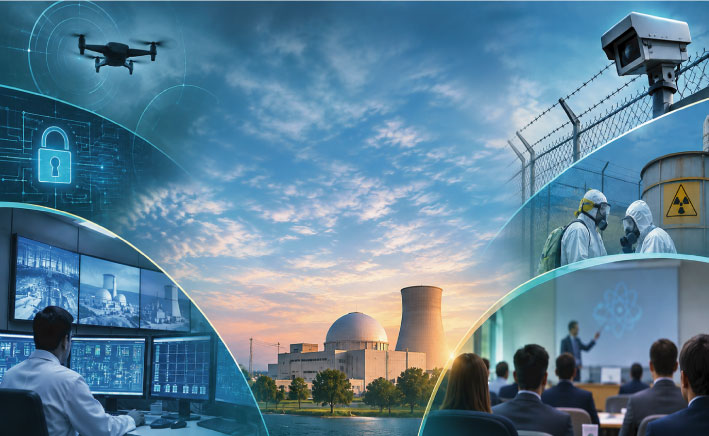
Gaps in infrastructure and training were filled during the first phase of cooperation, and the threat environment has changed since then. The IAEA has highlighted that the threat environment is shifting from traditional on-site security to one involving uncrewed systems. It’s 2024 International Conference on Nuclear Security listed artificial intelligence and uncrewed systems with both positive and negative implications for nuclear security, and has emphasized that security planners should consider expanding their security concepts beyond on-site threats to aerial threats. A small drone will not have to break into a perimeter to cause substantial costs. It can compel a response and bring to light deficiencies in the way aircraft are detected and in the rules for their engagement near populated areas. There is an additional challenge of cyber risk – modern plants are increasingly coming to rely on digital control systems which are not protected by physical security.
NISAS has already carried out a national course on computer security inspections, which was facilitated by the IAEA, and the Centre of Excellence has physical protection laboratories, which would be useful for testing. As a logical next step, a joint programme on counter-UAS and computer security could be developed on these facilities and based on IAEA guidance. It would also be a regional issue, as drones are now used in regional and global military practice and there is little room for misreading an incursion near a sensitive site.
Sovereign responsibility, voluntary partnership
In Pakistan, nuclear security is considered as a national responsibility and assistance from IAEA is provided on request. The partnership has endured because of its acceptance of that division of roles. Pakistan is not an NPT member state but has voluntary safeguards agreements with the Agency, and experience of implementing cooperation programmes. In October 2025, Director General Rafael Grossi referred to Pakistan as a “privileged partner” and in February 2026, he characterized it as being “well placed to assist other member states with peaceful applications of nuclear technology.”
That standing gives Pakistan strength to contribute. Countries starting civil nuclear programmes will need regulators and security managers trained from the outset, and PCENS, NISAS and PIEAS could serve as a training base for newcomer states in Asia and beyond, with the IAEA coordinating curricula and certification. A role of this kind would also support Pakistan’s case for wider civil nuclear cooperation and for criteria-based access to export control regimes.
Protecting facilities in armed conflict
Attacks on nuclear sites in Ukraine and Iran have blurred the line between nuclear security and military risk. DG IAEA Grossi has repeatedly said that armed attacks on nuclear facilities should never take place, because radiation can cross the borders of the targeted state. The Agency’s loss of continuity of knowledge over Iran’s enriched uranium inventory shows how verification suffers when access lapses after such attacks. South Asia has a regional instrument of its own. Under a 1988 agreement, India and Pakistan exchange lists of their nuclear installations each 1 January, and the exchange was repeated in 2026 despite strained relations.
Pakistan could usefully reinforce this norm in IAEA forums and support Agency guidance on protecting facilities during conflict. Damage to a nuclear installation would not remain within one state’s borders, and a crisis in which each side doubts the safety of the other’s facilities would shorten the time available for restraint.
Priorities for the next decade
Four priorities seem worth considering. The renewal of the NISAS designation could carry a wider mandate that includes drones and computer security. PCENS could be developed further as a training base for states new to nuclear power. Pakistan may wish to keep presenting its security record at IAEA conferences and training events, since credibility with the Agency supports its broader civil nuclear aspirations. It can also use IAEA forums to sustain the norm against attacks on nuclear facilities. The next stage of the partnership will be judged by whether training, regulation and emergency response keep pace with the threats that facilities in the region now face.
Author: Syed Ali Abbas, Research Officer, Center for International Strategic Studies, AJK.
