
The recent killing of Chinese nationals in Tajikistan by individuals traced to Afghanistan has once again underscored the dangers emanating from ungoverned Afghan spaces. This incident is not an isolated event but part of a broader regional pattern in which insecurity radiating from Afghanistan increasingly threatens bordering states and major economic partners. It marks a sharp reminder that the Pakistan-Afghanistan frontier, long a source of tension, is now a regional fault line whose instability disrupts regional trade corridors, affects China’s presence in Central Asia, and reinforces the urgency of addressing the unresolved border regime.
The historical context of Afghanistan’s borders is essential for understanding why only the Pakistan-Afghanistan frontier remains disputed. The Durand Line, drawn in 1893 between British India and Afghanistan, was reaffirmed in subsequent agreements in 1905 and 1919 and inherited by Pakistan under the international legal principle of uti possidetis juris.
Unlike this frontier, Afghanistan successfully and peacefully settled all its other borders. Its boundary with Iran was demarcated through British arbitration in 1872 and reaffirmed in 1935, with the 1973 Helmand Water Treaty later stabilising relations. Its northern borders with Turkmenistan, Uzbekistan, and Tajikistan were defined between 1885 and 1895 by Anglo-Russian boundary commissions that used the Amu Darya River as a natural dividing line, and all three Central Asian states recognised these inheritances after 1991. The Afghanistan-China border, rooted in an 1895 Anglo-Russian understanding, was formalised through a bilateral agreement in 1963 in which China ceded approximately 250 square miles to Afghanistan. These cases demonstrate that whenever Kabul has entered structured diplomacy, disputes have been peacefully resolved. The persistence of the Durand Line dispute therefore reflects political choice rather than legal ambiguity.
The Afghan Taliban’s reluctance to recognise the border continues a long-standing pattern of Afghan political behaviour. Several factors inform this position. Demographically, formal recognition requires acknowledging that more Pashtuns live in Pakistan than in Afghanistan, undermining long-standing Afghan narratives of Pashtun centrality. Politically, the border dispute provides the Taliban—who lack constitutional, electoral, or institutional legitimacy—with a nationalist symbol to unify internal factions and divert domestic attention. Strategically, retaining ambiguity gives Kabul leverage over Islamabad while avoiding domestic accusations of territorial concession. Finally, the Taliban’s deep ideological and historical linkages with the Tehreek-e-Taliban Pakistan (TTP) constrain their willingness to dismantle the group’s sanctuaries. The consequences of this reluctance now extend beyond Pakistan, affecting neighbouring states’ security interests, Central Asian stability, and broader regional cooperation.
Thus, Pakistan confronts a multidimensional challenge on its western frontier. The most immediate threat is the resurgence of cross-border terrorism, particularly the rising tempo of TTP attacks in Khyber Pakhtunkhwa and Balochistan since 2021.
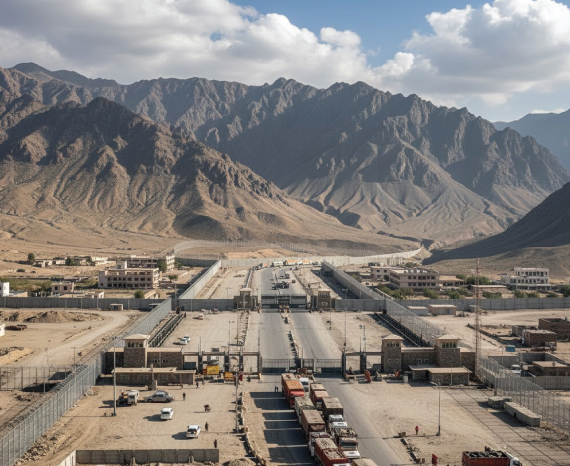
The absence of a mutually recognised border framework has also hindered the establishment of formal crisis-management mechanisms. Border closures at Torkham and Chaman—mostly triggered by security incidents—disrupt legal commerce, undermine local livelihoods, and fuel smuggling economies that further empower militant networks. The difficult terrain complicates surveillance, while overlapping tribal, familial, and economic linkages across the frontier create vulnerabilities that cannot be addressed through Pakistan’s unilateral security measures alone. Addressing these challenges requires Pakistan to adopt a structured, layered strategy.
Islamabad must prioritise the establishment of a permanent joint border management commission with Afghanistan, equipped with technical subgroups on fencing, biometric verification, and crisis de-escalation. Economic concessions, transit rights, and visa facilitation should be calibrated against verifiable Taliban action against TTP sanctuaries, enabling Pakistan to incentivise cooperation without resorting to punitive measures that affect ordinary Afghans. Cross-border economic zones at Chaman, Torkham, and Ghulam Khan can help replace illicit economies with regulated commerce. Complementing these efforts, Pakistan must also engage in sustained narrative diplomacy to counter decades of misinformation surrounding the Durand Line and engage Afghan scholars, elders, clergy, and youth to de-politicise the border over time.
Likewise, the Afghan Taliban must assume their responsibilities as the de facto authorities of Afghanistan. This begins with a transparent, decisive crackdown on the TTP and other militant and anti-Pakistan groups operating from Afghan territory. The Taliban should move toward at least administrative recognition of the border, starting with operational acceptance of fencing, biometric controls, and regulated crossings. Public rhetoric questioning the border must cease, given its corrosive effect on public sentiment and its role in fuelling hostility. Kabul should also establish empowered liaison offices to coordinate directly and regularly with Pakistani officials on security incidents and border mobility.
A question often raised is whether a Türkiye-Syria-style buffer zone could be established along the Pakistan-Afghanistan border. However, that arrangement emerged under very different conditions: Syria was in the midst of a civil war, Türkiye acted under NATO-related security concerns, and elements of the arrangement were linked to broader processes of the United Nations. None of these factors exist on the Pakistan-Afghanistan frontier. There is no UN mandate, Afghanistan remains a sovereign and internationally recognised state, and the border itself is harsh, mountainous, porous, and densely inhabited, making any such zone impractical and destabilising. Moreover, the Türkiye–Syria buffer zone delivered only limited and temporary tactical relief and remains internationally unrecognised. The only credible and sustainable path forward lies in diplomatic recognition, cooperative border governance, and economic interdependence, not militarised zones. In this context, Pakistan and the Afghan Taliban can move toward stability by establishing a permanent joint border management commission, regulating crossings, sharing intelligence, and gradually progressing toward formal or administrative recognition of the Durand Line.
Regional actors have an equally critical role. China, given its security concerns and economic stakes in Pakistan, Afghanistan, and Central Asia, is well-positioned to lead trilateral engagement and tie border stability to connectivity initiatives under the Belt and Road (BRI) framework. Iran’s experience with joint border commissions offers a model that Afghanistan and Pakistan can adapt. Central Asian republics can reinforce intelligence-sharing within the Shanghai Cooperation Organisation (SCO) and contribute technical expertise on demarcation and surveillance. Qatar and the Organization of Islamic Cooperation (OIC) can provide political and religious legitimacy for structured dialogue, ensuring both states engage constructively.
The UN can also contribute meaningfully, though within realistic constraints. While the UN’s role in Afghanistan centres on humanitarian relief, human rights monitoring, and technical assistance, it works within strict political limits and cannot impose border settlements. The UN can thus offer technical expertise through the Department of Political and Peacebuilding Affairs, support mapping and demarcation efforts, develop dispute-prevention mechanisms, and assist in managing regulated mobility through United Nations High Commissioner for Refugees (UNHCR) and International Organization for Migration (IOM). UN-supported confidence-building dialogues and workshops can institutionalise communication between border forces on both sides, reducing the risk of escalation.
A durable resolution of the Pakistan-Afghanistan border dispute requires politicalrecognition, cooperative mechanisms, and regional support rather than military arrangements only. Afghan rulers peacefully resolved other borders through arbitration, bilateral treaties, and boundary commissions. The current government’s political will is thus needed for settlement of Durand Line not through force but through diplomacy.
The killing of Chinese nationals in Tajikistan is a reminder that Afghanistan’s instability is increasingly regional, not bilateral. Ensuring stability along the Pakistan-Afghanistan frontier requires a convergence of Pakistan’s structured diplomacy, the Taliban’s assumption of sovereign responsibility, and coordinated facilitation by regional states and the United Nations. Without such collective action, the arc of insecurity emanating from Afghanistan will continue to widen, imperilling Pakistan, Iran, China, Central Asia, and Afghanistan itself.
The author is the President of Global Peace Strategy Forum, Islamabad.
