
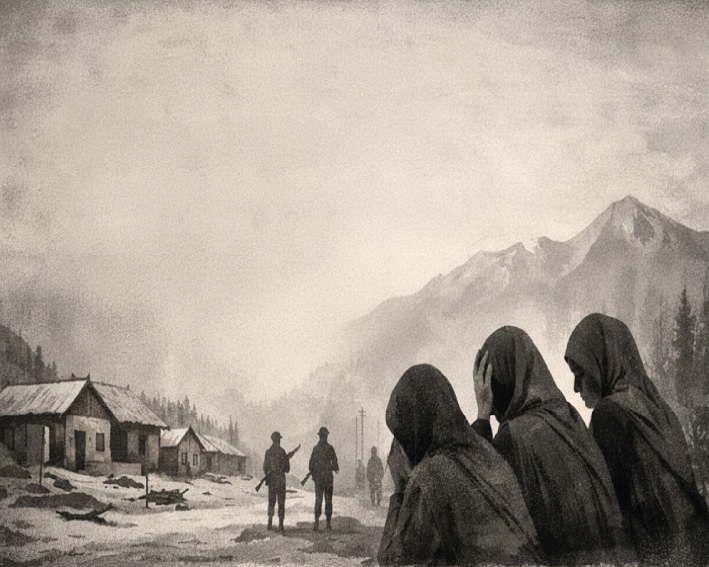
23 February 1991, one of the darkest days in the history of Kashmir, is not merely a day of mourning, but also a day of resistance. Every year, this day is observed as Kashmiri Women’s Resistance Day to honour the courage and resilience of the Kashmiri women victims of the Kunan Poshpora massacre, who transformed unspeakable violence into an enduring struggle for justice.
The sexual violence committed by the Indian Armed Forces in the twin villages of Kunan Poshpora in the presence of their family is an affront to humanity, carried out by men in uniform, who enjoy exceptional powers, legal protections, and near total impunity. “According to the victim women, rape is not an adequate word to describe what was done to them. It was not rape, it was war. Women were caught and held by a minimum of five to six army drunk forces.”
In the most conflict zones, sexual violence is used to break the strength of women and communities and force them into suppression and invisibility. But in Kashmir, it produced the opposite effect. Kashmiri women stepped into public life with great courage, leading protests, organizing civil society groups, raising their children with a strong commitment to the freedom struggle, documenting abuses, and becoming the moral voice of the resistance. From the streets to the courts, they challenged both occupation and militarization.
Kunan Poshpora is not viewed as an isolated case of mass rape in IIOJK; there are several other cases in which Indian armed forces have committed grave abuses, yet no perpetrators have faced criminal conviction. Other cases such as the Gaw Kadal Massacre: January 21, 1990, Handwara Massacre: January 25, 1990, Chhanpora Mass Rape: March 7, 1990. Pazipora Massacre: August 10, 1990, and many others. Decades later, many Kashmiri women and their families are still waiting for justice, while perpetrators serve openly, and the act of harassing Kashmiri youth continues.
At the center of these alleged war crimes lies the Armed Forces Special Power Act (AFSPA), which functions as a protection shield for the Armed Forces, and they commit abuses without accountability. This draconian law grants security forces exceptional powers of arrest, search, and use of force. It also requires prior permission from the central government before any prosecution of the forces. As per this framework, the local authorities cannot take any action against the forces without prior sanction. The central government runs under the instructions of New Delhi, and the influence of the forces, and from this process, accessing justice is impossible for the victims.
The tension between security and accountability lies at the heart of the Kunan Poshpora debate. For the women of Kashmir, the issue is not only about what happened in 1991, but also about the long-awaited struggle for justice. Many victims or survivors of this mass rape case refused to be silenced; they came forward, pursued legal process, engaged with the activists and journalists, and insisted on documenting their case despite social stigma.
This is the resilience and courage of the Kashmiri women, who stood with courage choose visibility instead of invisibility. They raised their voices against the brutal action committed by the Indian armed forces, turning their pain into protest. Their courage has the potential to protect and inspire many other women facing similar injustice. It is the decades-long struggle to be heard. In doing so, Kashmiri women transformed their personal trauma into collective resistance.
According to International Humanitarian Law, including the Geneva Conventions, “sexual violence against civilians is strictly prohibited. Inhuman treatments, rape, and attacks on personal dignity are classified as grave breaches of human rights violations. Similarly, under the Rome Statute of the International Criminal Court, rape and other forms of sexual violence constitute “War Crimes” or “Crimes against Humanity” when committed deliberately or as a part of systematic policies.
While International Human Rights Law reinforces these protections, the Convention on the Elimination of All Forms of Discrimination against Women seeks to investigate and prevent all forms of gender-based violence. The United Nations Security Council resolution 1325 and other related resolutions recognized sexual violence in the armed conflict as a threat to peace and security and call for accountability and justice for the survivors.
It shows that the case of Kunan Poshpora falls under the internationally recognized categories of grave human rights violations that require accountability, yet for the Kashmiri women, decades of wait justice remain elusive.
February 23: Kashmiri Women’s Resistance Day is not only to remember the pain and sacrifices of the Kashmiri women, but also a day demand accountability for their sufferings. It raises questions about whether the laws designed for security operations should override access to justice in cases including grave human rights violations. And it is about reinforcing that the rules and regulations of International Humanitarian Law and International Human Rights Law apply equally, even in the regions of protracted conflict.
Thirty-five years later, the Kunan Poshpora case remained unaddressed for justice, with all evidence submitted. The pursuit of justice in India, which is often called the world’s largest democracy, is challenged by the fact that a man in uniform can commit rape in the illegally occupied region and be granted exceptional powers with no accountability. It is also a test for the credibility of the international human rights commitments. The central issue remains that reconciliation cannot occur where accountability is contested or absent.
War Crimes Under the Armed Forces Special Powers Act: The Indian Army’s Impunity and the Case of Kunan Poshpora
257

previous post