
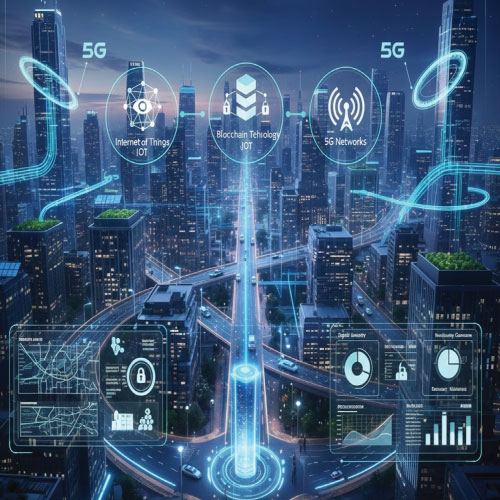
The modern Cities are undergoing a profound transformation. They are changing rapidly, from Singapore’s smart streets to Barcelona’s intelligent traffic systems cities are turning into super-connected places using the latest technology. At the center of this revolution lies a trio of transformative innovations: the Internet of Things (IoT), Block-chain technology, and 5G networks. Together these technologies are fundamentally redefining urban planning, public service delivery, and the very essence of civic governance. As we relate it through 2025, the smart city is no longer a futuristic concept but an emerging reality. According to recent analyses, smart city technologies can improve key quality of life indicators by 10 to 30 % translating into saved lives, reduced crime, shorter commutes, diminished health burdens, and strengthened social connectedness. Yet this digital transformation brings not just opportunities but also intense challenges that demand careful consideration.
The IoT Revolution, Cities that see, hear and respond. The Internet of Things forms the sensory nervous system of the smart city. Millions of interconnected sensors embedded throughout urban infrastructure continuously gather, transmit and analyze data in ways that were unimaginable just a decade ago. These digital watchers monitor everything from air quality and noise pollution to traffic patterns creating an unprecedented real time understanding of urban dynamics. Consider the traffic management one of the most visible applications of IoT technology. Traditional traffic systems operate on fixed lights and road management systems that dynamically adjust signal timing based on actual traffic flow, weather conditions and even emergency vehicle movements. The result is dramatic cities implementing these systems report reductions in travel time by up to 30% and significant decreases in traffic-related emissions. Waste management provides another compelling example of IoT’s transformative potential. Smart bins equipped with fill-level sensors communicate with collection services, enabling dynamic route optimization. This reduces collection costs by 30-40% cuts fuel consumption, and minimize the carbon footprint of waste management operations. Cities across the United States are rapidly adopting these IoT solutions, with both municipal governments and private transporters recognizing the operational and environmental benefits. The power of IoT extends beyond individual applications to create integrated urban systems. In leading smart cities, data from diverse sensors flows into centralized platforms that employ artificial intelligence to identify patterns, predict problems, and optimize responses. This comprehensive approach enables city managers to understand the complex interdependencies between transportation, energy, public safety, and environmental quality and to make more informed decisions that consider these interconnections.
Block-chain, while IoT provides the data foundation for smart cities, block-chain technology offers a revolutionary structure for managing, securing, and governing that data. As its core, block-chain is distributed log technology that creates static, transparent records of transactions and data exchanges. For smart cities grappling with concerns about data privacy, security, and centralized control, block-chain presents compelling solutions. The transparency and stability of block-chain make it particularly well-suited for urban governance applications. Consider identity management and public services delivery. Traditional systems require citizens to repeatedly verify their identity and documents across different agencies, creating friction and opportunities for fraud. Block-chain based digital identity systems enable secure, citizen-controlled credentials that can be instantly verified by any authorized service provider while maintaining privacy and reducing bureaucratic repetition. Block-chain also transforms supply chain management in smart cities. From tracking the source of construction materials to ensuring the integrity of food supply chains, block-chain creates verifiable, tamper-proof records that enhance accountability and public safety. Several cities are piloting block-chain systems for building permits and land registry, reducing processing times from weeks to days while creating permanent, auditable records of property transactions and construction compliance.
Perhaps most significantly, block-chain enables new models of participatory governance. Smart contract systems-self-executing agreements encoded on block-chain platforms can automate budget allocation based on citizen voting, ensure transparent distribution of public resources, and create verifiable audit trails for government expenditures. This technology has the potential to make urban governance more inclusive, democratic, and accountable, directly addressing widespread concerns about government transparency and citizen engagement. However, implementing block-chain in smart cities is not without challenges. The technology’s transparency can conflict with data privacy regulations such as GDPR (General Data Protection Regulation), which grants individuals the “right to be forgotten” difficult to reconcile with block-chain’s immutability. Cities must carefully design block-chain systems that balance transparency with privacy, including privacy-preserving technologies and thoughtful data governance systems.
5G Internets, the High-Speed Backbone of Smart Cities. If IoT is the sensory system and block-chain the governance framework, then 5G networks are the high-speed nervous system that makes real-time smart city operations possible. The fifth generation of wireless technology delivers three critical capabilities that distinguish it from its predecessors: ultra-high speeds (up to 100 times faster than 4G), ultra-low latency (response times under 1 millisecond), and massive device connectivity (supporting up to one million devices per square kilometer). These characteristics enable applications that were previously impractical or impossible. Autonomous vehicles, for instance, require split-second communication with surrounding vehicles, infrastructure, and central traffic management systems-capabilities that only 5G’s ultra-low latency can reliably provide. Real-time video analytics for public safety, predictive maintenance systems for critical infrastructure, and augmented reality applications for urban planning all depend on 5G’s speed and responsiveness. The impact of 5G extends across virtually every aspect of urban life. In healthcare, 5G enables remote surgery and real-time patient monitoring systems that can dramatically improve emergency response and chronic disease management. In energy management, 5G networks support smart grids that dynamically balance supply and demand, integrate renewable energy sources, and enable sophisticated demand-response programs that reduce peak loads and improve grid stability. Cities deploying 5G networks are already seeing tangible benefits. Smart surveillance systems powered by 5G can process video streams in real-time, identifying incidents and alerting authorities without the delay that troubled previous generations. Environmental monitoring systems can provide minute-by-minute air quality data across entire metropolitan areas, enabling rapid response to pollution events and informing public health advisories.
The true power of smart city technologies emerges not from individual applications but from their integration into cohesive ecosystems. Modern smart cities are developing platforms that combine loT data streams, block-chain-based governance systems, and 5G connectivity into unified urban operating systems. These integrated platforms enable cross-domain improvement that addresses the complex, interconnected challenges of urban life. For example, by combining traffic data, air quality monitoring, and energy consumption patterns, city managers can develop complete strategies that simultaneously reduce congestion, improve air quality, and optimize energy use. Similarly, integrated public safety systems that connect surveillance cameras, gunshot detection sensors, emergency call systems, and first responder communications create comprehensive situational awareness that can dramatically improve emergency response. Leading smart cities worldwide exemplify this integrated approach. Singapore, consistently ranked among the top smart cities globally, has developed a comprehensive “Virtual Singapore” platform-a dynamic 3D city model that integrates real-time data from across the city-state to support urban planning, disaster response, and policy simulation. Dubai has launched ambitious smart city initiatives encompassing everything from block-chain based business registration to Al-powered traffic management, positioning itself as a global leader in urban digital transformation.
Despite their immense promise, smart city technologies raise profound challenges that cities must address to realize their full potential. Chief among these is the tension between data collection and privacy. Smart cities generate unprecedented volumes of data about citizens’ movements, behaviors, and activities. Without robust privacy protections, this data collection can enable surveillance capabilities that threaten civil liberties and individual autonomy. Cyber-security represents another critical challenge. The interconnected nature of smart city systems creates potential vulnerabilities that malicious actors could exploit with devastating consequences. A successful cyber-attack on a smart city’s traffic management system could cause gridlock across an entire metropolitan area; compromised water or power systems could threaten public health and safety. Cities must invest heavily in cyber-security infrastructure, adopt security-by-design principles, and develop robust incident response capabilities. Digital equity poses a third fundamental challenge. Smart city benefits risk accumulating primarily to wealthier, technologically connected populations, potentially widening existing social and economic divides. Cities must ensure that smart city initiatives include marginalized communities, provide digital literacy training, expand broadband access, and design services that are accessible to all residents regardless of their technological sophistication. Data governance structures must address these challenges while enabling innovation. Cities need clear policies governing data collection, use, and sharing; transparent oversight mechanisms; and meaningful opportunities for citizen input into how smart city technologies are deployed and governed. Some cities are establishing data trusts-independent entities that steward urban data on behalf of citizens-as a model for balancing innovation with protection.
As we look toward the future, the trajectory of smart city development will be shaped by how effectively we address these challenges while harnessing technology’s transformative potential. The most successful smart cities will be those that view technology not as an end in it self but as a tool for advancing broader goals of sustainability, equity, livability, and democratic governance. Ultimately, the success of smart cities will be measured not by the sophistication of their technology but by improvements in residents’ quality of life and the strength of their democratic institutions. The technologies of loT, block-chain, and 5G are powerful tools, but they are tools in service of human flourishing. As cities worldwide embrace digital transformation, the challenge is to ensure that these technologies enhance rather than diminish human agency, strengthen rather than weaken social bonds, and create urban environments that are not just smarter, but more just, sustainable, and humane. The smart city revolution is well underway, reshaping urban governance and public services in profound ways. The cities that successfully manage this transformation will be those that couple technological innovation with thoughtful governance, strong public engagement, and an unwavering commitment to serving all their residents.
Author: Tayyaba Akram, BS Pol Science, Quaid-e-Azam University, Islamabad.
