
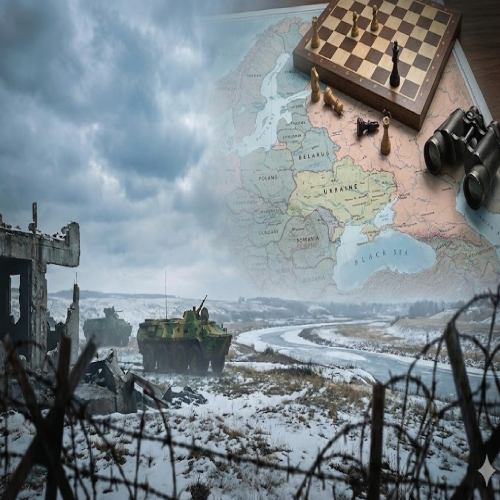
Ever since the Russian-Ukraine war, the understrength conventional power capability of Russia against the US-led NATO bolstering Ukraine often comes up with nuclear saber-rattling. The Russian President Vladimir Putin, addressing the world community on November 21, 2024, argued that Russia launched ballistic missile strikes against Dnipro City in response to the Ukraine ATACMS (supersonic tactical ballistic missile) and Storm Shadow (air-launched cruise missile) provided by the US and the UK against the military objects in Russia.
Putin has already warned the US-led NATO countries that Russia may strike the military facilities of the Western countries that supported Ukraine to use their missiles directly against Russia. Russia terms this as one of its “red lines” that the West is crossing, risking a large-scale military escalation to a nuclear level. Russia has already threatened to use nuclear weapons after Ukraine is largely supported by the US-led NATO members. It has stationed its tactical nuclear weapons in Belarus for deterrence and nuclear signaling purposes against Western countries in Europe. This is what many may argue, “back to the harsh realities of geostrategy.”
It is very important to ask oneself: Why does Russia often resort to nuclear saber-rattling? What does it want to achieve? Are the US-led NATO members deterred? How much is the Russia-Ukraine war boiling over for a nuclear use engulfing the entire Europe? Is the world considering nuclear risk reduction and the possible end of this war when Europe is turning into one of the world’s nuclear flashpoints?
Scholars contend that in a nuclear war, there are no victors. This goes back to the Ronald Reagan and Mikhail Gorbachev 1985 statement on nuclear war: “A nuclear war cannot be won and must not be fought.” Based on the logic of Mutual Assured Destruction (MAD), this remains valid in a nuclear environment, where each side will ultimately destroy the other. This primarily reflects the 1958 seminal work of Albert James Wohlstetter on the “Delicate Balance of Terror,” in which he argued that the presence of thermonuclear weapons between the US and the Soviet Union had produced a “presumed automatic balance” of power, which, in turn, made nuclear war “extremely unlikely.”
From an academic point of view, the Russian threat of using nuclear weapons over the US-led NATO’s military support for Ukraine could be on the following reasons: one, to let the Western countries become serious while getting on board for managing and resolving the Russia-Ukraine war to the best Russian terms; two, to give deterrence signaling to the Western countries so that they stop supplying sophisticated defensive and offensive missile capability that undermine the Russian conventional force capability in its war against Ukraine thereby escalating the Russian danger of using nuclear weapons in Ukraine; and three, to prevent the US from making Ukraine part of NATO, this is the longstanding issue and the fundamental reason for Russia-Ukraine War.
Although Russia appears to be succeeding on these strategic imperatives, its nuclear saber-rattling is mostly seen as mere rhetoric in Europe and in some sections of the US. However, leading scholars from a realist security paradigm consider that the Pentagon must be taking Putin’s nuclear threats seriously despite knowing the unknown about the Russian use of nuclear weapons. This reflects that sometimes the intended nuclear ambiguity, the fear of the unknown, may create caution between the nuclear rivals, what Thomas Schelling called the “threat that leaves something to chance.”
It can be argued that although it is unlikely that Russia will use nuclear weapons against Ukraine, since Ukraine does not fall within the ambit of NATO and since the US-led NATO members cannot provide sophisticated conventional forces that Ukraine may require, Russia could use nuclear weapons in an “extremis condition” without having a nuclear retaliation from the broader US-led Western alliance. Because this will risk a global “nuclear winter” with far-reaching global security implications, a nuclear threat from the state leadership becomes credible, especially when it has the capability and the political will to use nuclear weapons in the worst-case scenario.
This reminds us of “Guarding the Guardians” by Peter D. Feaver, which discusses the conceptual framework of the always/never dichotomy: nuclear weapons should be used only when absolutely necessary and never when not required. For Russia, nuclear saber-rattling may fall in such a conceptualized category of deterrence. Despite Russia’s conventional force capabilities being understrength compared with those of the US-NATO allies, the credible Russian nuclear forces, at both the tactical and strategic levels, remain a fundamental deterrent preventing the US-led NATO allies from crossing red lines that may not be acceptable to the Russian security leadership.
The Russian-Ukrainian war may provide us with some key lessons:
One, geopolitics/geostrategy often triumphs over geoeconomics, although the debate between the two continues to linger. But it is the geopolitics of international politics that underpins the world order falling within the ambit of bipolar, unipolar, and multipolar worlds. The Russia-Ukraine war depicts the return of geopolitics.
Two, a state like Ukraine, without substantial conventional and nuclear forces, becomes vulnerable to preemptive/preventive strikes against potential threats operating in the background of intensifying competition between the leading powers in the international system.
There, despite the emergence of emerging technologies, nuclear deterrence remains relevant, intact, reliable, and robust. It will continue to play a significant role in the background of nuclear politics across all ages. Russia, without possessing credible nuclear forces, could have been wounded much earlier in the wake of the Russia-Ukraine war. But this is not happening. Instead, it is Ukraine that has been suffering and losing territory to Russia without having conventional and nuclear forces. Ukraine must be missing something since it inherited nuclear weapons. The US-led NATO allies are very careful not to cross the perceived “redlines”.
Four, it is too late for the US-led NATO members to get Ukraine on board now. The resurgence of Russia may prevent Ukraine from joining NATO. Finland and Sweden, as they are, may become part of NATO without many security concerns for Russia, but Ukraine embedded within NATO will be a sharp nail in the Russian coffin.
Five, Ukraine, supported by the US-led NATO, should cut a deal now, rather than lose more territory to Russia. Ukraine, without the modest strategic support, is no match for Russia in terms of both conventional and nuclear forces.
Six, nuclear weapons and credible nuclear deterrence between Russia and the US-led NATO members may provide a powerful strategic incentive for managing the crisis while cutting a security deal between Ukraine and Russia.
Seven, yet another lesson the Russian-Ukrainian war entails is that a state, particularly when falling into an acute security dilemma or security rivalry, must possess credible deterrent forces and be a credible part of a nuclear security guarantee. Ukraine, without a security umbrella, suffers much more than expected.
Finally, the Russia-Ukraine war teaches the European and the US leadership how important it is to reinvigorate the crisis management mechanism already in place, modestly, to help resolve this and other future military crises in and around Europe.
Author: Dr. Zafar Khan is a Professor of International Relations and Executive Director at Balochistan Think Tank Network, Quetta.
