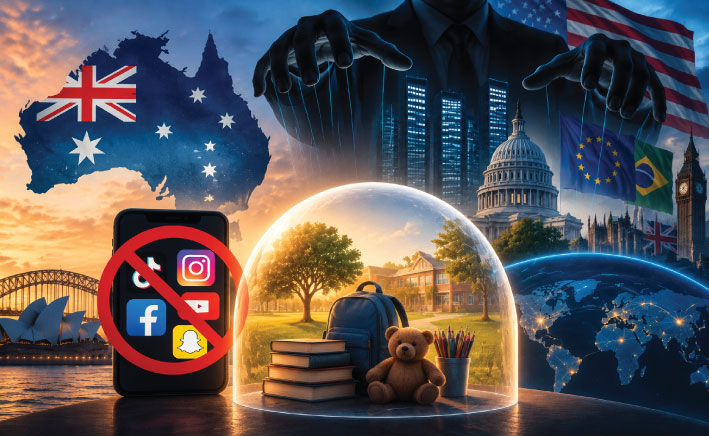
Australia’s decision to prohibit children under sixteen from using social media has been framed as a child protection measure, but the implications reach far beyond youth welfare. The ban reveals a deeper global shift. Governments now understand that directly regulating powerful American technology companies can provoke political backlash, economic retaliation and diplomatic strain. In this environment, youth-focused laws have become a safer political tool. The Australian ban signals a broader attempt to reassert public authority in a digital sphere dominated by private American platforms, at a moment when confronting them openly has become increasingly risky. More importantly, it reflects a growing recognition that digital governance is not only about the markets or power, but about protecting the children’s rights, dignity, and development in algorithmically shaped environments.
The evidence underpinning the child safety argument is substantial. The International Telecommunication Union estimates that about 79 percent of people aged fifteen to twenty four worldwide use the internet and in high income countries 93 percent of young people are online. In Australia, the national eSafety Commissioner reports that more than 80 percent of fourteen and fifteen year olds use social media daily and two thirds of twelve and thirteen year olds already have accounts. One in five Australian teenager’s encounters harmful content and one in four experiences cyberbullying or harassment. Globally, the World Health Organization notes that one in seven adolescents suffers from a mental health disorder and suicide has become a leading cause of teenage deaths. These statistics frame the issue not simply as platform regulation but as a question of safeguarding children’s well-being and personhood in digital spaces.
Internal research from platforms heightened concern. In 2023, leaked Meta documents showed that Instagram worsened body image issues for one in three teenage girls who already struggled with self esteem. In testimony before the United States Senate, whistleblower Arturo Bejar revealed that more than twenty five percent of thirteen to fifteen year olds surveyed had received unwanted sexual advances on Instagram. These details had been known to executives but not disclosed to the public. The gulf between internal knowledge and public messaging decreased trust and strengthened the argument for stronger safeguards designed specifically to protect children from being reduced to data profiles shaped by engagement algorithms.
Australian officials also cited research that constant digital stimulation affects sleep, increases anxiety and disrupts cognitive development. Prime Minister Anthony Albanese argued that parents had lost the ability to set reasonable limits because social platforms were engineered to maximise engagement. The new law places responsibility directly on companies, which must verify ages and delete accounts belonging to children under sixteen. This challenges a longstanding industry model that treats growth as the central priority and reframes regulation as a tool to humanize children rather than merely manage markets.
While child safety is essential, the timing and framing of the ban reveal another motivation. Governments have learned that confronting American platforms head on carries political and economic risks. Australia experienced this in 2021 when it introduced the News Media Bargaining Code. Google threatened to withdraw its search engine and Facebook blocked news content nationwide. Public health pages, emergency services and journalism outlets disappeared overnight. Although the government eventually prevailed, the episode exposed how much leverage platforms can exert over democratic states. In the current geopolitical climate, few governments are eager to replicate that experience.
Other countries have faced similar challenges. In Brazil, the Supreme Court ordered X, formerly Twitter, to block accounts spreading hate speech and coordinated misinformation. The company initially refused and its owner encouraged users to bypass the ruling with virtual private networks. Only after asset freezes and a nationwide suspension did the platform comply. In the United Kingdom, Musk’s warning of coming violence at a political rally drew condemnation from senior ministers who viewed the remarks as abhorrent. These incidents illustrate how platform owners now shape political narratives across borders in ways that can interfere with domestic governance. Even in the US, Elon Musk publicly accused President Donald Trump of lying and involvement in Epstein scandal when Trump’s Big Beautiful Bill was passed.
At the same time, American technology firms hold significant influence within the United States. Individuals linked to the tech sector contributed more than 390 million dollars to the last election cycle and technology companies spent more than 60 million dollars on federal lobbying. Meta’s spending alone reached a record 24.4 million dollars.
These domestic dynamics matter because they shape how American leaders respond when foreign governments attempt regulation. Recently, when reports surfaced that the European Commission planned a major fine against X, United States Vice President JD Vance accused Europe of attacking American companies. Andrew Puzder, the United States ambassador to the EU, warned that European digital laws unfairly targeted United States platforms. Their reactions reflected a belief that regulation of American tech firms abroad threatens American commercial power.
Under Donald Trump’s America First strategy, tariffs were used to punish countries seen as undermining United States business interests. Under policies such as tariffs previously employed by Donald Trump, economic pressure can become a geopolitical tool, raising concerns that measures intended to protect children’s rights online may face external resistance not on regulatory grounds, but because they are perceived as threats to commercial interests. If even the European Union, one of the strongest regulatory powers in the world, must defend its right to enforce its laws, smaller nations face a far more uncertain landscape. This is why Australia’s earlier confrontational approach toward platforms is less viable today. A direct clash with dominant American firms risks becoming entangled with trade negotiations, diplomatic relationships and the broader politics of United States power.
In this environment, youth protection laws have become an effective workaround. Regulating on behalf of children carries broad political legitimacy and is far less likely to be interpreted as an attack on American commercial interests. Other governments may follow this model in the coming years, using child safety as a politically safe pathway to curb platform influence without provoking geopolitical consequences.
Australia’s approach is not perfect. Teenagers will try to circumvent restrictions and age verification introduces privacy challenges. Yet the broader significance of the ban is clear. It reflects a world in which governments are trying to rebuild transparency and regulatory standards in the digital sphere while prioritizing the rights and humanity of children. Australia’s decision shows that democratic states are beginning to search for new strategies to regain control of their information environments, even if they must do so indirectly.
Author: Nimra Javed, Research Officer, Center for International Strategic Studies, AJK.
